 Add to Chrome
 Add to Firefox
 Add to Edge
DC-WAM: Dynamic-Centric Visual Supervision and Reasoning for World-Action Models
Jul 28, 2026
World-Action Models (WAMs) augment robot policies with future visual prediction, but it remains unclear what the visual modality should learn for control. While photorealistic future prediction provides dense supervision, it also incurs substantial computation and can allocate capacity to texture, illumination, and background variations that are only weakly related to action selection. Recent efficient WAM variants suggest that the main benefit of the video branch may not lie in the rendered future itself, but in the control-relevant visual representations induced during training. In this work, we revisit future video prediction from a dynamic-centric perspective and ask whether an existing RGB-based WAM can be redirected from appearance-dominated reconstruction toward interaction-induced visual dynamics without introducing additional modality-specific predictions or online inputs at deployment. We propose DC-WAM, a dynamic-centric WAM framework that redistributes supervision and computation in the RGB video branch. At the supervision level, DC-WAM combines temporal-difference flow matching with trajectory-guided weighting, emphasizing dense temporal changes and localized regions where the gripper, manipulated objects, and contact areas move. At the reasoning level, DynaRoute predicts token-wise dynamic relevance and converts it into an attention bias, guiding the model toward control-relevant future tokens. Experiments in simulation and on real-world manipulation tasks show that DC-WAM consistently improves policy performance, especially under out-of-distribution perturbations in lighting, object appearance, and background texture.

Adaptive Testing Environment Generation for Connected and Automated Vehicles with Dense Reinforcement Learning
Feb 29, 2024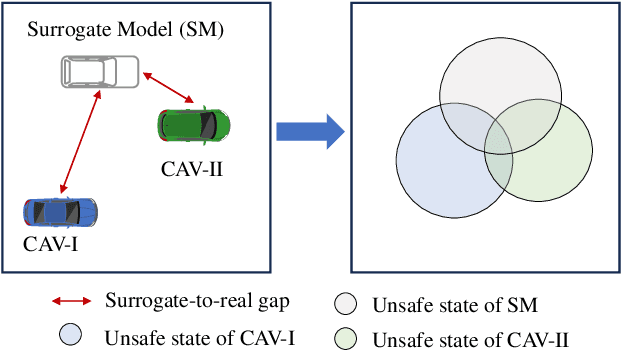
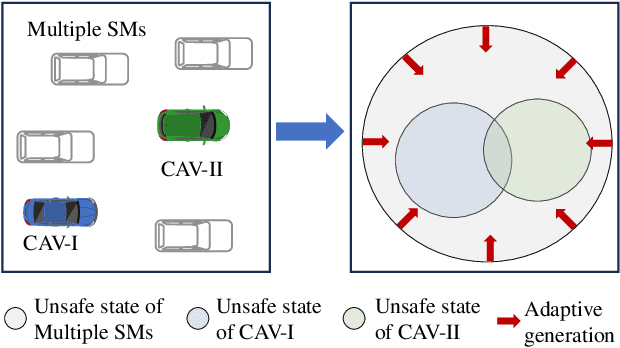
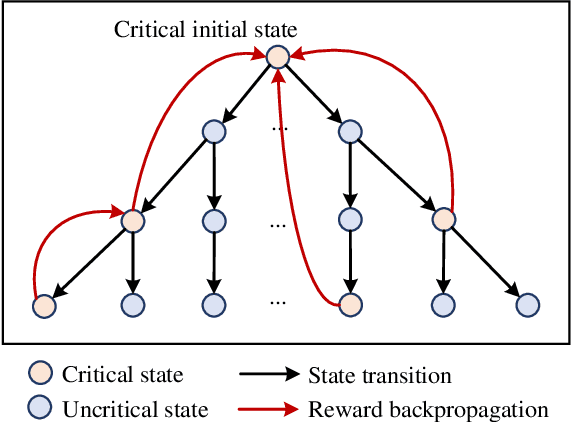
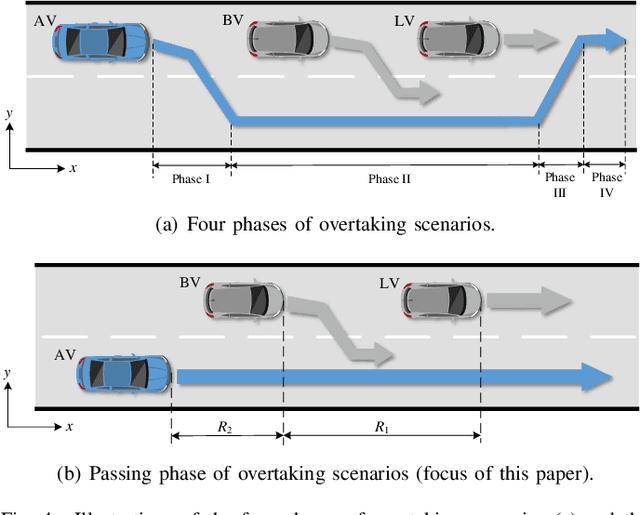
The assessment of safety performance plays a pivotal role in the development and deployment of connected and automated vehicles (CAVs). A common approach involves designing testing scenarios based on prior knowledge of CAVs (e.g., surrogate models), conducting tests in these scenarios, and subsequently evaluating CAVs' safety performances. However, substantial differences between CAVs and the prior knowledge can significantly diminish the evaluation efficiency. In response to this issue, existing studies predominantly concentrate on the adaptive design of testing scenarios during the CAV testing process. Yet, these methods have limitations in their applicability to high-dimensional scenarios. To overcome this challenge, we develop an adaptive testing environment that bolsters evaluation robustness by incorporating multiple surrogate models and optimizing the combination coefficients of these surrogate models to enhance evaluation efficiency. We formulate the optimization problem as a regression task utilizing quadratic programming. To efficiently obtain the regression target via reinforcement learning, we propose the dense reinforcement learning method and devise a new adaptive policy with high sample efficiency. Essentially, our approach centers on learning the values of critical scenes displaying substantial surrogate-to-real gaps. The effectiveness of our method is validated in high-dimensional overtaking scenarios, demonstrating that our approach achieves notable evaluation efficiency.