 Add to Chrome
 Add to Firefox
 Add to Edge
Rethink the Role of Neural Decoders in Quantum Error Correction
May 12, 2026
Quantum error correction (QEC) is essential for enabling quantum advantages, with decoding as a central algorithmic primitive. Owing to its importance and intrinsic difficulty, substantial effort has been made to QEC decoder design, among which neural decoders have recently emerged as a promising data-driven paradigm. Despite this progress, practical deployment remains hindered by a fundamental accuracy-latency tradeoff, often on the microsecond timescale. To address this challenge, here we revisit neural decoders for surface-code decoding under explicit accuracy-latency constraints, considering code distances up to d=9 (161 physical qubits). We unify and redesign representative neural decoders into five architectural paradigms and develop an end-to-end compression pipeline to evaluate their deployability and performance on FPGA hardware. Through systematic experiments, we reveal several previously underexplored insights: (i) near-term decoding performance is driven more by data scale than architectural complexity; (ii) appropriate inductive bias is essential for achieving high decoding accuracy; and (iii) INT4 quantization is a prerequisite for meeting microsecond-scale latency requirements on FPGAs. Together, these findings provide concrete guidance toward scalable and real-time neural QEC decoding.

Graph Condensation via Receptive Field Distribution Matching
Jun 28, 2022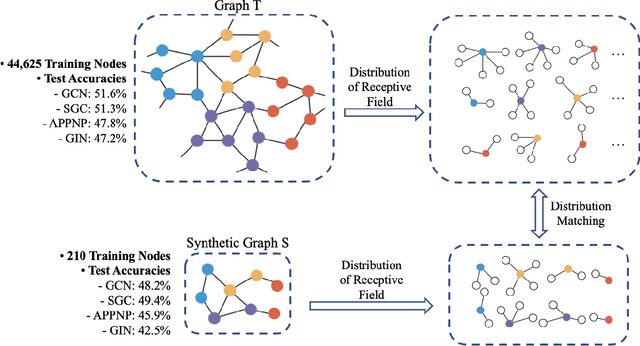

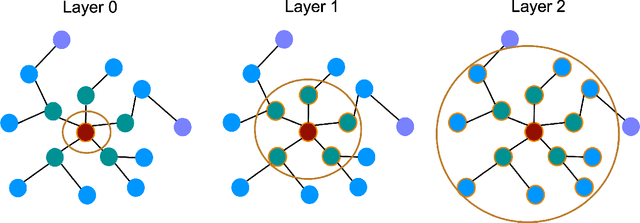

Graph neural networks (GNNs) enable the analysis of graphs using deep learning, with promising results in capturing structured information in graphs. This paper focuses on creating a small graph to represent the original graph, so that GNNs trained on the size-reduced graph can make accurate predictions. We view the original graph as a distribution of receptive fields and aim to synthesize a small graph whose receptive fields share a similar distribution. Thus, we propose Graph Condesation via Receptive Field Distribution Matching (GCDM), which is accomplished by optimizing the synthetic graph through the use of a distribution matching loss quantified by maximum mean discrepancy (MMD). Additionally, we demonstrate that the synthetic graph generated by GCDM is highly generalizable to a variety of models in evaluation phase and that the condensing speed is significantly improved using this framework.