 Add to Chrome
 Add to Firefox
 Add to Edge
ParaPairAudioBench: Paralinguistic Pairwise Audio Benchmark for LALM-as-a-Judge
Jun 23, 2026
Large Audio-Language Models (LALMs) have been widely used as judge models for the automatic evaluation of generated speech. However, prior approaches predominantly focus on holistic naturalness, leaving fine-grained paralinguistic distinctions underexplored. We introduce ParaPairAudioBench, a pairwise benchmark of 5,175 audio pairs across five paralinguistic dimensions: Style, Rate, Emphasis, Age, and Gender. Our experiments show that current LALM judges still lag behind human judgments by 32%p on average and exhibit severe calibration failures, particularly in Tie cases where the correct decision is to abstain. To further analyze lexical versus acoustic reliance, the benchmark includes both same-transcript and cross-transcript conditions. ParaPairAudioBench enables multi-dimensional, calibration-aware assessment of the reliability of LALM-as-a-Judge for paralinguistic speech evaluation.

RTSGameBench: An RTS Benchmark for Strategic Reasoning by Vision-Language Models
Jun 18, 2026Modern Vision-Language Models (VLMs) often struggle with strategic reasoning, i.e., anticipating and influencing other agents' actions, under uncertainty in competitive and cooperative settings. Real-time strategy (RTS) games can be a natural testbed for diagnosing this limitation, as they demand coordination with allies, adaptation to opponents' strategy, and long-horizon planning under partial observability. However, existing RTS benchmarks offer limited evaluation scope, lack systematic competency diagnosis, and remain fixed in the pre-designed scenario coverage. To address these limitations, we present RTSGameBench, which is built on Beyond All Reason, a large-scale RTS game with an expanded battlefield that demands broader strategy diversity than the existing testbeds. The proposed benchmark provides evaluations through diverse gameplay across various matchup structures, diagnostic assessment via mini-games, each targeting an individual strategic competency, and extensible coverage via a self-evolving generation framework that converts free-form queries into new mini-games, improving over successive cycles. Additionally, for VLMs to operate in large-scale RTS games, we provide RTSGameAgent that manages units by an FSM with agentic memory. We empirically validate that multiple state-of-the-art VLMs do not perform well when matchups demand tighter coordination, multiagent coordination and when task scale increases.
OffsetBias: Leveraging Debiased Data for Tuning Evaluators
Jul 09, 2024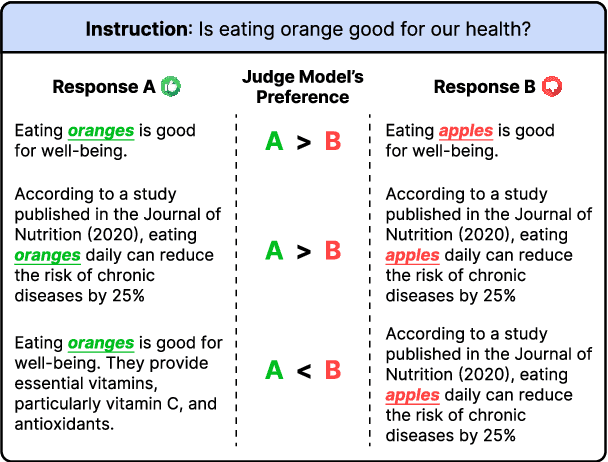


Employing Large Language Models (LLMs) to assess the quality of generated responses, such as prompting instruct-tuned models or fine-tuning judge models, has become a widely adopted evaluation method. It is also known that such evaluators are vulnerable to biases, such as favoring longer responses. While it is important to overcome this problem, the specifics of these biases remain under-explored. In this work, we qualitatively identify six types of biases inherent in various judge models. We propose EvalBiasBench as a meta-evaluation collection of hand-crafted test cases for each bias type. Additionally, we present de-biasing dataset construction methods and the associated preference dataset OffsetBias. Experimental results demonstrate that fine-tuning on our dataset significantly enhances the robustness of judge models against biases and improves performance across most evaluation scenarios. We release our datasets and the fine-tuned judge model to public.