 Add to Chrome
 Add to Firefox
 Add to Edge
Detecting Knowledge Gaps from Conversational AI Interactions Using Curriculum Prerequisite Graphs
Jun 09, 2026
Large online courses generate thousands of student questions directed at conversational AI teaching assistants, yet these interaction logs remain largely untapped as diagnostic signals. We present a pipeline that maps student questions from a conversational AI teaching assistant to curriculum topics using a few-shot text classifier, grounded in a GPT-4-extracted prerequisite knowledge graph of course concepts. Evaluated on 1,340 question events from 164 students in a graduate-level AI course, our classifier achieves 80.0% accuracy across 43 labels (42 curriculum topics plus an "unknown" abstention class). Topic-level question volume correlates significantly with student self-reported difficulty from an independent mid-semester survey (rho = 0.491, p = 0.008, n = 28 topics), providing convergent evidence that the classified question stream reflects genuine topic difficulty. These results demonstrate that conversational AI interaction logs, mapped onto curriculum structure, carry actionable signals about topic-level knowledge gaps and provide instructors with a curriculum-grounded view of which topics warrant attention.

Surfacing Isolated Learners with Outcome-Independent Mediation of Feedback between Teachers and Students Using AI
May 28, 2026AI-augmented classrooms generate rich teacher and student feedback before graded outcomes become available, yet these signals can be difficult to translate into timely instructional decisions. We propose an interpretable decision layer: a transparent mechanism that ranks course topics requiring attention without using grades or post-hoc outcome labels. The approach combines three signals: student learning difficulty prevalence, disagreement between learner self-reports and observed difficulties, and unresolved teacher concerns. The output is a ranked set of topic priorities with per-topic decision records explaining each ranking. In one graduate CS course offering ($n=5$ instructor interviews; $n=279$ survey responses), prioritized topics aligned with instructor concerns (top-5 overlap 3/5; Spearman $ρ=0.80$) and student-reported topic difficulty ($ρ=0.46$, $p=.048$). Multi-signal integration also surfaced learners not identified through individual signal sources alone (AUC $=0.96$ vs. $0.91$ for gap prevalence alone). Reflective thinking, help-seeking, and self-efficacy provided additional evidence that student behavioral signals align with learning-related constructs. While preliminary, these findings suggest that transparent coordination mechanisms may help support human-AI co-agency when feedback is incomplete.
Evaluating Learner Representations for Differentiation Prior to Instructional Outcomes
Apr 07, 2026Learner representations play a central role in educational AI systems, yet it is often unclear whether they preserve meaningful differences between students when instructional outcomes are unavailable or highly context-dependent. This work examines how to evaluate learner representations based on whether they retain separation between learners under a shared comparison rule. We introduce distinctiveness, a representation-level measure that evaluates how each learner differs from others in the cohort using pairwise distances, without requiring clustering, labels, or task-specific evaluation. Using student-authored questions collected through a conversational AI agent in an online learning environment, we compare representations based on individual questions with representations that aggregate patterns across a student's interactions over time. Results show that learner-level representations yield higher separation, stronger clustering structure, and more reliable pairwise discrimination than interaction-level representations. These findings demonstrate that learner representations can be evaluated independently of instructional outcomes and provide a practical pre-deployment criterion using distinctiveness as a diagnostic metric for assessing whether a representation supports differentiated modeling or personalization.
OffsetBias: Leveraging Debiased Data for Tuning Evaluators
Jul 09, 2024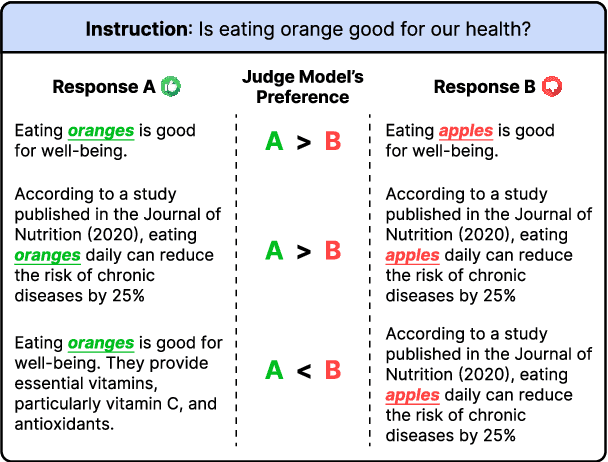


Employing Large Language Models (LLMs) to assess the quality of generated responses, such as prompting instruct-tuned models or fine-tuning judge models, has become a widely adopted evaluation method. It is also known that such evaluators are vulnerable to biases, such as favoring longer responses. While it is important to overcome this problem, the specifics of these biases remain under-explored. In this work, we qualitatively identify six types of biases inherent in various judge models. We propose EvalBiasBench as a meta-evaluation collection of hand-crafted test cases for each bias type. Additionally, we present de-biasing dataset construction methods and the associated preference dataset OffsetBias. Experimental results demonstrate that fine-tuning on our dataset significantly enhances the robustness of judge models against biases and improves performance across most evaluation scenarios. We release our datasets and the fine-tuned judge model to public.
HaRiM$^+$: Evaluating Summary Quality with Hallucination Risk
Nov 24, 2022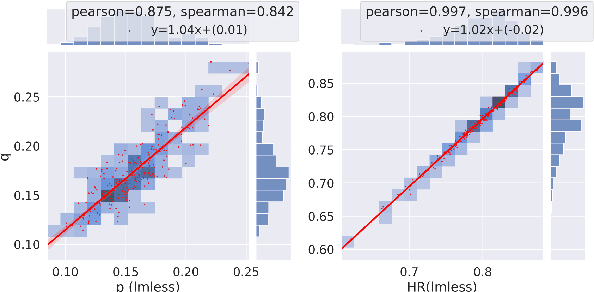
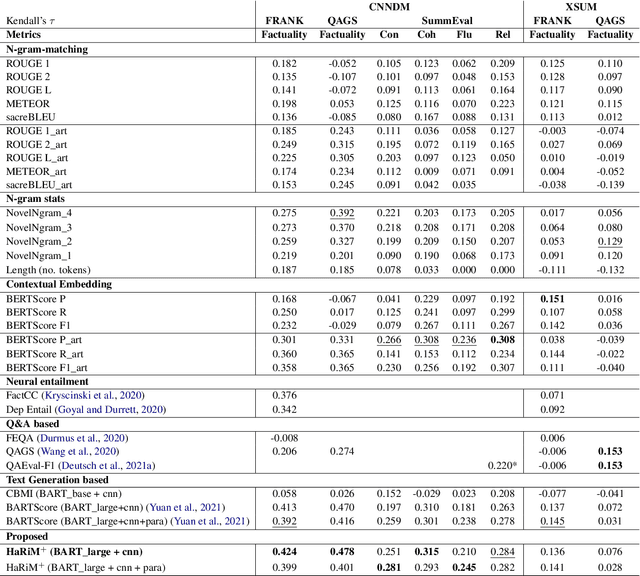
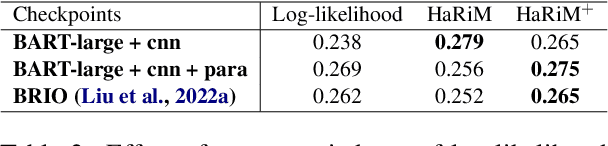
One of the challenges of developing a summarization model arises from the difficulty in measuring the factual inconsistency of the generated text. In this study, we reinterpret the decoder overconfidence-regularizing objective suggested in (Miao et al., 2021) as a hallucination risk measurement to better estimate the quality of generated summaries. We propose a reference-free metric, HaRiM+, which only requires an off-the-shelf summarization model to compute the hallucination risk based on token likelihoods. Deploying it requires no additional training of models or ad-hoc modules, which usually need alignment to human judgments. For summary-quality estimation, HaRiM+ records state-of-the-art correlation to human judgment on three summary-quality annotation sets: FRANK, QAGS, and SummEval. We hope that our work, which merits the use of summarization models, facilitates the progress of both automated evaluation and generation of summary.
* 9 pages (+ 21 pages of Appendix), AACL 2022