 Add to Chrome
 Add to Firefox
 Add to Edge
ParaPairAudioBench: Paralinguistic Pairwise Audio Benchmark for LALM-as-a-Judge
Jun 23, 2026
Large Audio-Language Models (LALMs) have been widely used as judge models for the automatic evaluation of generated speech. However, prior approaches predominantly focus on holistic naturalness, leaving fine-grained paralinguistic distinctions underexplored. We introduce ParaPairAudioBench, a pairwise benchmark of 5,175 audio pairs across five paralinguistic dimensions: Style, Rate, Emphasis, Age, and Gender. Our experiments show that current LALM judges still lag behind human judgments by 32%p on average and exhibit severe calibration failures, particularly in Tie cases where the correct decision is to abstain. To further analyze lexical versus acoustic reliance, the benchmark includes both same-transcript and cross-transcript conditions. ParaPairAudioBench enables multi-dimensional, calibration-aware assessment of the reliability of LALM-as-a-Judge for paralinguistic speech evaluation.

OmniACBench: A Benchmark for Evaluating Context-Grounded Acoustic Control in Omni-Modal Models
Mar 25, 2026Most testbeds for omni-modal models assess multimodal understanding via textual outputs, leaving it unclear whether these models can properly speak their answers. To study this, we introduce OmniACBench, a benchmark for evaluating context-grounded acoustic control in omni-modal models. Given a spoken instruction, a text script, and an image, a model must read the script aloud with an appropriate tone and manner. OmniACBench comprises 3,559 verified instances covering six acoustic features: speech rate, phonation, pronunciation, emotion, global accent, and timbre. Extensive experiments on eight models reveal their limitations in the proposed setting, despite their strong performance on prior textual-output evaluations. Our analyses show that the main bottleneck lies not in processing individual modalities, but in integrating multimodal context for faithful speech generation. Moreover, we identify three common failure modes-weak direct control, failed implicit inference, and failed multimodal grounding-providing insights for developing models that can verbalize responses effectively.
SNAP: Speaker Nulling for Artifact Projection in Speech Deepfake Detection
Mar 21, 2026Recent advancements in text-to-speech technologies enable generating high-fidelity synthetic speech nearly indistinguishable from real human voices. While recent studies show the efficacy of self-supervised learning-based speech encoders for deepfake detection, these models struggle to generalize across unseen speakers. Our quantitative analysis suggests these encoder representations are substantially influenced by speaker information, causing detectors to exploit speaker-specific correlations rather than artifact-related cues. We call this phenomenon speaker entanglement. To mitigate this reliance, we introduce SNAP, a speaker-nulling framework. We estimate a speaker subspace and apply orthogonal projection to suppress speaker-dependent components, isolating synthesis artifacts within the residual features. By reducing speaker entanglement, SNAP encourages detectors to focus on artifact-related patterns, leading to state-of-the-art performance.
Lightweight Audio Segmentation for Long-form Speech Translation
Jun 15, 2024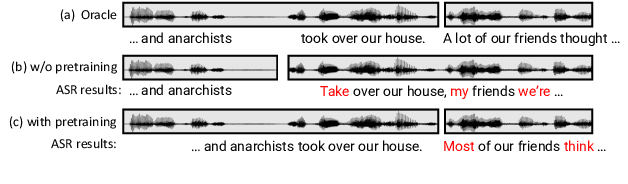
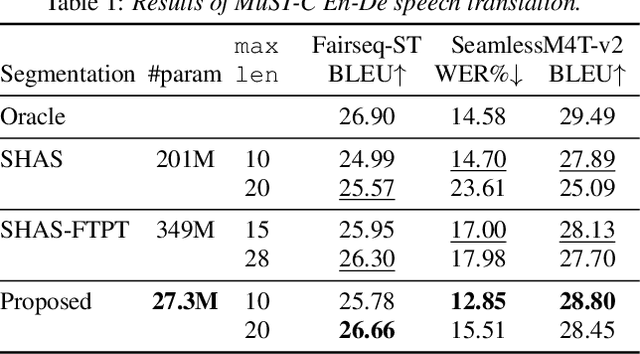
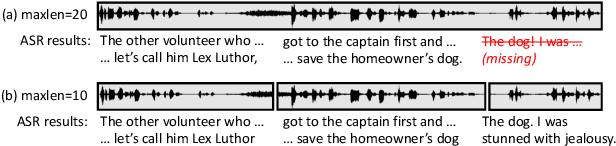
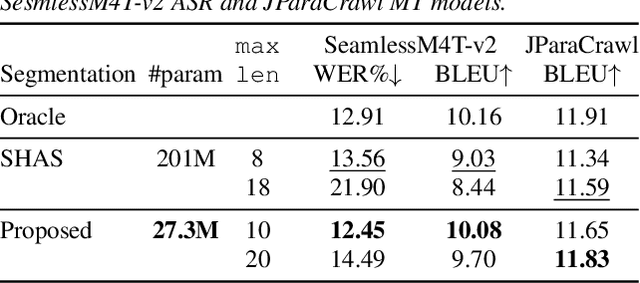
Speech segmentation is an essential part of speech translation (ST) systems in real-world scenarios. Since most ST models are designed to process speech segments, long-form audio must be partitioned into shorter segments before translation. Recently, data-driven approaches for the speech segmentation task have been developed. Although the approaches improve overall translation quality, a performance gap exists due to a mismatch between the models and ST systems. In addition, the prior works require large self-supervised speech models, which consume significant computational resources. In this work, we propose a segmentation model that achieves better speech translation quality with a small model size. We propose an ASR-with-punctuation task as an effective pre-training strategy for the segmentation model. We also show that proper integration of the speech segmentation model into the underlying ST system is critical to improve overall translation quality at inference time.
HyperCLOVA X Technical Report
Apr 13, 2024We introduce HyperCLOVA X, a family of large language models (LLMs) tailored to the Korean language and culture, along with competitive capabilities in English, math, and coding. HyperCLOVA X was trained on a balanced mix of Korean, English, and code data, followed by instruction-tuning with high-quality human-annotated datasets while abiding by strict safety guidelines reflecting our commitment to responsible AI. The model is evaluated across various benchmarks, including comprehensive reasoning, knowledge, commonsense, factuality, coding, math, chatting, instruction-following, and harmlessness, in both Korean and English. HyperCLOVA X exhibits strong reasoning capabilities in Korean backed by a deep understanding of the language and cultural nuances. Further analysis of the inherent bilingual nature and its extension to multilingualism highlights the model's cross-lingual proficiency and strong generalization ability to untargeted languages, including machine translation between several language pairs and cross-lingual inference tasks. We believe that HyperCLOVA X can provide helpful guidance for regions or countries in developing their sovereign LLMs.