 Add to Chrome
 Add to Firefox
 Add to Edge
MoLGE: Mixture of Language Group Experts for Efficient Scaling of Massively Multilingual Speech Recognition
Jul 27, 2026
Massively multilingual automatic speech recognition (ASR) models covering hundreds of languages must maintain robust performance across diverse linguistic and acoustic conditions. However, these models often encounter the curse of multilinguality, where model capacity is diluted across languages. To address this challenge, we propose Mixture of Language Group Experts (MoLGE), built upon speech self-supervised models (S3Ms). MoLGE assigns dedicated expert modules to clusters of similar languages, reducing the number of required submodules compared to conventional language-specific Mixture-of-Experts (MoE) schemes. It further integrates a hierarchical Low-Rank Adaptation (LoRA) strategy into the disentangled acoustic and linguistic components of the S3M architecture, enabling efficient modeling of language-specific characteristics while maintaining parameter efficiency. Further, we investigate the impact of language grouping strategies based on both linguistic and data-driven criteria on overall performance, providing an interpretable perspective on how language structure influences scalability in multilingual speech systems. In experiments, we evaluate MoLGE on a multilingual benchmark encompassing 495 languages. Results demonstrate that MoLGE consistently outperforms dense multilingual baselines with a minimal increase in trainable parameters. Notably, these language grouping strategies yield substantial improvements for both phonetic and orthographic aspects of ASR modeling. Our findings suggest that structured language specialization provides an effective pathway for massively scaling language coverage of multilingual ASR.

ParaPairAudioBench: Paralinguistic Pairwise Audio Benchmark for LALM-as-a-Judge
Jun 23, 2026Large Audio-Language Models (LALMs) have been widely used as judge models for the automatic evaluation of generated speech. However, prior approaches predominantly focus on holistic naturalness, leaving fine-grained paralinguistic distinctions underexplored. We introduce ParaPairAudioBench, a pairwise benchmark of 5,175 audio pairs across five paralinguistic dimensions: Style, Rate, Emphasis, Age, and Gender. Our experiments show that current LALM judges still lag behind human judgments by 32%p on average and exhibit severe calibration failures, particularly in Tie cases where the correct decision is to abstain. To further analyze lexical versus acoustic reliance, the benchmark includes both same-transcript and cross-transcript conditions. ParaPairAudioBench enables multi-dimensional, calibration-aware assessment of the reliability of LALM-as-a-Judge for paralinguistic speech evaluation.
Benchmarks Are Not That Out of Distribution: Word Overlap Predicts Performance
Feb 11, 2026Understanding what constitutes high-quality pre-training data remains a central question in language model training. In this work, we investigate whether benchmark performance is primarily driven by the degree of statistical pattern overlap between pre-training corpora and evaluation datasets. We measure this overlap using word-level unigram cross-entropy and word frequency statistics, and perform controlled experiments across $10$ zero-shot benchmarks, $4$ pre-training datasets spanning $8.5\mathrm{B}$ to $60\mathrm{B}$ tokens, and model sizes ranging from $400\mathrm{M}$ to $3\mathrm{B}$ parameters. Our results demonstrate a robust inverse relationship between word-level unigram cross-entropy and benchmark performance, suggesting that widely used benchmarks are strongly influenced by word overlap between training and evaluation data. Thus, larger pre-training subsets with similar word-level unigram cross-entropy yield improved downstream results, indicating that word frequency statistics play an additional role in shaping benchmark scores. Taken together, these results suggest that many standard benchmarks are only weakly out-of-distribution relative to pre-training corpora, so that simple word-overlap statistics predict benchmark performance.
UniCoM: A Universal Code-Switching Speech Generator
Aug 21, 2025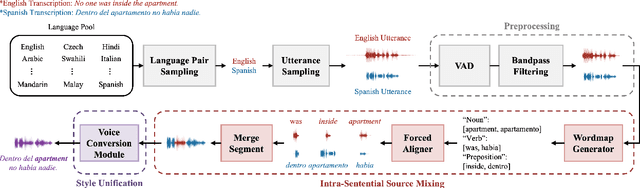
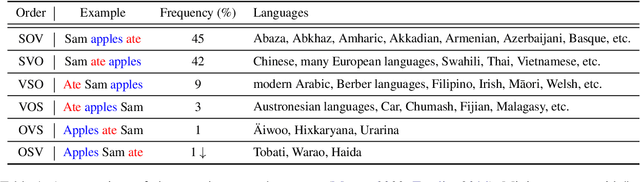
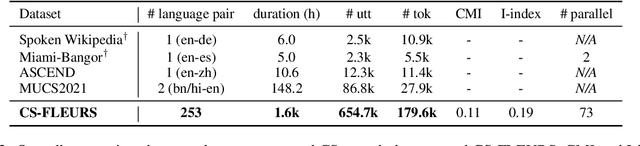
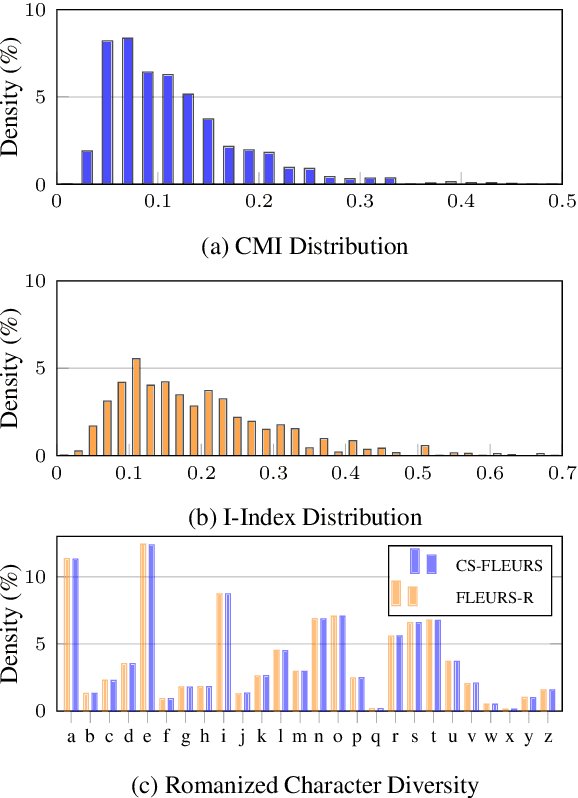
Code-switching (CS), the alternation between two or more languages within a single speaker's utterances, is common in real-world conversations and poses significant challenges for multilingual speech technology. However, systems capable of handling this phenomenon remain underexplored, primarily due to the scarcity of suitable datasets. To resolve this issue, we propose Universal Code-Mixer (UniCoM), a novel pipeline for generating high-quality, natural CS samples without altering sentence semantics. Our approach utilizes an algorithm we call Substituting WORDs with Synonyms (SWORDS), which generates CS speech by replacing selected words with their translations while considering their parts of speech. Using UniCoM, we construct Code-Switching FLEURS (CS-FLEURS), a multilingual CS corpus designed for automatic speech recognition (ASR) and speech-to-text translation (S2TT). Experimental results show that CS-FLEURS achieves high intelligibility and naturalness, performing comparably to existing datasets on both objective and subjective metrics. We expect our approach to advance CS speech technology and enable more inclusive multilingual systems.
On the Robustness of Reward Models for Language Model Alignment
May 12, 2025The Bradley-Terry (BT) model is widely practiced in reward modeling for reinforcement learning with human feedback (RLHF). Despite its effectiveness, reward models (RMs) trained with BT model loss are prone to over-optimization, losing generalizability to unseen input distributions. In this paper, we study the cause of over-optimization in RM training and its downstream effects on the RLHF procedure, accentuating the importance of distributional robustness of RMs in unseen data. First, we show that the excessive dispersion of hidden state norms is the main source of over-optimization. Then, we propose batch-wise sum-to-zero regularization (BSR) to enforce zero-centered reward sum per batch, constraining the rewards with extreme magnitudes. We assess the impact of BSR in improving robustness in RMs through four scenarios of over-optimization, where BSR consistently manifests better robustness. Subsequently, we compare the plain BT model and BSR on RLHF training and empirically show that robust RMs better align the policy to the gold preference model. Finally, we apply BSR to high-quality data and models, which surpasses state-of-the-art RMs in the 8B scale by adding more than 5% in complex preference prediction tasks. By conducting RLOO training with 8B RMs, AlpacaEval 2.0 reduces generation length by 40% while adding a 7% increase in win rate, further highlighting that robustness in RMs induces robustness in RLHF training. We release the code, data, and models: https://github.com/LinkedIn-XFACT/RM-Robustness.
Stable Language Model Pre-training by Reducing Embedding Variability
Sep 12, 2024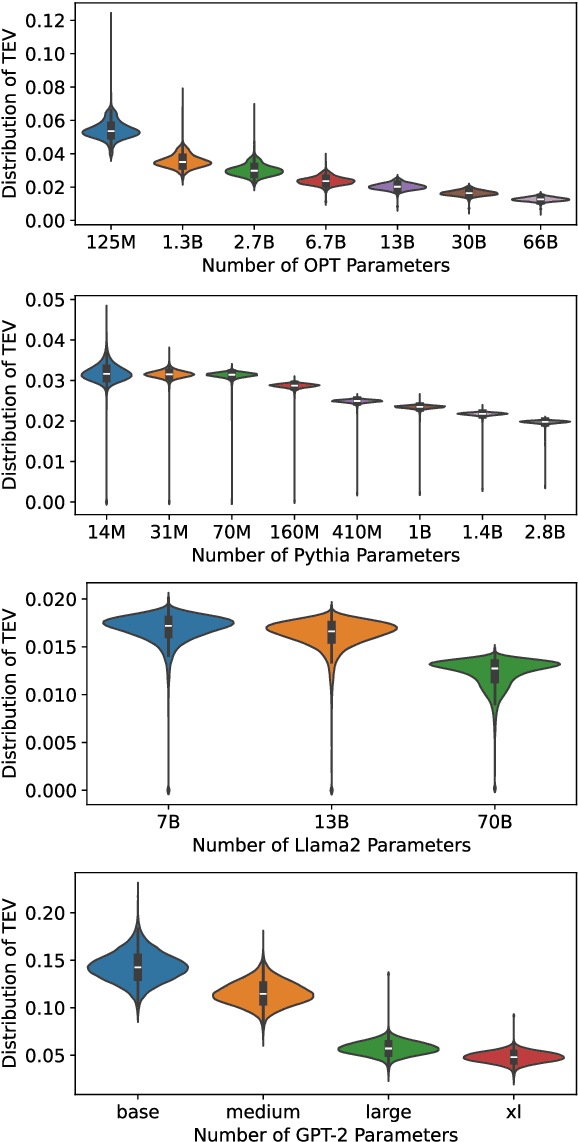
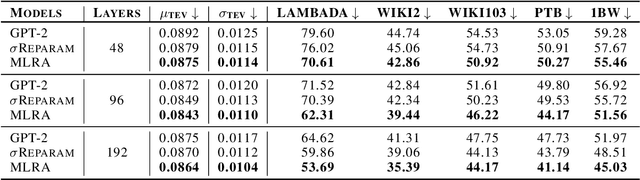
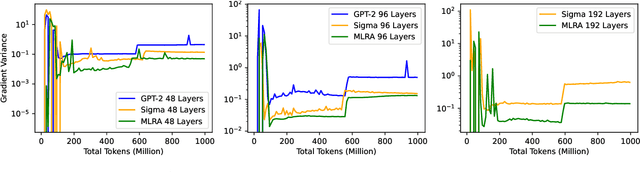
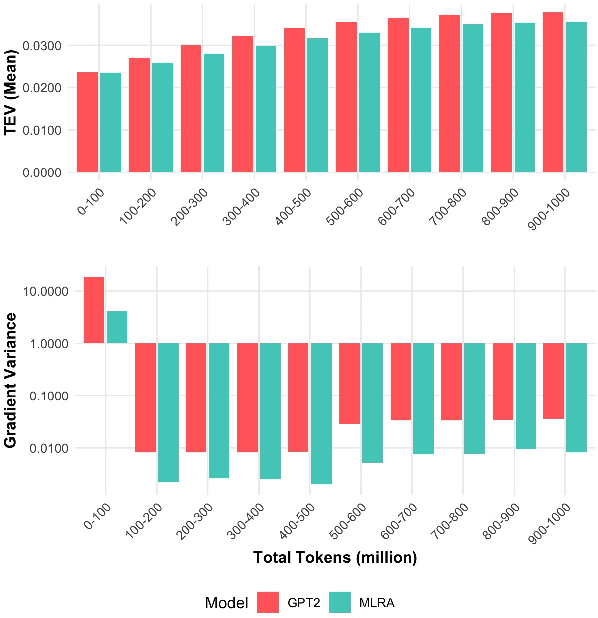
Stable pre-training is essential for achieving better-performing language models. However, tracking pre-training stability by calculating gradient variance at every step is impractical due to the significant computational costs. We explore Token Embedding Variability (TEV) as a simple and efficient proxy for assessing pre-training stability in language models with pre-layer normalization, given that shallower layers are more prone to gradient explosion (section 2.2). Moreover, we propose Multi-head Low-Rank Attention (MLRA) as an architecture to alleviate such instability by limiting the exponential growth of output embedding variance, thereby preventing the gradient explosion (section 3.2). Empirical results on GPT-2 with MLRA demonstrate increased stability and lower perplexity, particularly in deeper models.