 Add to Chrome
 Add to Firefox
 Add to Edge
Physics-Informed Laplace Neural Operator for Solving Partial Differential Equations
Feb 13, 2026
Neural operators have emerged as fast surrogate solvers for parametric partial differential equations (PDEs). However, purely data-driven models often require extensive training data and can generalize poorly, especially in small-data regimes and under unseen (out-of-distribution) input functions that are not represented in the training data. To address these limitations, we propose the Physics-Informed Laplace Neural Operator (PILNO), which enhances the Laplace Neural Operator (LNO) by embedding governing physics into training through PDE, boundary condition, and initial condition residuals. To improve expressivity, we first introduce an Advanced LNO (ALNO) backbone that retains a pole-residue transient representation while replacing the steady-state branch with an FNO-style Fourier multiplier. To make physics-informed training both data-efficient and robust, PILNO further leverages (i) virtual inputs: an unlabeled ensemble of input functions spanning a broad spectral range that provides abundant physics-only supervision and explicitly targets out-of-distribution (OOD) regimes; and (ii) temporal-causality weighting: a time-decaying reweighting of the physics residual that prioritizes early-time dynamics and stabilizes optimization for time-dependent PDEs. Across four representative benchmarks -- Burgers' equation, Darcy flow, a reaction-diffusion system, and a forced KdV equation -- PILNO consistently improves accuracy in small-data settings (e.g., N_train <= 27), reduces run-to-run variability across random seeds, and achieves stronger OOD generalization than purely data-driven baselines.

Posting Bot Detection on Blockchain-based Social Media Platform using Machine Learning Techniques
Aug 28, 2020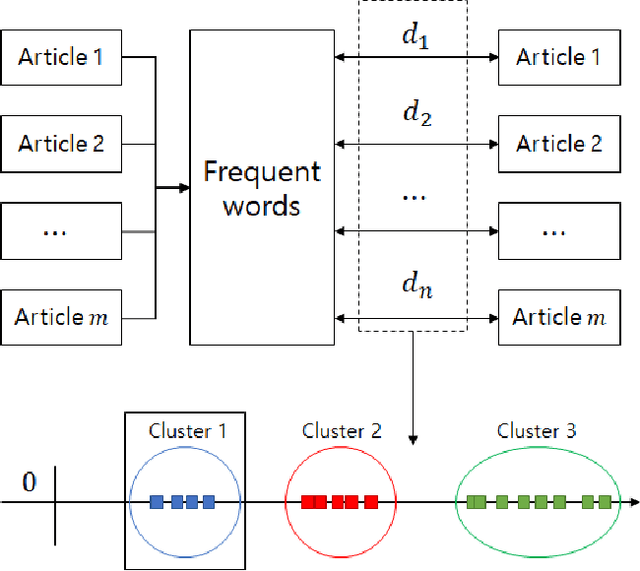
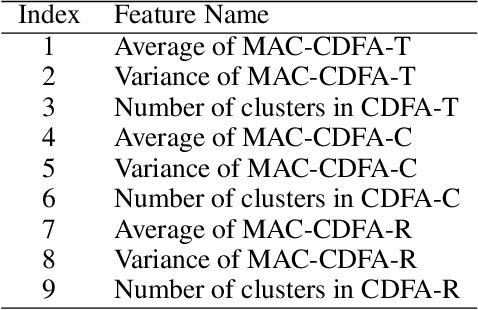
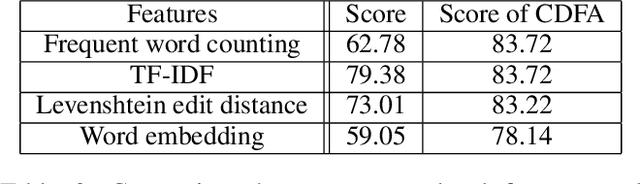
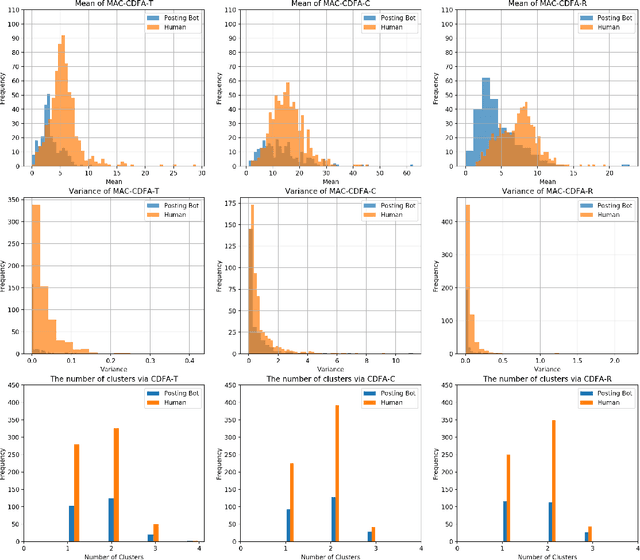
Steemit is a blockchain-based social media platform, where authors can get author rewards in the form of cryptocurrencies called STEEM and SBD (Steem Blockchain Dollars) if their posts are upvoted. Interestingly, curators (or voters) can also get rewards by voting others' posts, which is called a curation reward. A reward is proportional to a curator's STEEM stakes. Throughout this process, Steemit hopes "good" content will be automatically discovered by users in a decentralized way, which is known as the Proof-of-Brain (PoB). However, there are many bot accounts programmed to post automatically and get rewards, which discourages real human users from creating good content. We call this type of bot a posting bot. While there are many papers that studied bots on traditional centralized social media platforms such as Facebook and Twitter, we are the first to study posting bots on a blockchain-based social media platform. Compared with the bot detection on the usual social media platforms, the features we created have an advantage that posting bots can be detected without limiting the number or length of posts. We can extract the features of posts by clustering distances between blog data or replies. These features are obtained from the Minimum Average Cluster from Clustering Distance between Frequent words and Articles (MAC-CDFA), which is not used in any of the previous social media research. Based on the enriched features, we enhanced the quality of classification tasks. Comparing the F1-scores, the features we created outperformed the features used for bot detection on Facebook and Twitter.