 Add to Chrome
 Add to Firefox
 Add to Edge
PRoID: Predicted Rate of Information Delivery in Multi-Robot Exploration and Relaying
Apr 12, 2026
We address Multi-Robot Exploration and Relaying (MRER): a team of robots must explore an unknown environment and deliver acquired information to a fixed base station within a mission time limit. The central challenge is deciding when each robot should stop exploring and relay: this depends on what the robot is likely to find ahead, what information it uniquely holds, and whether immediate or future delivery is more valuable. Prior approaches either ignore the reporting requirement entirely or rely on fixed-schedule relay strategies that cannot adapt to environment structure, team composition, or mission progress. We introduce PRoID (Predicted Rate of Information Delivery), a relay criterion that uses learned map prediction to estimate each robot's future information gain along its planned path, accounting for what teammates are already relaying. PRoID triggers relay when immediate return yields higher information delivery per unit time. We further propose PRoID-Safe, a failure-aware extension that incorporates robot survival probability into the relay criterion, naturally biasing decisions toward earlier relay as failure risk grows. We evaluate on real-world indoor floor plan datasets and show that PRoID and PRoID-Safe outperform fixed-schedule baselines, with stronger relative gains in failure scenarios.

PIPE Planner: Pathwise Information Gain with Map Predictions for Indoor Robot Exploration
Mar 10, 2025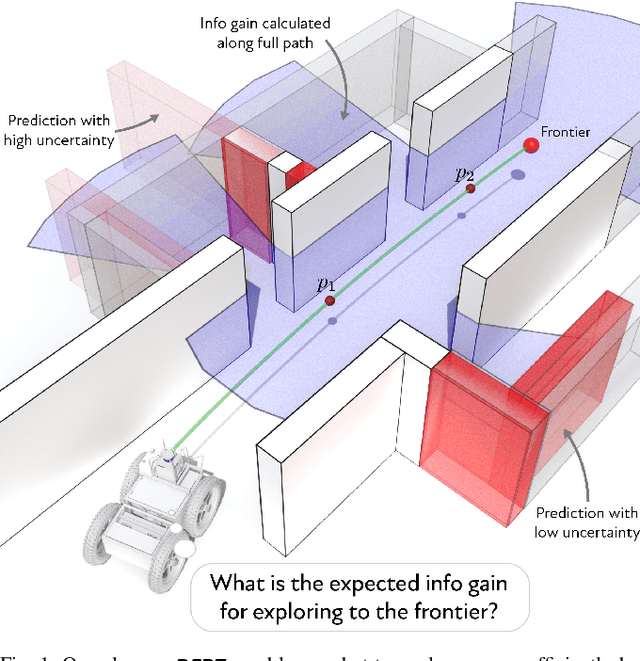
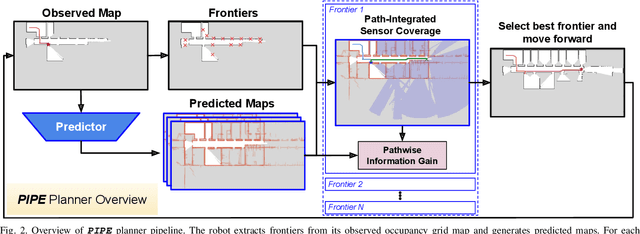
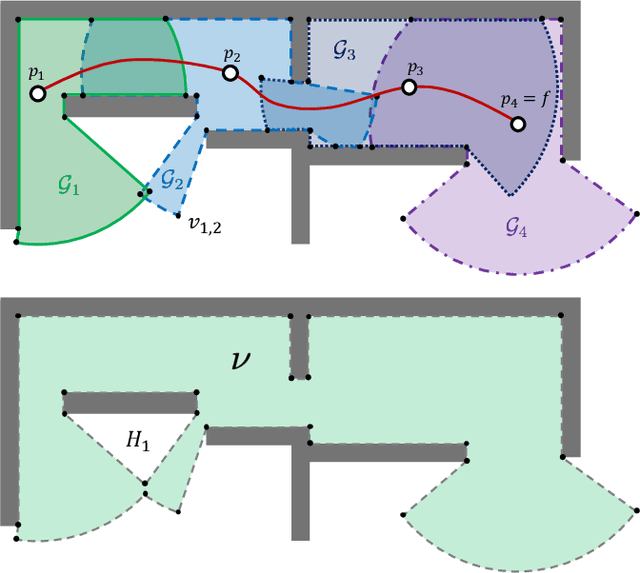
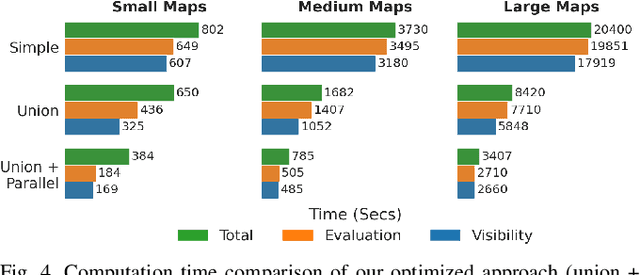
Autonomous exploration in unknown environments requires estimating the information gain of an action to guide planning decisions. While prior approaches often compute information gain at discrete waypoints, pathwise integration offers a more comprehensive estimation but is often computationally challenging or infeasible and prone to overestimation. In this work, we propose the Pathwise Information Gain with Map Prediction for Exploration (PIPE) planner, which integrates cumulative sensor coverage along planned trajectories while leveraging map prediction to mitigate overestimation. To enable efficient pathwise coverage computation, we introduce a method to efficiently calculate the expected observation mask along the planned path, significantly reducing computational overhead. We validate PIPE on real-world floorplan datasets, demonstrating its superior performance over state-of-the-art baselines. Our results highlight the benefits of integrating predictive mapping with pathwise information gain for efficient and informed exploration.