 Add to Chrome
 Add to Firefox
 Add to Edge
Understanding vs. Generation: Navigating Optimization Dilemma in Multimodal Models
Feb 17, 2026
Current research in multimodal models faces a key challenge where enhancing generative capabilities often comes at the expense of understanding, and vice versa. We analyzed this trade-off and identify the primary cause might be the potential conflict between generation and understanding, which creates a competitive dynamic within the model. To address this, we propose the Reason-Reflect-Refine (R3) framework. This innovative algorithm re-frames the single-step generation task into a multi-step process of "generate-understand-regenerate". By explicitly leveraging the model's understanding capability during generation, we successfully mitigate the optimization dilemma, achieved stronger generation results and improved understanding ability which are related to the generation process. This offers valuable insights for designing next-generation unified multimodal models. Code is available at https://github.com/sen-ye/R3.

Distribution Matching Variational AutoEncoder
Dec 08, 2025Most visual generative models compress images into a latent space before applying diffusion or autoregressive modelling. Yet, existing approaches such as VAEs and foundation model aligned encoders implicitly constrain the latent space without explicitly shaping its distribution, making it unclear which types of distributions are optimal for modeling. We introduce \textbf{Distribution-Matching VAE} (\textbf{DMVAE}), which explicitly aligns the encoder's latent distribution with an arbitrary reference distribution via a distribution matching constraint. This generalizes beyond the Gaussian prior of conventional VAEs, enabling alignment with distributions derived from self-supervised features, diffusion noise, or other prior distributions. With DMVAE, we can systematically investigate which latent distributions are more conducive to modeling, and we find that SSL-derived distributions provide an excellent balance between reconstruction fidelity and modeling efficiency, reaching gFID equals 3.2 on ImageNet with only 64 training epochs. Our results suggest that choosing a suitable latent distribution structure (achieved via distribution-level alignment), rather than relying on fixed priors, is key to bridging the gap between easy-to-model latents and high-fidelity image synthesis. Code is avaliable at https://github.com/sen-ye/dmvae.
MMoE: Robust Spoiler Detection with Multi-modal Information and Domain-aware Mixture-of-Experts
Mar 14, 2024
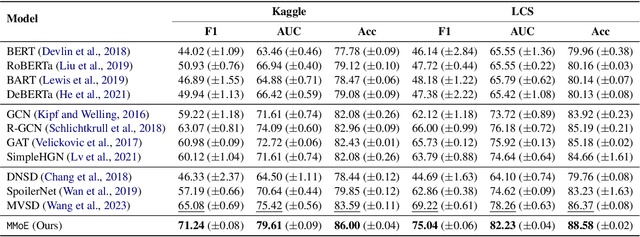
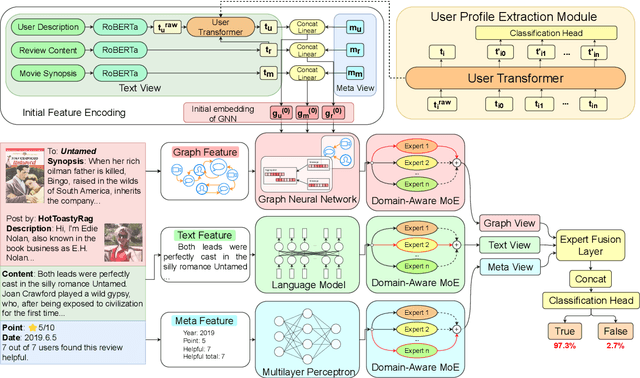
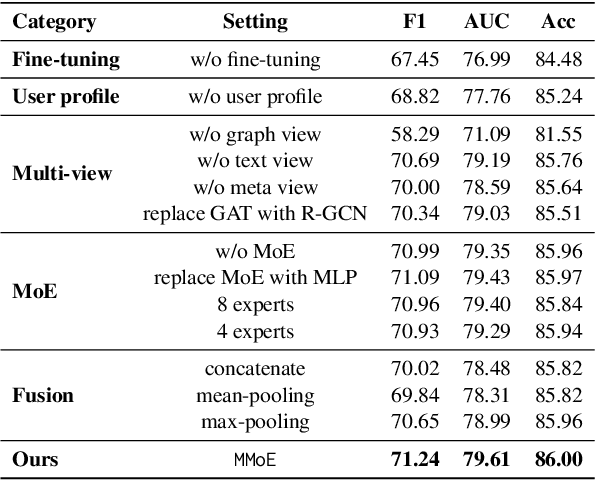
Online movie review websites are valuable for information and discussion about movies. However, the massive spoiler reviews detract from the movie-watching experience, making spoiler detection an important task. Previous methods simply focus on reviews' text content, ignoring the heterogeneity of information in the platform. For instance, the metadata and the corresponding user's information of a review could be helpful. Besides, the spoiler language of movie reviews tends to be genre-specific, thus posing a domain generalization challenge for existing methods. To this end, we propose MMoE, a multi-modal network that utilizes information from multiple modalities to facilitate robust spoiler detection and adopts Mixture-of-Experts to enhance domain generalization. MMoE first extracts graph, text, and meta feature from the user-movie network, the review's textual content, and the review's metadata respectively. To handle genre-specific spoilers, we then adopt Mixture-of-Experts architecture to process information in three modalities to promote robustness. Finally, we use an expert fusion layer to integrate the features from different perspectives and make predictions based on the fused embedding. Experiments demonstrate that MMoE achieves state-of-the-art performance on two widely-used spoiler detection datasets, surpassing previous SOTA methods by 2.56% and 8.41% in terms of accuracy and F1-score. Further experiments also demonstrate MMoE's superiority in robustness and generalization.