 Add to Chrome
 Add to Firefox
 Add to Edge
Cross Domain Few-Shot Class-Incremental Audio Classification Via Adversarial Contrastive Learning
Jul 02, 2026
Current Few-shot Class-incremental Audio Classification (FCAC) methods assume that samples of base and incremental classes are in the same domain (following the same distribution). However, there is generally a domain shift between the above two types of samples. In this paper, we explore the problem of Cross Domain FCAC where samples of base and incremental classes have domain shift. We propose a strategy of adversarial contrastive training which enables the model to effectively classify samples of different classes from unseen domains. The model consists of an encoder and a classifier. The encoder is trained in base session but frozen in incremental sessions, whereas the classifier is trained in all sessions. Experiments are done on six pairs of cross-domain datasets. Results show that our method exceeds state-of-the-art methods in average accuracy. The code is at https://github.com/YongjieSi/ACL.

Few-Shot Open-Set Audio Classification Using Attention Information-Fused Prototypes
Jul 01, 2026Most existing audio classification methods suppose that each query (testing) sample belongs to a class of support (training) samples, and misrecognize samples of unseen classes as seen classes (cannot reject samples of unseen classes). In this study, we propose a method for Few-shot Open-set Audio Classification (FOAC), which can recognize query samples of seen classes after updating the model using a few support samples, and meanwhile reject query samples from unseen classes. We design a model consisting of an encoder and a classifier. The encoder is the backbone of a ResNet used for extracting embeddings. The classifier consists of prototype generators of few-shot classes and open-set classes. Prototypes of few-shot classes are obtained by fusing the class-discriminative information of support and query embeddings and by assigning larger weighting coefficient to representative part of the support embeddings. One prototype is generated for open-set classes using the proposed prototype generator. The encoder is trained with abundant samples of base classes in supervised manner, and then the prototypes of base classes are generated under the supervision of a joint loss. The classifier is trained using a few samples of few-shot classes in a meta-training way. Three public datasets (LS-100, NSynth-100, and FSC-89) are used to assess the performance of our method. Experiments show that our method has advantage over prior methods in AUROC and accuracy. This advantage has statistical significance for most prior methods. Our method has lower computational complexity than most prior methods. The code is at https://github.com/Jessytan/FOAC-AIFP.
Few-shot Class-variable Incremental Audio Classification via Prototype Adaptation and Pseudo Class-variable Training
Jun 08, 2026In the task of few-shot class-incremental audio classification, the number of classes is assumed to always increase without considering the possibility of decrease. However, the number of classes generally increases or decreases in practice. In this paper, we investigate a problem of Few-shot Class-variable Incremental Audio Classification (FCIAC), in which the number of classes increases or decreases. We propose a FCIAC method using prototype adaptation and pseudo class-variable training. The model in our method consists of an encoder and a classifier. The classifier is initialized by a class-variable prototype adaptation network, whose structure dynamically changes with the change of classes. In addition, we design a pseudo class-variable training strategy to enhance the model's adaptability to changing classes. Experiments on three public datasets show that our method exceeds previous methods in average accuracy. The code is at: https://github.com/cgq2971-afk/FCIAC.
When Large Language Model Meets Optimization
May 16, 2024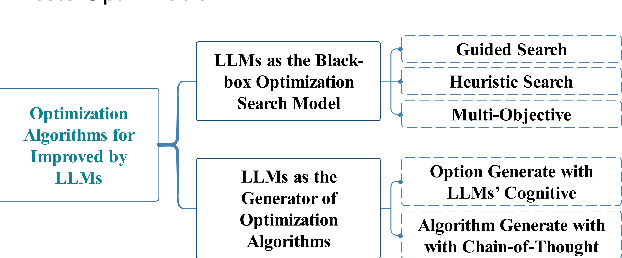
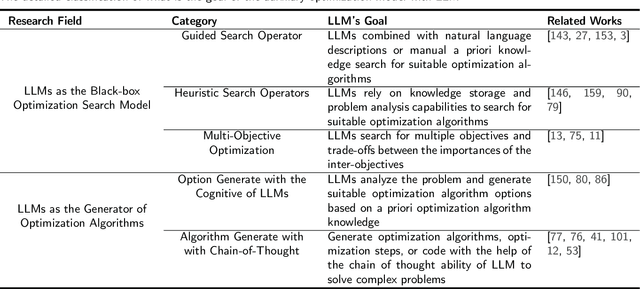
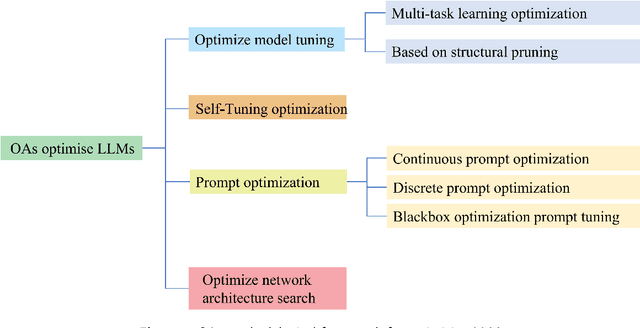
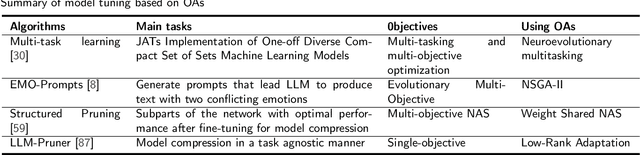
Optimization algorithms and large language models (LLMs) enhance decision-making in dynamic environments by integrating artificial intelligence with traditional techniques. LLMs, with extensive domain knowledge, facilitate intelligent modeling and strategic decision-making in optimization, while optimization algorithms refine LLM architectures and output quality. This synergy offers novel approaches for advancing general AI, addressing both the computational challenges of complex problems and the application of LLMs in practical scenarios. This review outlines the progress and potential of combining LLMs with optimization algorithms, providing insights for future research directions.
A First-Order Algorithmic Framework for Wasserstein Distributionally Robust Logistic Regression
Oct 28, 2019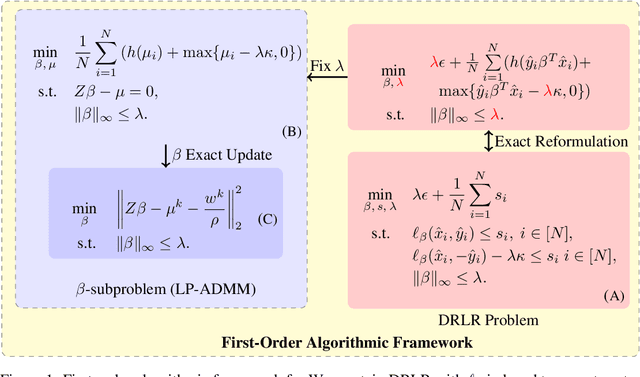
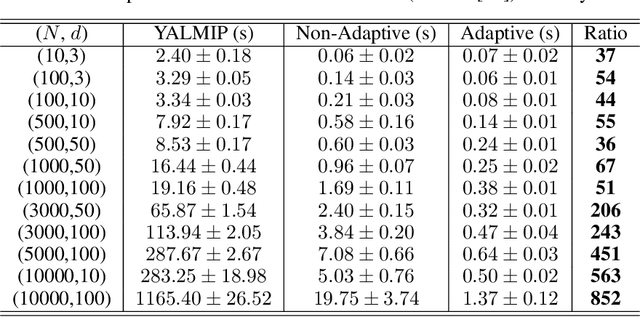
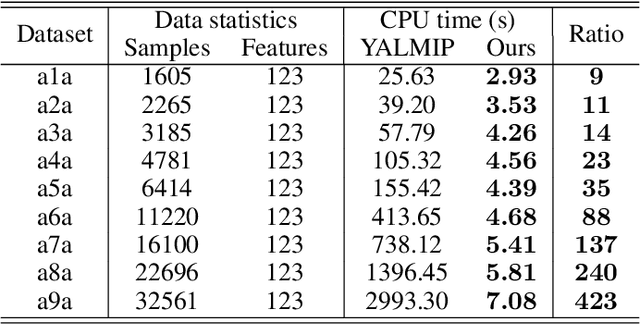
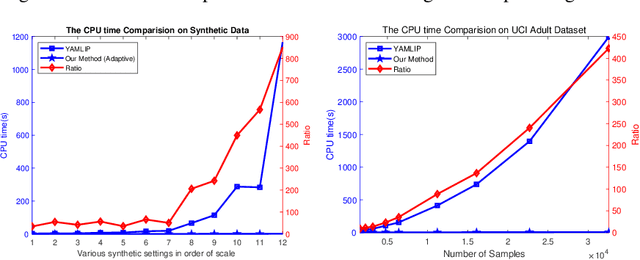
Wasserstein distance-based distributionally robust optimization (DRO) has received much attention lately due to its ability to provide a robustness interpretation of various learning models. Moreover, many of the DRO problems that arise in the learning context admits exact convex reformulations and hence can be tackled by off-the-shelf solvers. Nevertheless, the use of such solvers severely limits the applicability of DRO in large-scale learning problems, as they often rely on general purpose interior-point algorithms. On the other hand, there are very few works that attempt to develop fast iterative methods to solve these DRO problems, which typically possess complicated structures. In this paper, we take a first step towards resolving the above difficulty by developing a first-order algorithmic framework for tackling a class of Wasserstein distance-based distributionally robust logistic regression (DRLR) problem. Specifically, we propose a novel linearized proximal ADMM to solve the DRLR problem, whose objective is convex but consists of a smooth term plus two non-separable non-smooth terms. We prove that our method enjoys a sublinear convergence rate. Furthermore, we conduct three different experiments to show its superb performance on both synthetic and real-world datasets. In particular, our method can achieve the same accuracy up to 800+ times faster than the standard off-the-shelf solver.
Object Reachability via Swaps under Strict and Weak Preferences
Sep 17, 2019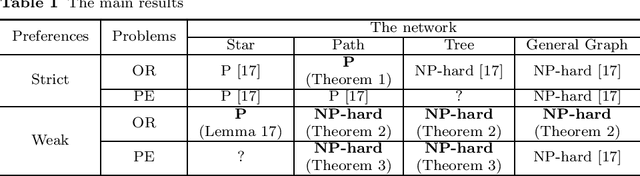
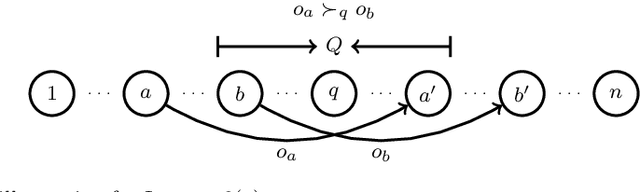

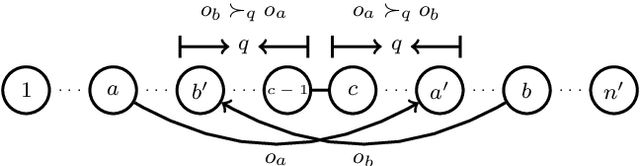
The \textsc{Housing Market} problem is a widely studied resource allocation problem. In this problem, each agent can only receive a single object and has preferences over all objects. Starting from an initial endowment, we want to reach a certain assignment via a sequence of rational trades. We first consider whether an object is reachable for a given agent under a social network, where a trade between two agents is allowed if they are neighbors in the network and no participant has a deficit from the trade. Assume that the preferences of the agents are strict (no tie among objects is allowed). This problem is polynomially solvable in a star-network and NP-complete in a tree-network. It is left as a challenging open problem whether the problem is polynomially solvable when the network is a path. We answer this open problem positively by giving a polynomial-time algorithm. Then we show that when the preferences of the agents are weak (ties among objects are allowed), the problem becomes NP-hard even when the network is a path. In addition, we consider the computational complexity of finding different optimal assignments for the problem under the network being a path or a star.