 Add to Chrome
 Add to Firefox
 Add to Edge
Few-Shot Open-Set Audio Classification Using Attention Information-Fused Prototypes
Jul 01, 2026
Most existing audio classification methods suppose that each query (testing) sample belongs to a class of support (training) samples, and misrecognize samples of unseen classes as seen classes (cannot reject samples of unseen classes). In this study, we propose a method for Few-shot Open-set Audio Classification (FOAC), which can recognize query samples of seen classes after updating the model using a few support samples, and meanwhile reject query samples from unseen classes. We design a model consisting of an encoder and a classifier. The encoder is the backbone of a ResNet used for extracting embeddings. The classifier consists of prototype generators of few-shot classes and open-set classes. Prototypes of few-shot classes are obtained by fusing the class-discriminative information of support and query embeddings and by assigning larger weighting coefficient to representative part of the support embeddings. One prototype is generated for open-set classes using the proposed prototype generator. The encoder is trained with abundant samples of base classes in supervised manner, and then the prototypes of base classes are generated under the supervision of a joint loss. The classifier is trained using a few samples of few-shot classes in a meta-training way. Three public datasets (LS-100, NSynth-100, and FSC-89) are used to assess the performance of our method. Experiments show that our method has advantage over prior methods in AUROC and accuracy. This advantage has statistical significance for most prior methods. Our method has lower computational complexity than most prior methods. The code is at https://github.com/Jessytan/FOAC-AIFP.

Fully Few-shot Class-incremental Audio Classification Using Expandable Dual-embedding Extractor
Jun 12, 2024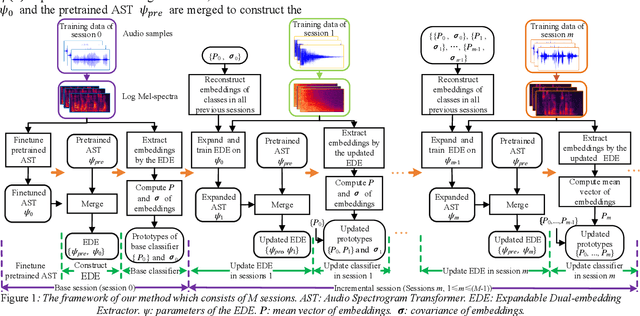
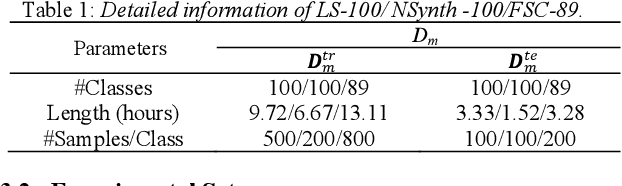
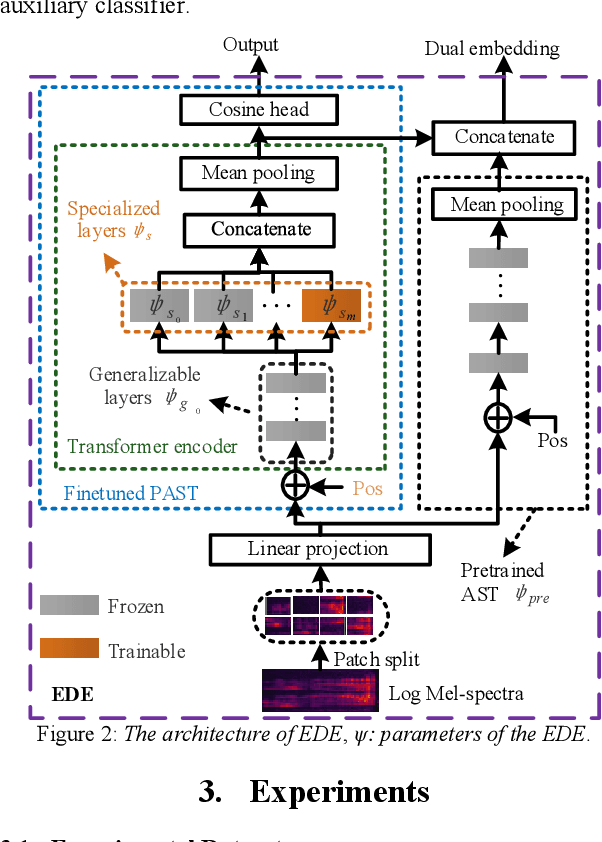
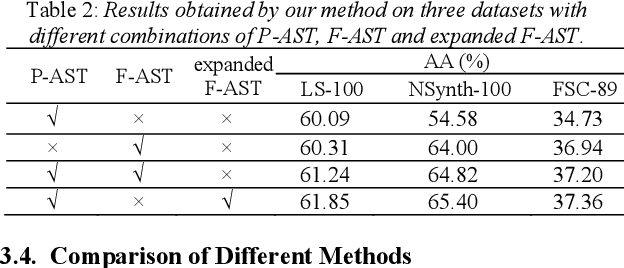
It's assumed that training data is sufficient in base session of few-shot class-incremental audio classification. However, it's difficult to collect abundant samples for model training in base session in some practical scenarios due to the data scarcity of some classes. This paper explores a new problem of fully few-shot class-incremental audio classification with few training samples in all sessions. Moreover, we propose a method using expandable dual-embedding extractor to solve it. The proposed model consists of an embedding extractor and an expandable classifier. The embedding extractor consists of a pretrained Audio Spectrogram Transformer (AST) and a finetuned AST. The expandable classifier consists of prototypes and each prototype represents a class. Experiments are conducted on three datasets (LS-100, NSynth-100 and FSC-89). Results show that our method exceeds seven baseline ones in average accuracy with statistical significance. Code is at: https://github.com/YongjieSi/EDE.