 Add to Chrome
 Add to Firefox
 Add to Edge
Few-Shot Open-Set Audio Classification via Transductive Prototype Refinement and Class Logit Enhancement
Jul 29, 2026
Few-shot Open-set audio classification requires classifying query samples from known classes with a few labeled support samples while rejecting query samples from unknown classes. Transductive inference jointly observes the full unlabeled query set to improve prototype estimation, yet standard transductive updates do not distinguish known from unknown query samples, leaving prototypes vulnerable to open-set contamination. Drawing on latent-inlierness weighting and decoupled scoring for unknown-class samples, we propose a two-phase transductive method operating over a frozen audio encoder. First, each query sample is assigned a latent inlierness score that down-weights likely unknown-class samples, so that prototype refinement is driven primarily by known-class evidence. The refined prototypes are then directly optimized on a transductive loss combining support cross-entropy, inlierness-weighted conditional entropy minimization, and inlierness-weighted marginal entropy maximization, while open-set rejection uses a prior-adaptive free-energy score that adjusts its threshold with the prior proportion of unknown-class samples, decoupling detection from classification. Experiments on three audio datasets show our method achieves state-of-the-art results for few-shot open-set audio classification under multiple experimental conditions.

TriA Pipeline: A Large-Scale Automatic Audio Annotation Pipeline For Audio Classification In Specific Scenarios
Jul 07, 2026There are some datasets of varying scales for audio classification (AC) applied to different tasks. However, annotated data is limited for most scenarios, such as domestic environments. To address this challenge, we propose an $\textbf{A}$utomatic $\textbf{A}$udio $\textbf{A}$nnotation Pipeline--TriA Pipeline, which can efficiently convert audio from various scenarios into high-quality training data with audio event annotations. A TriA dataset was constructed with the TriA Pipeline, over 2130 hours of audio covering 431 audio classes. Furthermore, we partitioned a prior-knowledge-guided subset (TriA$_{\mathrm{GK}}$) from TriA and conduct comparative experiments on three domestic AC tasks. Comparing the result on manually annotated data only and that on manually annotated data combines TriA$_{\mathrm{GK}}$, TriA$_{\mathrm{GK}}$ could achieve average relative gains of 3.97% in accuracy and 3.35% in Macro-F1, validating the effectiveness of TriA$_{\mathrm{GK}}$ and the TriA Pipeline.
Cross Domain Few-Shot Class-Incremental Audio Classification Via Adversarial Contrastive Learning
Jul 02, 2026Current Few-shot Class-incremental Audio Classification (FCAC) methods assume that samples of base and incremental classes are in the same domain (following the same distribution). However, there is generally a domain shift between the above two types of samples. In this paper, we explore the problem of Cross Domain FCAC where samples of base and incremental classes have domain shift. We propose a strategy of adversarial contrastive training which enables the model to effectively classify samples of different classes from unseen domains. The model consists of an encoder and a classifier. The encoder is trained in base session but frozen in incremental sessions, whereas the classifier is trained in all sessions. Experiments are done on six pairs of cross-domain datasets. Results show that our method exceeds state-of-the-art methods in average accuracy. The code is at https://github.com/YongjieSi/ACL.
Few-Shot Open-Set Audio Classification Using Attention Information-Fused Prototypes
Jul 01, 2026Most existing audio classification methods suppose that each query (testing) sample belongs to a class of support (training) samples, and misrecognize samples of unseen classes as seen classes (cannot reject samples of unseen classes). In this study, we propose a method for Few-shot Open-set Audio Classification (FOAC), which can recognize query samples of seen classes after updating the model using a few support samples, and meanwhile reject query samples from unseen classes. We design a model consisting of an encoder and a classifier. The encoder is the backbone of a ResNet used for extracting embeddings. The classifier consists of prototype generators of few-shot classes and open-set classes. Prototypes of few-shot classes are obtained by fusing the class-discriminative information of support and query embeddings and by assigning larger weighting coefficient to representative part of the support embeddings. One prototype is generated for open-set classes using the proposed prototype generator. The encoder is trained with abundant samples of base classes in supervised manner, and then the prototypes of base classes are generated under the supervision of a joint loss. The classifier is trained using a few samples of few-shot classes in a meta-training way. Three public datasets (LS-100, NSynth-100, and FSC-89) are used to assess the performance of our method. Experiments show that our method has advantage over prior methods in AUROC and accuracy. This advantage has statistical significance for most prior methods. Our method has lower computational complexity than most prior methods. The code is at https://github.com/Jessytan/FOAC-AIFP.
Few-shot Class-variable Incremental Audio Classification via Prototype Adaptation and Pseudo Class-variable Training
Jun 08, 2026In the task of few-shot class-incremental audio classification, the number of classes is assumed to always increase without considering the possibility of decrease. However, the number of classes generally increases or decreases in practice. In this paper, we investigate a problem of Few-shot Class-variable Incremental Audio Classification (FCIAC), in which the number of classes increases or decreases. We propose a FCIAC method using prototype adaptation and pseudo class-variable training. The model in our method consists of an encoder and a classifier. The classifier is initialized by a class-variable prototype adaptation network, whose structure dynamically changes with the change of classes. In addition, we design a pseudo class-variable training strategy to enhance the model's adaptability to changing classes. Experiments on three public datasets show that our method exceeds previous methods in average accuracy. The code is at: https://github.com/cgq2971-afk/FCIAC.
Fully Few-shot Class-incremental Audio Classification Using Expandable Dual-embedding Extractor
Jun 12, 2024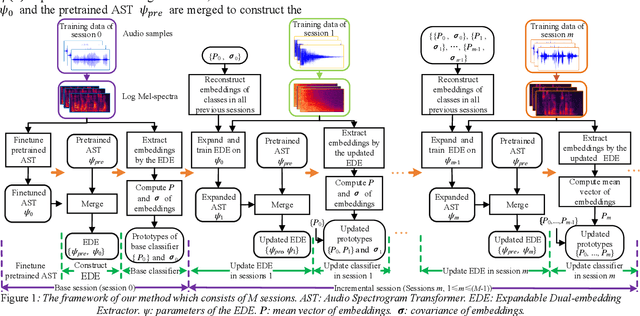
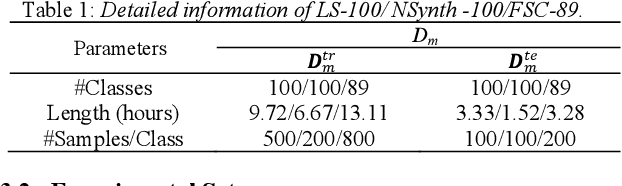
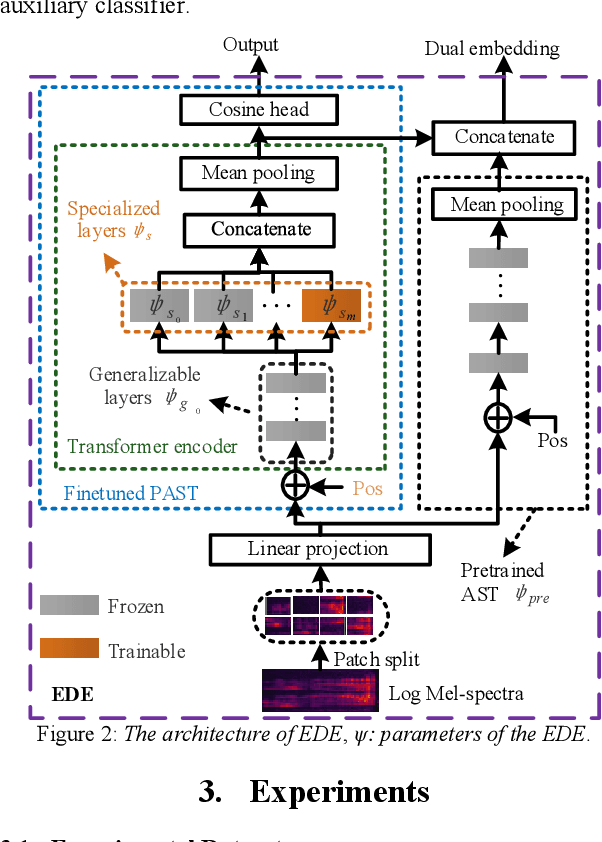
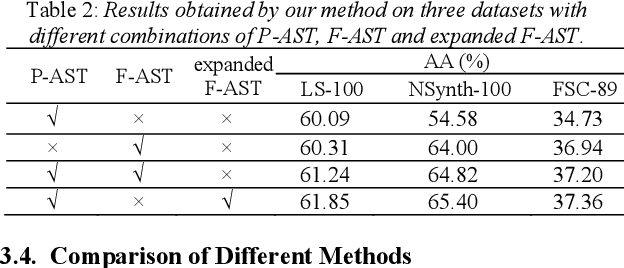
It's assumed that training data is sufficient in base session of few-shot class-incremental audio classification. However, it's difficult to collect abundant samples for model training in base session in some practical scenarios due to the data scarcity of some classes. This paper explores a new problem of fully few-shot class-incremental audio classification with few training samples in all sessions. Moreover, we propose a method using expandable dual-embedding extractor to solve it. The proposed model consists of an embedding extractor and an expandable classifier. The embedding extractor consists of a pretrained Audio Spectrogram Transformer (AST) and a finetuned AST. The expandable classifier consists of prototypes and each prototype represents a class. Experiments are conducted on three datasets (LS-100, NSynth-100 and FSC-89). Results show that our method exceeds seven baseline ones in average accuracy with statistical significance. Code is at: https://github.com/YongjieSi/EDE.
Lightweight Speaker Verification Using Transformation Module with Feature Partition and Fusion
Dec 06, 2023Although many efforts have been made on decreasing the model complexity for speaker verification, it is still challenging to deploy speaker verification systems with satisfactory result on low-resource terminals. We design a transformation module that performs feature partition and fusion to implement lightweight speaker verification. The transformation module consists of multiple simple but effective operations, such as convolution, pooling, mean, concatenation, normalization, and element-wise summation. It works in a plug-and-play way, and can be easily implanted into a wide variety of models to reduce the model complexity while maintaining the model error. First, the input feature is split into several low-dimensional feature subsets for decreasing the model complexity. Then, each feature subset is updated by fusing it with the inter-feature-subsets correlational information to enhance its representational capability. Finally, the updated feature subsets are independently fed into the block (one or several layers) of the model for further processing. The features that are output from current block of the model are processed according to the steps above before they are fed into the next block of the model. Experimental data are selected from two public speech corpora (namely VoxCeleb1 and VoxCeleb2). Results show that implanting the transformation module into three models (namely AMCRN, ResNet34, and ECAPA-TDNN) for speaker verification slightly increases the model error and significantly decreases the model complexity. Our proposed method outperforms baseline methods on the whole in memory requirement and computational complexity with lower equal error rate. It also generalizes well across truncated segments with various lengths.
Domestic Activities Classification from Audio Recordings Using Multi-scale Dilated Depthwise Separable Convolutional Network
Jun 09, 2023
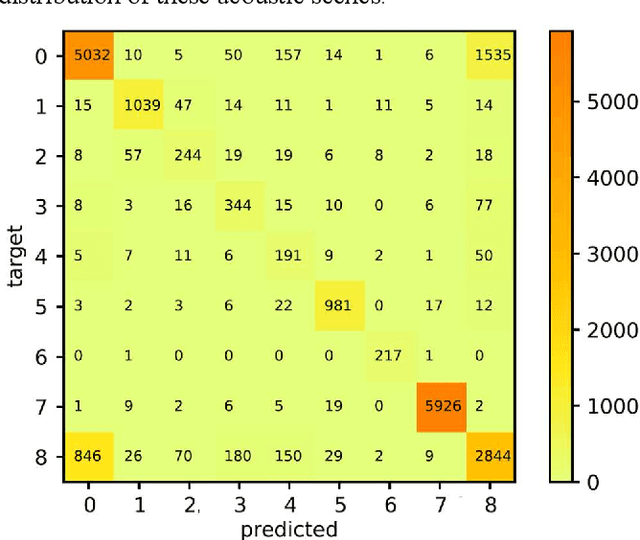
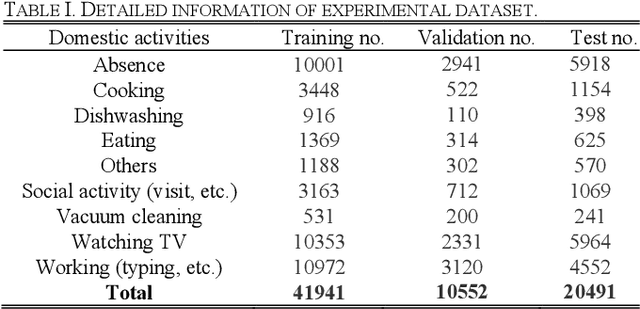
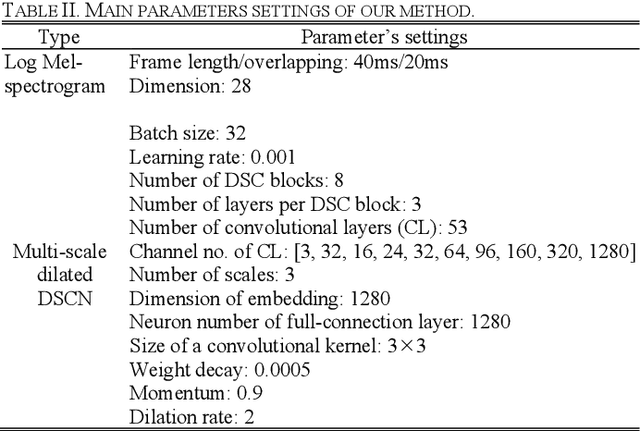
Domestic activities classification (DAC) from audio recordings aims at classifying audio recordings into pre-defined categories of domestic activities, which is an effective way for estimation of daily activities performed in home environment. In this paper, we propose a method for DAC from audio recordings using a multi-scale dilated depthwise separable convolutional network (DSCN). The DSCN is a lightweight neural network with small size of parameters and thus suitable to be deployed in portable terminals with limited computing resources. To expand the receptive field with the same size of DSCN's parameters, dilated convolution, instead of normal convolution, is used in the DSCN for further improving the DSCN's performance. In addition, the embeddings of various scales learned by the dilated DSCN are concatenated as a multi-scale embedding for representing property differences among various classes of domestic activities. Evaluated on a public dataset of the Task 5 of the 2018 challenge on Detection and Classification of Acoustic Scenes and Events (DCASE-2018), the results show that: both dilated convolution and multi-scale embedding contribute to the performance improvement of the proposed method; and the proposed method outperforms the methods based on state-of-the-art lightweight network in terms of classification accuracy.
Acoustic Scene Clustering Using Joint Optimization of Deep Embedding Learning and Clustering Iteration
Jun 09, 2023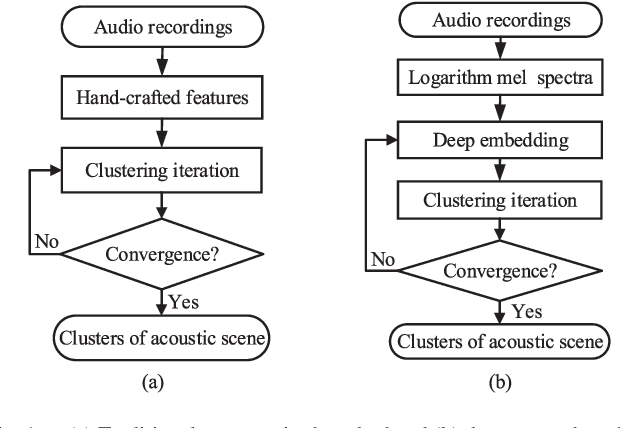
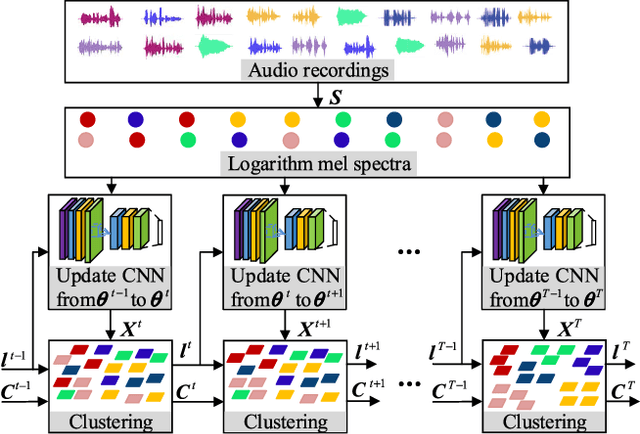
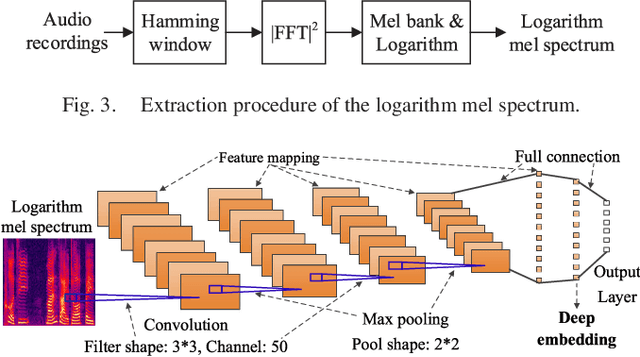
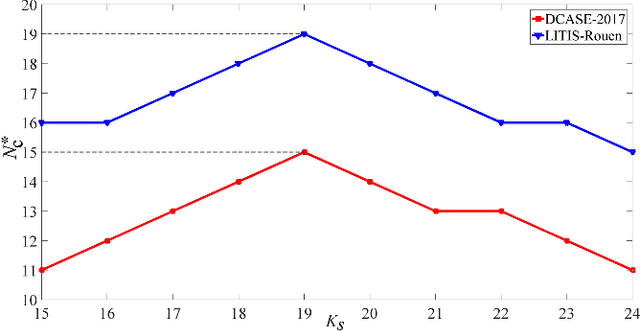
Recent efforts have been made on acoustic scene classification in the audio signal processing community. In contrast, few studies have been conducted on acoustic scene clustering, which is a newly emerging problem. Acoustic scene clustering aims at merging the audio recordings of the same class of acoustic scene into a single cluster without using prior information and training classifiers. In this study, we propose a method for acoustic scene clustering that jointly optimizes the procedures of feature learning and clustering iteration. In the proposed method, the learned feature is a deep embedding that is extracted from a deep convolutional neural network (CNN), while the clustering algorithm is the agglomerative hierarchical clustering (AHC). We formulate a unified loss function for integrating and optimizing these two procedures. Various features and methods are compared. The experimental results demonstrate that the proposed method outperforms other unsupervised methods in terms of the normalized mutual information and the clustering accuracy. In addition, the deep embedding outperforms many state-of-the-art features.
Low-Complexity Acoustic Scene Classification Using Data Augmentation and Lightweight ResNet
Jun 03, 2023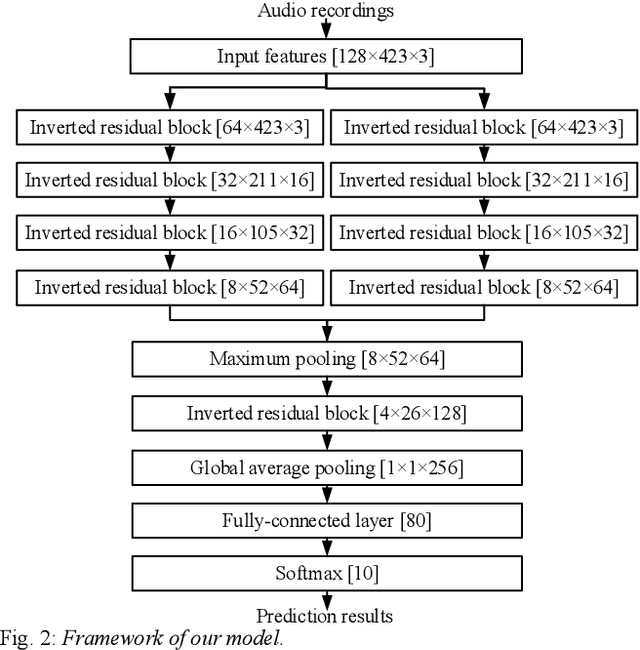
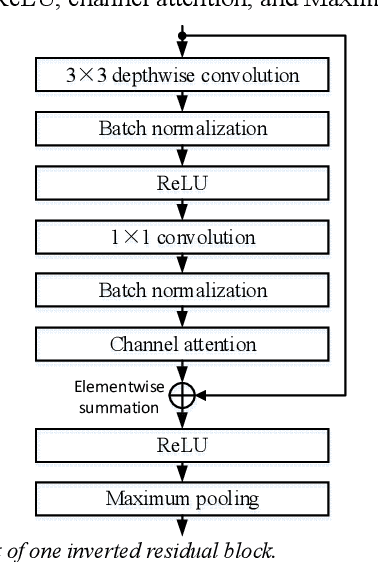
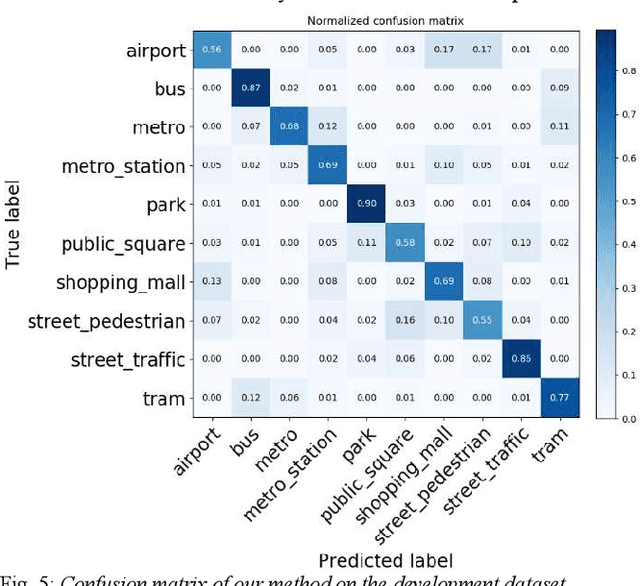
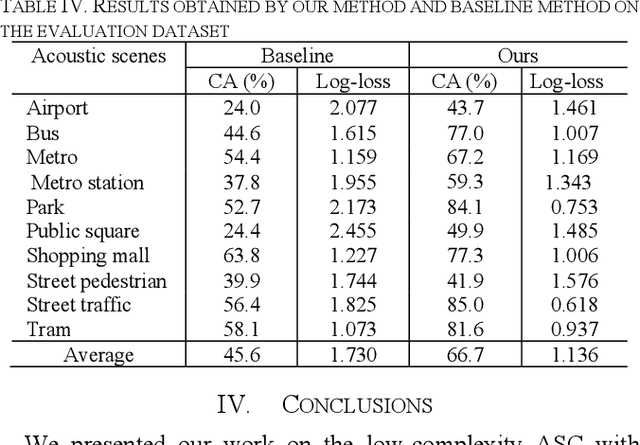
We present a work on low-complexity acoustic scene classification (ASC) with multiple devices, namely the subtask A of Task 1 of the DCASE2021 challenge. This subtask focuses on classifying audio samples of multiple devices with a low-complexity model, where two main difficulties need to be overcome. First, the audio samples are recorded by different devices, and there is mismatch of recording devices in audio samples. We reduce the negative impact of the mismatch of recording devices by using some effective strategies, including data augmentation (e.g., mix-up, spectrum correction, pitch shift), usages of multi-patch network structure and channel attention. Second, the model size should be smaller than a threshold (e.g., 128 KB required by the DCASE2021 challenge). To meet this condition, we adopt a ResNet with both depthwise separable convolution and channel attention as the backbone network, and perform model compression. In summary, we propose a low-complexity ASC method using data augmentation and a lightweight ResNet. Evaluated on the official development and evaluation datasets, our method obtains classification accuracy scores of 71.6% and 66.7%, respectively; and obtains Log-loss scores of 1.038 and 1.136, respectively. Our final model size is 110.3 KB which is smaller than the maximum of 128 KB.