 Add to Chrome
 Add to Firefox
 Add to Edge
DCVC-MB: Neural B-Frame Video Compression using State Space Models
Jul 15, 2026
In this paper we propose DCVC-Mamba (DCVC-MB), a neural video codec framework for B-frame coding. Our approach incorporates an IBP frame strategy for low-delay B-frame coding, a spatio-temporal fusion model based on state-space models for bidirectional temporal prediction, and an entropy-aware skipping mechanism that selectively omits coding certain latents to reduce entropy coding times. In addition to our model contributions we also implement two inference-time strategies that enhance compression performance. Experimental evaluation shows that DCVC-MB compares favorably to existing NVCs and traditional codecs. The method demonstrates BD-rate reductions of up to $8.98\%$ on average compared to prior neural video codecs, and improvements of up to $30.45\%$ and $1.81\%$ over the VTM-19.0-LDP and VTM-19.0-RA(Inter-GoP=16) benchmarks, respectively, contributing to advances in neural video compression.

Standardizing Generative Face Video Compression using Supplemental Enhancement Information
Oct 19, 2024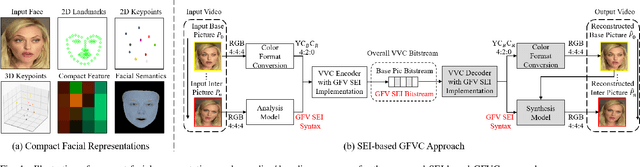
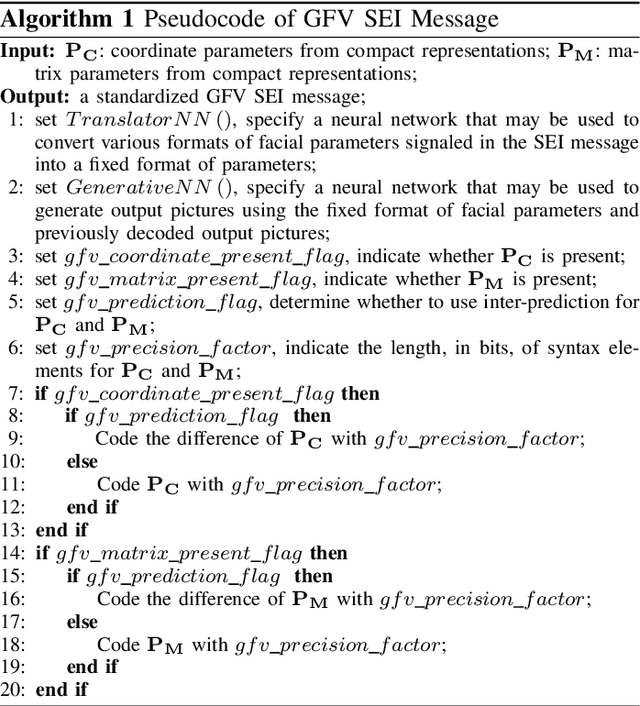
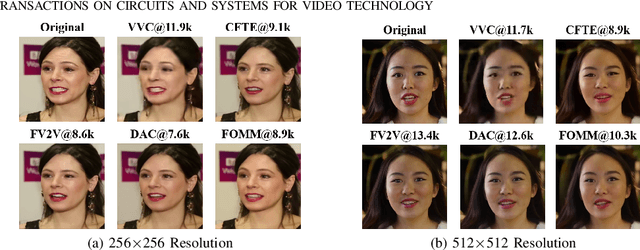
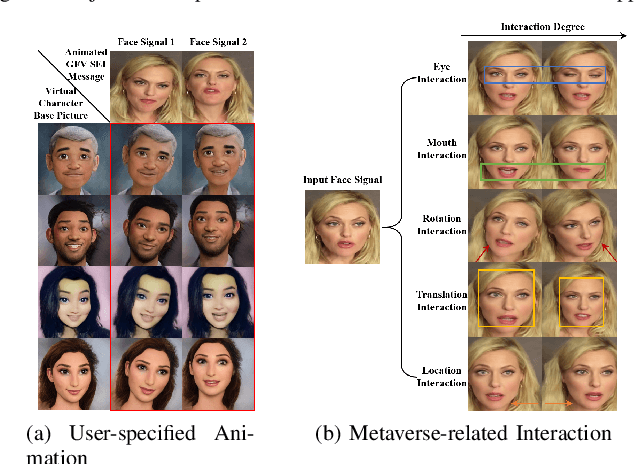
This paper proposes a Generative Face Video Compression (GFVC) approach using Supplemental Enhancement Information (SEI), where a series of compact spatial and temporal representations of a face video signal (i.e., 2D/3D key-points, facial semantics and compact features) can be coded using SEI message and inserted into the coded video bitstream. At the time of writing, the proposed GFVC approach is an official "technology under consideration" (TuC) for standardization by the Joint Video Experts Team (JVET) of ISO/IEC JVT 1/SC 29 and ITU-T SG16. To the best of the authors' knowledge, the JVET work on the proposed SEI-based GFVC approach is the first standardization activity for generative video compression. The proposed SEI approach has not only advanced the reconstruction quality of early-day Model-Based Coding (MBC) via the state-of-the-art generative technique, but also established a new SEI definition for future GFVC applications and deployment. Experimental results illustrate that the proposed SEI-based GFVC approach can achieve remarkable rate-distortion performance compared with the latest Versatile Video Coding (VVC) standard, whilst also potentially enabling a wide variety of functionalities including user-specified animation/filtering and metaverse-related applications.