 Add to Chrome
 Add to Firefox
 Add to Edge
Layered Risk Mapping for Autonomous Patient Transport in Expeditionary Medical Facilities
Jul 15, 2026
In expeditionary medical facilities, routine patient transport imposes a compounding burden of personal protective equipment consumption, staff diversion, and elevated infection risk that becomes unsustainable under surge conditions. While autonomous wheelchairs could absorb this operational load, the safety-critical nature of patient transit within these highly unstructured and dynamic environments poses complex navigational challenges. To address this, we present a layered risk mapping framework that fuses four heterogeneous environmental hazards (terrain slope, static and dynamic obstacles, and semantic traversability) into a unified probabilistic cost surface via a Noisy-OR fusion model. In a paired Monte-Carlo evaluation, risk-informed fusion reduces collision rates from over 73% to under 32% and more than doubles obstacle clearance relative to a risk-unaware baseline. Additionaly, Noisy-OR achieves the highest clearance to obstacles and the lowest conditional peak risk across all tested hazard densities. We further validate the framework on a commercial powered wheelchair across three representative mission profiles in indoor and outdoor deployments, demonstrating that this architecture successfully meets the planning requirements of this previously unaddressed operational regime.

Socially-Aware Autonomous Doorway Traversal and Payload Delivery for Emergency Assistance
Jul 06, 2026In this work, we focus on the scenario of a robot-assisted emergency evacuation. We consider two capabilities relevant to such a setting. The first is opening doors ahead of the people being evacuated, so that their path toward an exit stays clear. The second is retrieving rescue equipment and delivering it to the emergency responders carrying out the evacuation. From a systems perspective, this involves several tasks at once. The robot must locate ADA-compliant door buttons and the rescue equipment it needs to retrieve. Additionally, it must remain aware of the people around it and adapt its behavior to them, so that it supports the evacuation rather than getting in the way. We address these demands with a behavior tree at the core of our framework. This structure is chosen for its ability to select high-level tasks based on environmental triggers, and to extend to new situations as they arise. We evaluate the system in 105 trials on the Toyota Human Support Robot, across five hardware and three simulation scenarios. These trials capture the decisions the robot must make in this setting: whether to press a door button, yield to a nearby person, walk through a door someone else is holding, or first retrieve rescue equipment before traversing the door. Overall, the system completes 97 of the 105 trials successfully. These results suggest our framework provides a practical basis for robotic assistance in broader emergency response tasks. Code and video demonstrations are available at https://github.com/AndrewSnowdy/hsr_mm_control.
Human-in-the-Loop Failure Recovery with Adaptive Task Allocation
Feb 03, 2026Since the recent Covid-19 pandemic, mobile manipulators and humanoid assistive robots with higher levels of autonomy have increasingly been adopted for patient care and living assistance. Despite advancements in autonomy, these robots often struggle to perform reliably in dynamic and unstructured environments and require human intervention to recover from failures. Effective human-robot collaboration is essential to enable robots to receive assistance from the most competent operator, in order to reduce their workload and minimize disruptions in task execution. In this paper, we propose an adaptive method for allocating robotic failures to human operators (ARFA). Our proposed approach models the capabilities of human operators, and continuously updates these beliefs based on their actual performance for failure recovery. For every failure to be resolved, a reward function calculates expected outcomes based on operator capabilities and historical data, task urgency, and current workload distribution. The failure is then assigned to the operator with the highest expected reward. Our simulations and user studies show that ARFA outperforms random allocation, significantly reducing robot idle time, improving overall system performance, and leading to a more distributed workload among operators.
Human-Robot Collaboration for the Remote Control of Mobile Humanoid Robots with Torso-Arm Coordination
May 09, 2025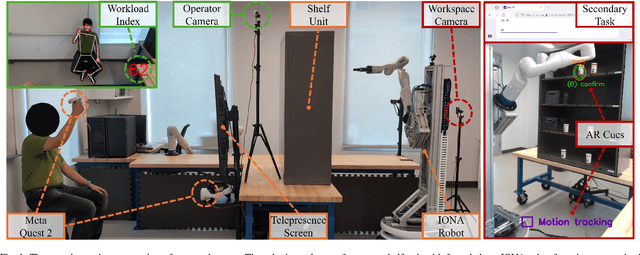
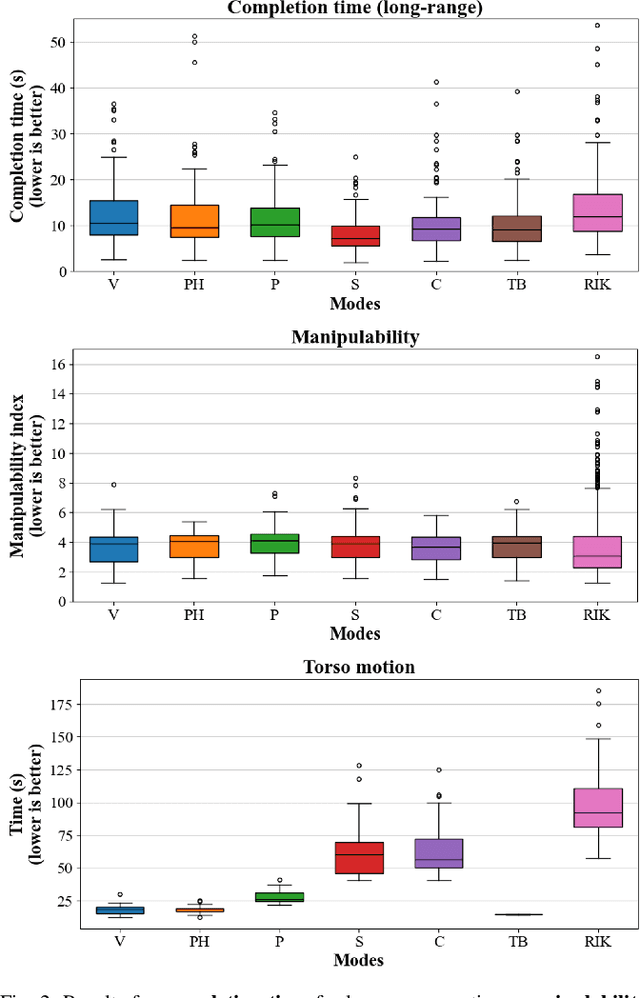
Recently, many humanoid robots have been increasingly deployed in various facilities, including hospitals and assisted living environments, where they are often remotely controlled by human operators. Their kinematic redundancy enhances reachability and manipulability, enabling them to navigate complex, cluttered environments and perform a wide range of tasks. However, this redundancy also presents significant control challenges, particularly in coordinating the movements of the robot's macro-micro structure (torso and arms). Therefore, we propose various human-robot collaborative (HRC) methods for coordinating the torso and arm of remotely controlled mobile humanoid robots, aiming to balance autonomy and human input to enhance system efficiency and task execution. The proposed methods include human-initiated approaches, where users manually control torso movements, and robot-initiated approaches, which autonomously coordinate torso and arm based on factors such as reachability, task goal, or inferred human intent. We conducted a user study with N=17 participants to compare the proposed approaches in terms of task performance, manipulability, and energy efficiency, and analyzed which methods were preferred by participants.