 Add to Chrome
 Add to Firefox
 Add to Edge
ZOMP: Zeroth-Order Multi-Modal Prompt Tuning for Vision-Language Models
Aug 08, 2026
Fine-tuning vision-language models such as CLIP typically requires backpropagation (BP) through the full model, which is infeasible when only forward-pass access is available, as is common for memory-constrained edge devices and proprietary model deployments. Prior BP-free, zeroth-order prompt-tuning methods avoid this requirement but often tune prompts in a single modality or optimize over a search space large enough that convergence requires thousands of forward passes, which is impractical under realistic query budgets. We propose ZOMP (Zeroth-Order Multimodal Prompt tuning), a query-efficient, fully forward-only method that tunes deep prompts in both the vision and text branches of a frozen CLIP model using simultaneous perturbation stochastic approximation. ZOMP combines three ingredients: a cross-modal low-rank reparameterization that ties the two branches through a shared factor and keeps the effective search dimensionality small, a gradient-correction momentum term that stabilizes the noisy zeroth-order estimate, and a budget-indexed rank schedule that unlocks capacity as the query budget is spent. Across 13 vision-language benchmarks under a matched 5,000-query budget, ZOMP consistently outperforms prior BP-free prompt-tuning methods in both few-shot accuracy and query efficiency, and it generalizes better across base-to-new, cross-dataset transfer, and out-of-distribution settings. Our results show that jointly exploiting multimodality and low-rank structure is an effective route to practical, query-efficient BP-free prompt tuning.

Can MLLMs Critique Like Humans? Evaluating Open-Ended Aesthetic Reasoning in Multimodal Large Language Models
Jun 29, 2026Open-ended aesthetic critique is a challenge for multimodal large language models (MLLMs): unlike multiple-choice aesthetic benchmarks, it has no single correct answer, and most aesthetic evaluation has measured models against numeric scores rather than the written critiques people actually give. We evaluate MLLM critiques against ranked human references and ask whether they are close to human ones. Using the Reddit Photo Critique Dataset, we score five open-weight MLLMs against multiple ranked human critiques per photo with reference-based similarity metrics, under six prompt conditions that disentangle persona framing, aspect hinting, length control, and single- versus multi-pass generation, and add an image-grounding control that feeds each model the wrong photograph. We find that reference-based similarity gives a misleading picture. Stricter lexical and learned metrics show only weak alignment with human critiques, while a coarse embedding cosine reports broad topical overlap that the grounding control traces to a stable house style rather than image-specific observation. Behaviorally, the models diverge from humans in consistent ways the scores do not surface: even under a length cap they write two to three times as much, cover nearly every aesthetic aspect where humans are selective, engage each aspect more uniformly and at greater depth, and repeat themselves across critiques of the same photo where humans vary. We argue that reference-based similarity rewards a fluent, comprehensive critique style rather than the selectivity and specificity of human critique, and discuss implications for evaluating and training open-ended multimodal generation.
Near-Optimal Regret for the Safe Learning-based Control of the Constrained Linear Quadratic Regulator
Apr 24, 2026We study the problem of adaptive control of the stochastic linear quadratic regulator (LQR) with constraints that must be satisfied at every time step. Prior work on the multidimensional problem has shown $\tilde{O}(T^{2/3})$ regret and satisfaction of robust constraints, leaving open the question of whether $\tilde{O}(\sqrt{T})$ regret can be attained in the constrained LQR setting. We contribute to this problem by showing $\tilde{O}(\sqrt{T})$ regret and satisfaction of chance constraints. This type of constraints allow us to handle unbounded noise and also enable analytical techniques not directly applicable to robust constraints. Our proposed algorithm for this problem uses an SDP to select an optimistic policy, and then "scales back" this policy until it is verifiably-safe. Our theoretical analysis establishes regret and constraint guarantees via a key lemma that bounds the system covariance in terms of the chosen policy. This covariance-based analysis is in contrast with the cost-to-go based analysis that is typically used in adaptive LQR.
MMLoP: Multi-Modal Low-Rank Prompting for Efficient Vision-Language Adaptation
Feb 24, 2026Prompt learning has become a dominant paradigm for adapting vision-language models (VLMs) such as CLIP to downstream tasks without modifying pretrained weights. While extending prompts to both vision and text encoders across multiple transformer layers significantly boosts performance, it dramatically increases the number of trainable parameters, with state-of-the-art methods requiring millions of parameters and abandoning the parameter efficiency that makes prompt tuning attractive. In this work, we propose \textbf{MMLoP} (\textbf{M}ulti-\textbf{M}odal \textbf{Lo}w-Rank \textbf{P}rompting), a framework that achieves deep multi-modal prompting with only \textbf{11.5K trainable parameters}, comparable to early text-only methods like CoOp. MMLoP parameterizes vision and text prompts at each transformer layer through a low-rank factorization, which serves as an implicit regularizer against overfitting on few-shot training data. To further close the accuracy gap with state-of-the-art methods, we introduce three complementary components: a self-regulating consistency loss that anchors prompted representations to frozen zero-shot CLIP features at both the feature and logit levels, a uniform drift correction that removes the global embedding shift induced by prompt tuning to preserve class-discriminative structure, and a shared up-projection that couples vision and text prompts through a common low-rank factor to enforce cross-modal alignment. Extensive experiments across three benchmarks and 11 diverse datasets demonstrate that MMLoP achieves a highly favorable accuracy-efficiency tradeoff, outperforming the majority of existing methods including those with orders of magnitude more parameters, while achieving a harmonic mean of 79.70\% on base-to-novel generalization.
Stochastic Gradient Descent with Strategic Querying
Aug 23, 2025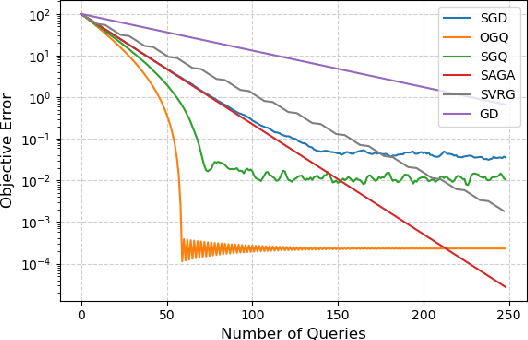
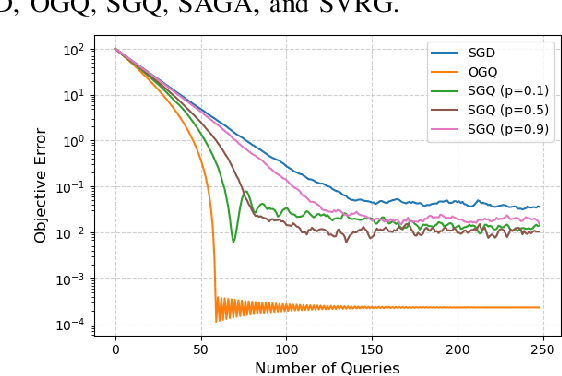
This paper considers a finite-sum optimization problem under first-order queries and investigates the benefits of strategic querying on stochastic gradient-based methods compared to uniform querying strategy. We first introduce Oracle Gradient Querying (OGQ), an idealized algorithm that selects one user's gradient yielding the largest possible expected improvement (EI) at each step. However, OGQ assumes oracle access to the gradients of all users to make such a selection, which is impractical in real-world scenarios. To address this limitation, we propose Strategic Gradient Querying (SGQ), a practical algorithm that has better transient-state performance than SGD while making only one query per iteration. For smooth objective functions satisfying the Polyak-Lojasiewicz condition, we show that under the assumption of EI heterogeneity, OGQ enhances transient-state performance and reduces steady-state variance, while SGQ improves transient-state performance over SGD. Our numerical experiments validate our theoretical findings.
Few-Shot Adversarial Low-Rank Fine-Tuning of Vision-Language Models
May 21, 2025Vision-Language Models (VLMs) such as CLIP have shown remarkable performance in cross-modal tasks through large-scale contrastive pre-training. To adapt these large transformer-based models efficiently for downstream tasks, Parameter-Efficient Fine-Tuning (PEFT) techniques like LoRA have emerged as scalable alternatives to full fine-tuning, especially in few-shot scenarios. However, like traditional deep neural networks, VLMs are highly vulnerable to adversarial attacks, where imperceptible perturbations can significantly degrade model performance. Adversarial training remains the most effective strategy for improving model robustness in PEFT. In this work, we propose AdvCLIP-LoRA, the first algorithm designed to enhance the adversarial robustness of CLIP models fine-tuned with LoRA in few-shot settings. Our method formulates adversarial fine-tuning as a minimax optimization problem and provides theoretical guarantees for convergence under smoothness and nonconvex-strong-concavity assumptions. Empirical results across eight datasets using ViT-B/16 and ViT-B/32 models show that AdvCLIP-LoRA significantly improves robustness against common adversarial attacks (e.g., FGSM, PGD), without sacrificing much clean accuracy. These findings highlight AdvCLIP-LoRA as a practical and theoretically grounded approach for robust adaptation of VLMs in resource-constrained settings.
The Safety-Privacy Tradeoff in Linear Bandits
Apr 23, 2025We consider a collection of linear stochastic bandit problems, each modeling the random response of different agents to proposed interventions, coupled together by a global safety constraint. We assume a central coordinator must choose actions to play on each bandit with the objective of regret minimization, while also ensuring that the expected response of all agents satisfies the global safety constraints at each round, in spite of uncertainty about the bandits' parameters. The agents consider their observed responses to be private and in order to protect their sensitive information, the data sharing with the central coordinator is performed under local differential privacy (LDP). However, providing higher level of privacy to different agents would have consequences in terms of safety and regret. We formalize these tradeoffs by building on the notion of the sharpness of the safety set - a measure of how the geometric properties of the safe set affects the growth of regret - and propose a unilaterally unimprovable vector of privacy levels for different agents given a maximum regret budget.
Constrained Online Convex Optimization with Polyak Feasibility Steps
Feb 18, 2025In this work, we study online convex optimization with a fixed constraint function $g : \mathbb{R}^d \rightarrow \mathbb{R}$. Prior work on this problem has shown $O(\sqrt{T})$ regret and cumulative constraint satisfaction $\sum_{t=1}^{T} g(x_t) \leq 0$, while only accessing the constraint value and subgradient at the played actions $g(x_t), \partial g(x_t)$. Using the same constraint information, we show a stronger guarantee of anytime constraint satisfaction $g(x_t) \leq 0 \ \forall t \in [T]$, and matching $O(\sqrt{T})$ regret guarantees. These contributions are thanks to our approach of using Polyak feasibility steps to ensure constraint satisfaction, without sacrificing regret. Specifically, after each step of online gradient descent, our algorithm applies a subgradient descent step on the constraint function where the step-size is chosen according to the celebrated Polyak step-size. We further validate this approach with numerical experiments.
Decentralized Low-Rank Fine-Tuning of Large Language Models
Jan 26, 2025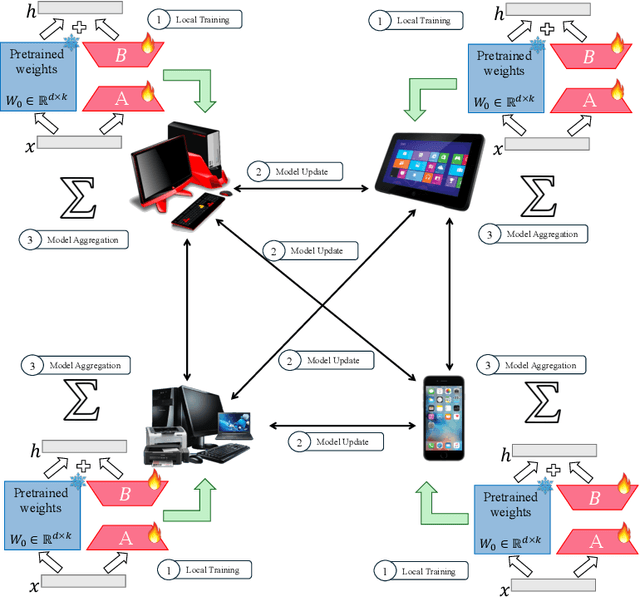

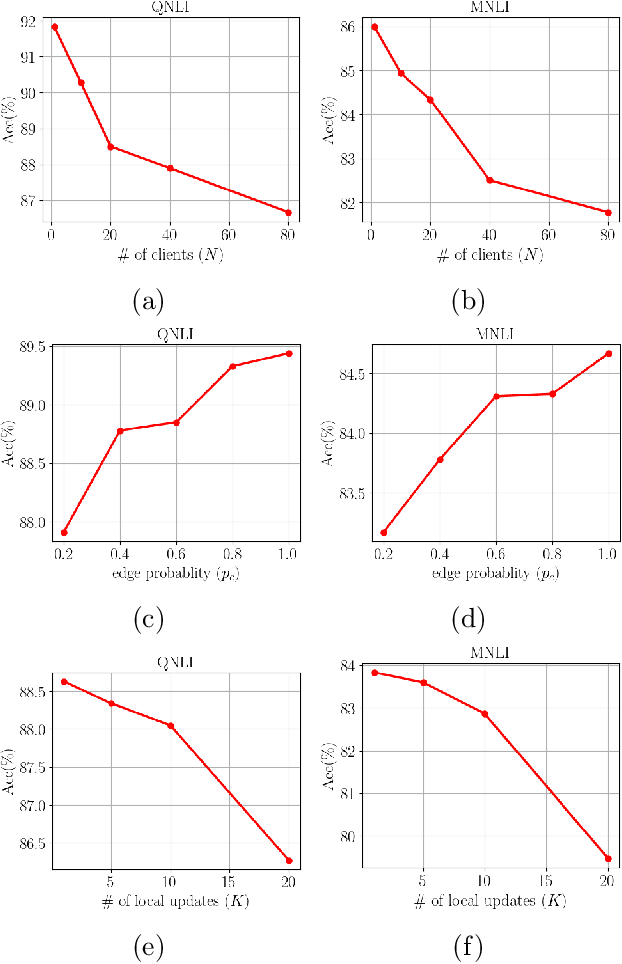

The emergence of Large Language Models (LLMs) such as GPT-4, LLaMA, and BERT has transformed artificial intelligence, enabling advanced capabilities across diverse applications. While parameter-efficient fine-tuning (PEFT) techniques like LoRA offer computationally efficient adaptations of these models, their practical deployment often assumes centralized data and training environments. However, real-world scenarios frequently involve distributed, privacy-sensitive datasets that require decentralized solutions. Federated learning (FL) addresses data privacy by coordinating model updates across clients, but it is typically based on centralized aggregation through a parameter server, which can introduce bottlenecks and communication constraints. Decentralized learning, in contrast, eliminates this dependency by enabling direct collaboration between clients, improving scalability and efficiency in distributed environments. Despite its advantages, decentralized LLM fine-tuning remains underexplored. In this work, we propose \texttt{Dec-LoRA}, an algorithm for decentralized fine-tuning of LLMs based on low-rank adaptation (LoRA). Through extensive experiments on BERT and LLaMA-2 models, we evaluate \texttt{Dec-LoRA}'s performance in handling data heterogeneity and quantization constraints, enabling scalable, privacy-preserving LLM fine-tuning in decentralized settings.
Communication-Efficient and Tensorized Federated Fine-Tuning of Large Language Models
Oct 16, 2024Parameter-efficient fine-tuning (PEFT) methods typically assume that Large Language Models (LLMs) are trained on data from a single device or client. However, real-world scenarios often require fine-tuning these models on private data distributed across multiple devices. Federated Learning (FL) offers an appealing solution by preserving user privacy, as sensitive data remains on local devices during training. Nonetheless, integrating PEFT methods into FL introduces two main challenges: communication overhead and data heterogeneity. In this paper, we introduce FedTT and FedTT+, methods for adapting LLMs by integrating tensorized adapters into client-side models' encoder/decoder blocks. FedTT is versatile and can be applied to both cross-silo FL and large-scale cross-device FL. FedTT+, an extension of FedTT tailored for cross-silo FL, enhances robustness against data heterogeneity by adaptively freezing portions of tensor factors, further reducing the number of trainable parameters. Experiments on BERT and LLaMA models demonstrate that our proposed methods successfully address data heterogeneity challenges and perform on par or even better than existing federated PEFT approaches while achieving up to 10$\times$ reduction in communication cost.