 Add to Chrome
 Add to Firefox
 Add to Edge
SEGRA: Structured Experience-Guided Graph Reasoning Agent for Gremlin Based Question Answering
Jul 21, 2026
Enterprise IT support knowledge graphs capture rich relationships among cases, users, devices, symptoms, taxonomic categories, root causes, and historical resolutions. Yet querying them in Gremlin requires knowledge of graph schemas, traversal semantics, edge directionality, and property-graph-specific constraints, making them difficult for non-expert operators to use. We introduce SEGRA, an experience-guided agent for enterprise text-to-Gremlin question answering. SEGRA integrates intent routing, schema- and taxonomy-grounded query generation, multi-shot decomposition, execution-aware verification, and a curriculum-bootstrapped skill library that reuses verified query patterns. On an enterprise IT support benchmark, SEGRA achieves a $7.0\times$ higher mean judge score than backbone-only chain-of-thought prompting. Its skill library further reduces LLM calls by $20\%$ and dollar cost by $18\%$ relative to SEGRA without skills, while preserving answer quality. These results show that schema-grounded agent design and reusable execution experience improve both accuracy and efficiency for enterprise graph QA.

ReDiTT: Retrieval Augmented Conditional Diffusion Transformers for Asynchronous Time Series
Jul 14, 2026We present a diffusion based model for asynchronous time series prediction, where the goal is to predict the next inter event time and event type. To address the inherent uncertainty of future events, we introduce ReDiTT, a retrieval augmented conditional diffusion transformer that operates in latent space. ReDiTT retrieves structurally similar latent sequences from a memory bank during both training and inference and incorporates them as reference conditions through cross attention. This retrieval based conditioning allows the model to attend to relevant temporal dynamics and provides global structural guidance for generation. As a result, ReDiTT stabilizes long horizon forecasting and improves sample diversity. Experiments on seven real world datasets demonstrate state of the art performance on next event prediction and long horizon forecasting. Our code is available at https://github.com/BorealisAI/ReDiTT.
Adaptive Randomized Smoothing: Certifying Multi-Step Defences against Adversarial Examples
Jun 14, 2024


We propose Adaptive Randomized Smoothing (ARS) to certify the predictions of our test-time adaptive models against adversarial examples. ARS extends the analysis of randomized smoothing using f-Differential Privacy to certify the adaptive composition of multiple steps. For the first time, our theory covers the sound adaptive composition of general and high-dimensional functions of noisy input. We instantiate ARS on deep image classification to certify predictions against adversarial examples of bounded $L_{\infty}$ norm. In the $L_{\infty}$ threat model, our flexibility enables adaptation through high-dimensional input-dependent masking. We design adaptivity benchmarks, based on CIFAR-10 and CelebA, and show that ARS improves accuracy by $2$ to $5\%$ points. On ImageNet, ARS improves accuracy by $1$ to $3\%$ points over standard RS without adaptivity.
Differentially Private Latent Diffusion Models
May 25, 2023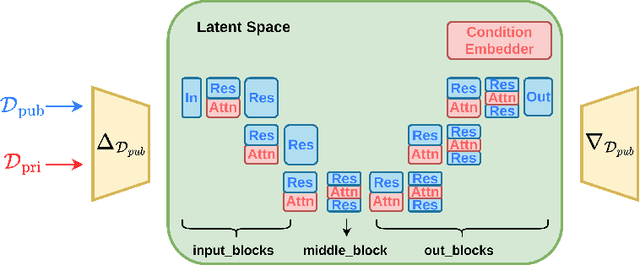
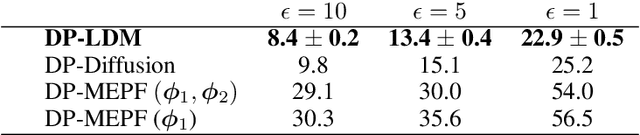
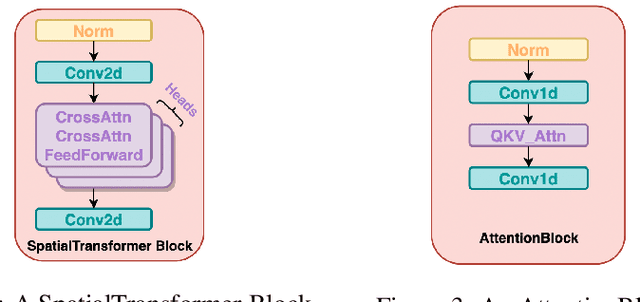
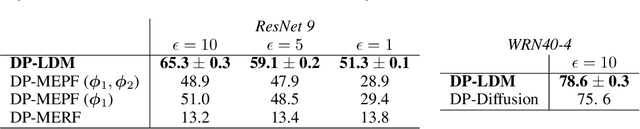
Diffusion models (DMs) are widely used for generating high-quality image datasets. However, since they operate directly in the high-dimensional pixel space, optimization of DMs is computationally expensive, requiring long training times. This contributes to large amounts of noise being injected into the differentially private learning process, due to the composability property of differential privacy. To address this challenge, we propose training Latent Diffusion Models (LDMs) with differential privacy. LDMs use powerful pre-trained autoencoders to reduce the high-dimensional pixel space to a much lower-dimensional latent space, making training DMs more efficient and fast. Unlike [Ghalebikesabi et al., 2023] that pre-trains DMs with public data then fine-tunes them with private data, we fine-tune only the attention modules of LDMs at varying layers with privacy-sensitive data, reducing the number of trainable parameters by approximately 96% compared to fine-tuning the entire DM. We test our algorithm on several public-private data pairs, such as ImageNet as public data and CIFAR10 and CelebA as private data, and SVHN as public data and MNIST as private data. Our approach provides a promising direction for training more powerful, yet training-efficient differentially private DMs that can produce high-quality synthetic images.