 Add to Chrome
 Add to Firefox
 Add to Edge
SEGRA: Structured Experience-Guided Graph Reasoning Agent for Gremlin Based Question Answering
Jul 21, 2026
Enterprise IT support knowledge graphs capture rich relationships among cases, users, devices, symptoms, taxonomic categories, root causes, and historical resolutions. Yet querying them in Gremlin requires knowledge of graph schemas, traversal semantics, edge directionality, and property-graph-specific constraints, making them difficult for non-expert operators to use. We introduce SEGRA, an experience-guided agent for enterprise text-to-Gremlin question answering. SEGRA integrates intent routing, schema- and taxonomy-grounded query generation, multi-shot decomposition, execution-aware verification, and a curriculum-bootstrapped skill library that reuses verified query patterns. On an enterprise IT support benchmark, SEGRA achieves a $7.0\times$ higher mean judge score than backbone-only chain-of-thought prompting. Its skill library further reduces LLM calls by $20\%$ and dollar cost by $18\%$ relative to SEGRA without skills, while preserving answer quality. These results show that schema-grounded agent design and reusable execution experience improve both accuracy and efficiency for enterprise graph QA.

DQA: Diagnostic Question Answering for IT Support
Apr 07, 2026Enterprise IT support interactions are fundamentally diagnostic: effective resolution requires iterative evidence gathering from ambiguous user reports to identify an underlying root cause. While retrieval-augmented generation (RAG) provides grounding through historical cases, standard multi-turn RAG systems lack explicit diagnostic state and therefore struggle to accumulate evidence and resolve competing hypotheses across turns. We introduce DQA, a diagnostic question-answering framework that maintains persistent diagnostic state and aggregates retrieved cases at the level of root causes rather than individual documents. DQA combines conversational query rewriting, retrieval aggregation, and state-conditioned response generation to support systematic troubleshooting under enterprise latency and context constraints. We evaluate DQA on 150 anonymized enterprise IT support scenarios using a replay-based protocol. Averaged over three independent runs, DQA achieves a 78.7% success rate under a trajectory-level success criterion, compared to 41.3% for a multi-turn RAG baseline, while reducing average turns from 8.4 to 3.9.
VIGIL: Towards Edge-Extended Agentic AI for Enterprise IT Support
Mar 17, 2026Enterprise IT support is constrained by heterogeneous devices, evolving policies, and long-tail failure modes that are difficult to resolve centrally. We present VIGIL, an edge-extended agentic AI system that deploys desktop-resident agents to perform situated diagnosis, retrieval over enterprise knowledge, and policy-governed remediation directly on user devices with explicit consent and end-to-end observability. In a 10-week pilot of VIGIL's operational loop on 100 resource-constrained endpoints, VIGIL reduces interaction rounds by 39%, achieves at least 4 times faster diagnosis, and supports self-service resolution in 82% of matched cases. Users report excellent usability, high trust, and low cognitive workload across four validated instruments, with qualitative feedback highlighting transparency as critical for trust. Notably, users rated the system higher when no historical matches were available, suggesting on-device diagnosis provides value independent of knowledge base coverage. This pilot establishes safety and observability foundations for fleet-wide continuous improvement.
Learning Combinatorial Optimization on Graphs: A Survey with Applications to Networking
May 22, 2020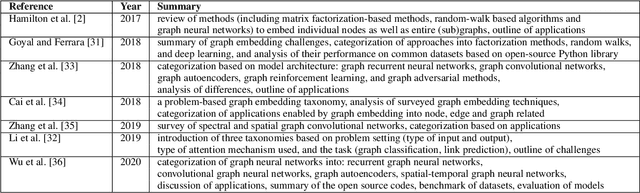
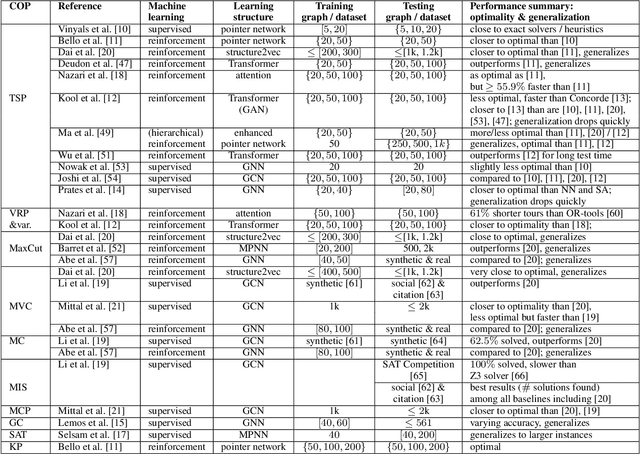
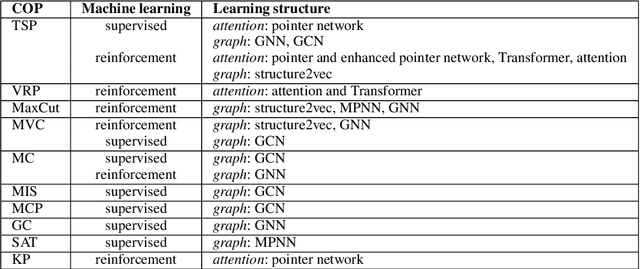

Existing approaches to solving combinatorial optimization problems on graphs suffer from the need to engineer each problem algorithmically, with practical problems recurring in many instances. The practical side of theoretical computer science, such as computational complexity then needs to be addressed. Relevant developments in machine learning research on graphs is surveyed, for this purpose. We organize and compare the structures involved with learning to solve combinatorial optimization problems, with a special eye on the telecommunications domain and its continuous development of live and research networks.