 Add to Chrome
 Add to Firefox
 Add to Edge
Uncertainty Quantification for Flow-Based Vision-Language-Action Models
Jun 16, 2026
Vision-language-action models (VLAs) combine vision-language backbones with expressive generative action heads trained via flow matching on large-scale robotic datasets. Despite their strong empirical performance in robotic manipulation, VLAs lack mechanisms to quantify confidence in their predictions and to detect when their actions may be unreliable. This presents a critical limitation for real-world deployment in non-stationary environments, where models inevitably encounter scenarios outside their pretraining distribution and may fail without warning. To address this, we derive an efficient method for quantifying epistemic uncertainty in flow-matching models by leveraging velocity-field disagreement (VFD) across a small ensemble. We successfully use this uncertainty estimate for failure detection during deployment and active fine-tuning of flow-based VLAs. To this end, we propose SAVE, a framework for uncertainty-guided active multitask fine-tuning that reduces the number of costly expert demonstrations required to adapt VLAs to new tasks. Through extensive experiments on the LIBERO benchmark, we demonstrate that VFD yields better-calibrated uncertainty estimates predictive of downstream performance, that VFD achieves strong performance in detecting failures, and that uncertainty-guided data acquisition with SAVE requires at least 22% fewer samples than baselines. In summary, our work shows that quantifying epistemic uncertainty in flow-based VLAs improves both failure awareness and adaptation. Project website: tum-lsy.github.io/uq_vla/.

MATT-Diff: Multimodal Active Target Tracking by Diffusion Policy
Nov 14, 2025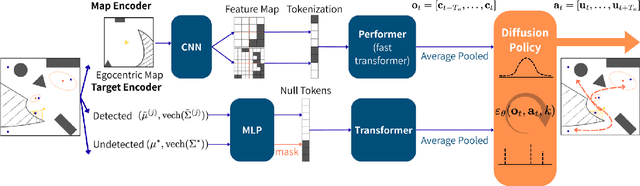
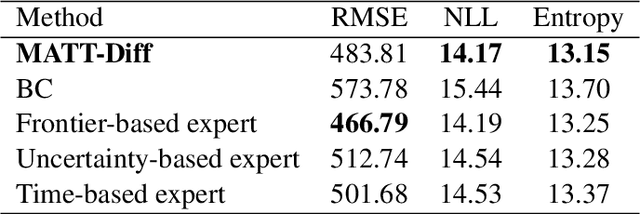
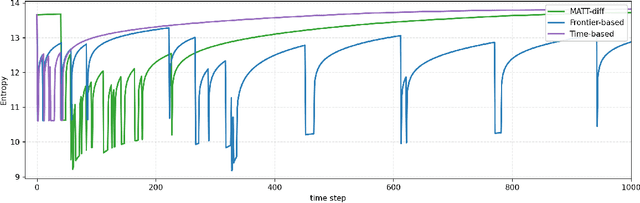
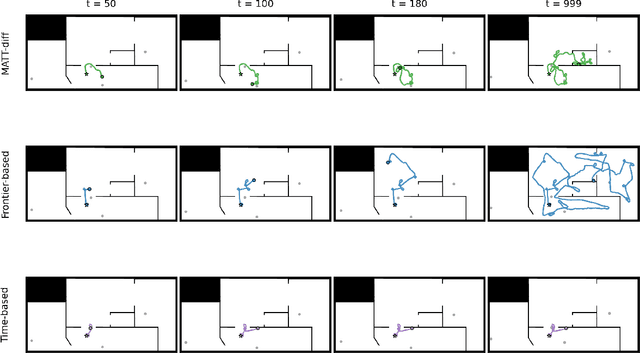
This paper proposes MATT-Diff: Multi-Modal Active Target Tracking by Diffusion Policy, a control policy that captures multiple behavioral modes - exploration, dedicated tracking, and target reacquisition - for active multi-target tracking. The policy enables agent control without prior knowledge of target numbers, states, or dynamics. Effective target tracking demands balancing exploration for undetected or lost targets with following the motion of detected but uncertain ones. We generate a demonstration dataset from three expert planners including frontier-based exploration, an uncertainty-based hybrid planner switching between frontier-based exploration and RRT* tracking based on target uncertainty, and a time-based hybrid planner switching between exploration and tracking based on target detection time. We design a control policy utilizing a vision transformer for egocentric map tokenization and an attention mechanism to integrate variable target estimates represented by Gaussian densities. Trained as a diffusion model, the policy learns to generate multi-modal action sequences through a denoising process. Evaluations demonstrate MATT-Diff's superior tracking performance against expert and behavior cloning baselines across multiple target motions, empirically validating its advantages in target tracking.