 Add to Chrome
 Add to Firefox
 Add to Edge
ELT: Elastic Looped Transformers for Visual Generation
Apr 13, 2026
We introduce Elastic Looped Transformers (ELT), a highly parameter-efficient class of visual generative models based on a recurrent transformer architecture. While conventional generative models rely on deep stacks of unique transformer layers, our approach employs iterative, weight-shared transformer blocks to drastically reduce parameter counts while maintaining high synthesis quality. To effectively train these models for image and video generation, we propose the idea of Intra-Loop Self Distillation (ILSD), where student configurations (intermediate loops) are distilled from the teacher configuration (maximum training loops) to ensure consistency across the model's depth in a single training step. Our framework yields a family of elastic models from a single training run, enabling Any-Time inference capability with dynamic trade-offs between computational cost and generation quality, with the same parameter count. ELT significantly shifts the efficiency frontier for visual synthesis. With $4\times$ reduction in parameter count under iso-inference-compute settings, ELT achieves a competitive FID of $2.0$ on class-conditional ImageNet $256 \times 256$ and FVD of $72.8$ on class-conditional UCF-101.

Design-o-meter: Towards Evaluating and Refining Graphic Designs
Nov 22, 2024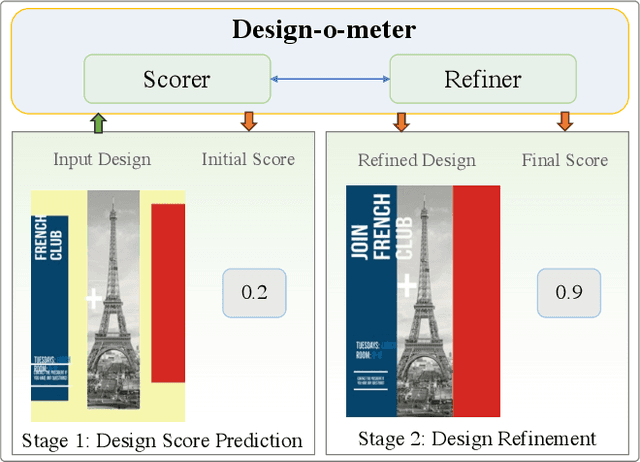
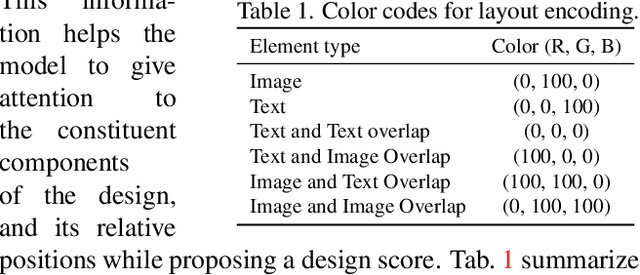

Graphic designs are an effective medium for visual communication. They range from greeting cards to corporate flyers and beyond. Off-late, machine learning techniques are able to generate such designs, which accelerates the rate of content production. An automated way of evaluating their quality becomes critical. Towards this end, we introduce Design-o-meter, a data-driven methodology to quantify the goodness of graphic designs. Further, our approach can suggest modifications to these designs to improve its visual appeal. To the best of our knowledge, Design-o-meter is the first approach that scores and refines designs in a unified framework despite the inherent subjectivity and ambiguity of the setting. Our exhaustive quantitative and qualitative analysis of our approach against baselines adapted for the task (including recent Multimodal LLM-based approaches) brings out the efficacy of our methodology. We hope our work will usher more interest in this important and pragmatic problem setting.
Emotionally Enhanced Talking Face Generation
Mar 26, 2023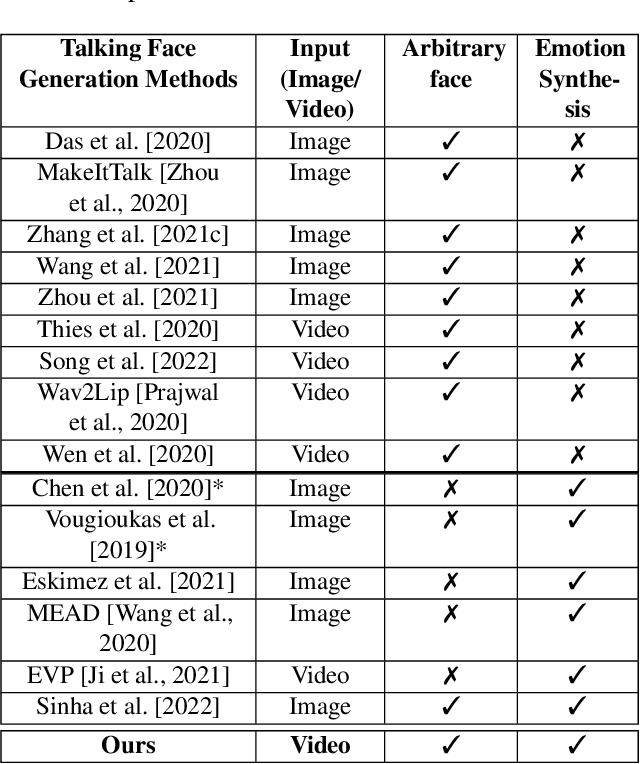
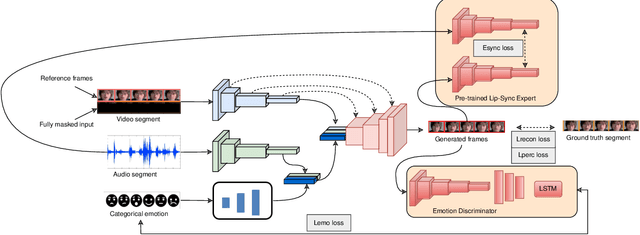
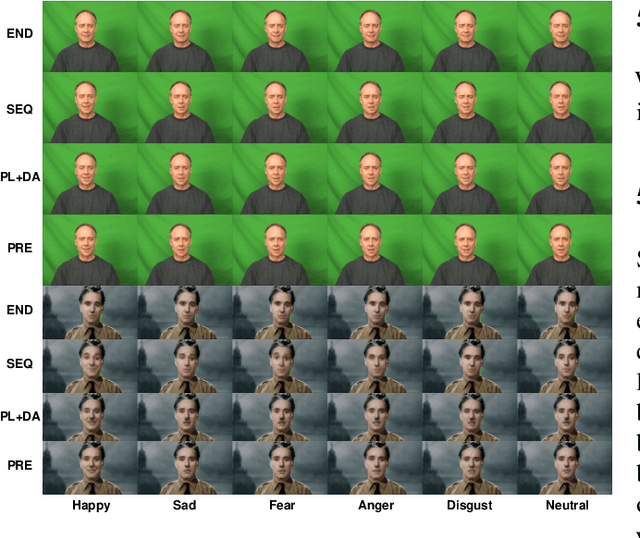
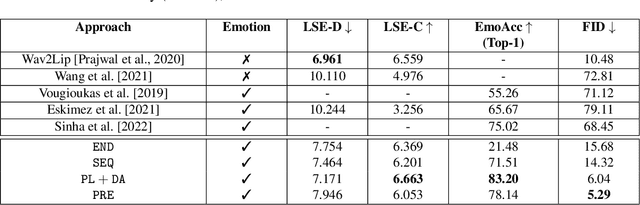
Several works have developed end-to-end pipelines for generating lip-synced talking faces with various real-world applications, such as teaching and language translation in videos. However, these prior works fail to create realistic-looking videos since they focus little on people's expressions and emotions. Moreover, these methods' effectiveness largely depends on the faces in the training dataset, which means they may not perform well on unseen faces. To mitigate this, we build a talking face generation framework conditioned on a categorical emotion to generate videos with appropriate expressions, making them more realistic and convincing. With a broad range of six emotions, i.e., \emph{happiness}, \emph{sadness}, \emph{fear}, \emph{anger}, \emph{disgust}, and \emph{neutral}, we show that our model can adapt to arbitrary identities, emotions, and languages. Our proposed framework is equipped with a user-friendly web interface with a real-time experience for talking face generation with emotions. We also conduct a user study for subjective evaluation of our interface's usability, design, and functionality. Project page: https://midas.iiitd.edu.in/emo/