 Add to Chrome
 Add to Firefox
 Add to Edge
Towards Design Compositing
Apr 16, 2026
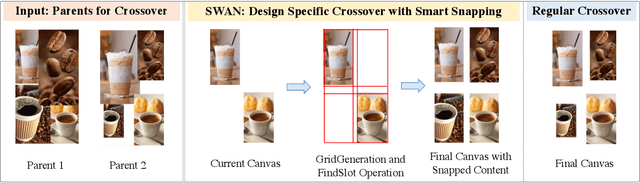
Graphic design creation involves harmoniously assembling multimodal components such as images, text, logos, and other visual assets collected from diverse sources, into a visually-appealing and cohesive design. Recent methods have largely focused on layout prediction or complementary element generation, while retaining input elements exactly, implicitly assuming that provided components are already stylistically harmonious. In practice, inputs often come from disparate sources and exhibit visual mismatch, making this assumption limiting. We argue that identity-preserving stylization and compositing of input elements is a critical missing ingredient for truly harmonized components-to-design pipelines. To this end, we propose GIST, a training-free, identity-preserving image compositor that sits between layout prediction and typography generation, and can be plugged into any existing components-to-design or design-refining pipeline without modification. We demonstrate this by integrating GIST with two substantially different existing methods, LaDeCo and Design-o-meter. GIST shows significant improvements in visual harmony and aesthetic quality across both pipelines, as validated by LLaVA-OV and GPT-4V on aspect-wise ratings and pairwise preference over naive pasting. Project Page: abhinav-mahajan10.github.io/GIST/.

Design-o-meter: Towards Evaluating and Refining Graphic Designs
Nov 22, 2024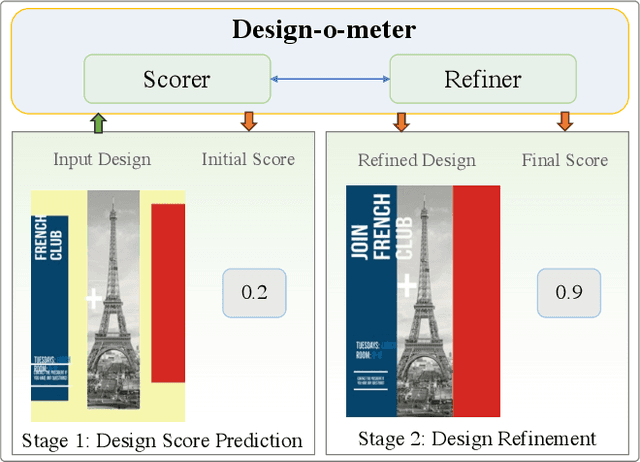
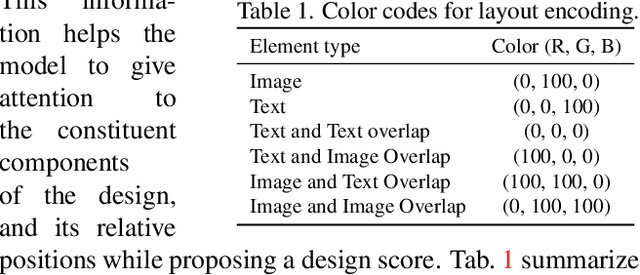

Graphic designs are an effective medium for visual communication. They range from greeting cards to corporate flyers and beyond. Off-late, machine learning techniques are able to generate such designs, which accelerates the rate of content production. An automated way of evaluating their quality becomes critical. Towards this end, we introduce Design-o-meter, a data-driven methodology to quantify the goodness of graphic designs. Further, our approach can suggest modifications to these designs to improve its visual appeal. To the best of our knowledge, Design-o-meter is the first approach that scores and refines designs in a unified framework despite the inherent subjectivity and ambiguity of the setting. Our exhaustive quantitative and qualitative analysis of our approach against baselines adapted for the task (including recent Multimodal LLM-based approaches) brings out the efficacy of our methodology. We hope our work will usher more interest in this important and pragmatic problem setting.