 Add to Chrome
 Add to Firefox
 Add to Edge
Multilingual Idioms in Sentences and Conversations Across High-, Medium-, and Low-Resource Languages
Jun 01, 2026
Idiomatic expressions pose a major challenge for multilingual NLP because their meanings shift between figurative and literal usage, often requiring context for accurate interpretation. Prior work has focused on high-resource languages typically evaluates isolated idiom-meaning questions, overlooking realistic discourse. We introduce MIDI, a multilingual idiom dataset spanning 3 high-, 3 medium-, and 12 low-resource languages, curated by native speakers. Unlike previous datasets, MIDI provides idioms embedded in both sentence-level and conversational contexts, capturing both literal and figurative readings. Benchmarking state-of-the-art models shows that idiom comprehension degrades in low-resource languages and that, in all resource tiers, literal interpretations are substantially harder than figurative ones. Conversational context improves performance but does not eliminate these disparities. Through controlled tests and interventions on hidden representations, we further separate memorization from reasoning, exposing core limitations of current models.

Commonsense Reasoning in Arab Culture
Feb 18, 2025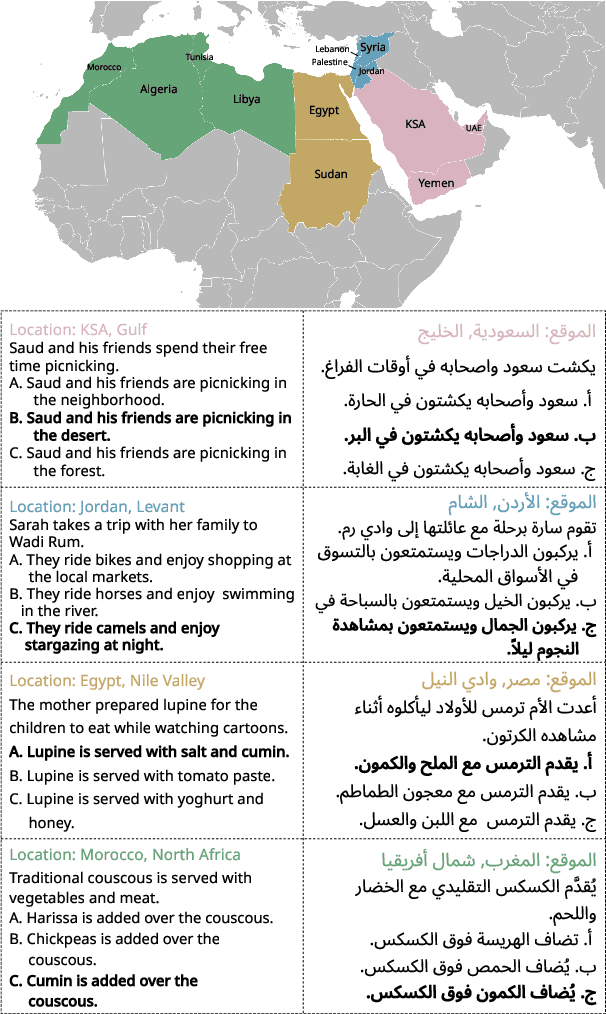
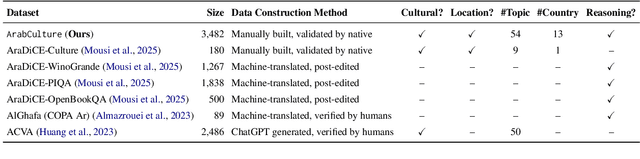
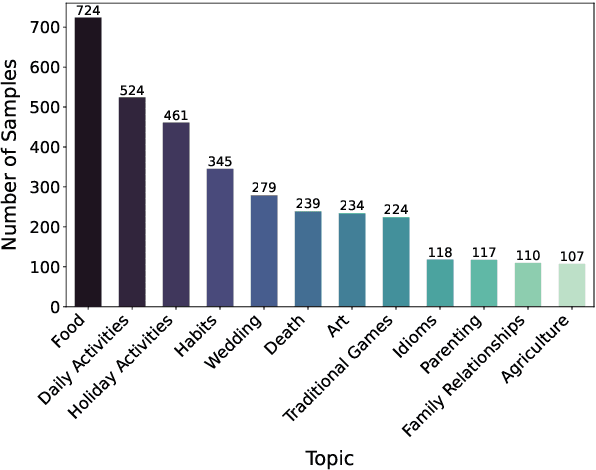
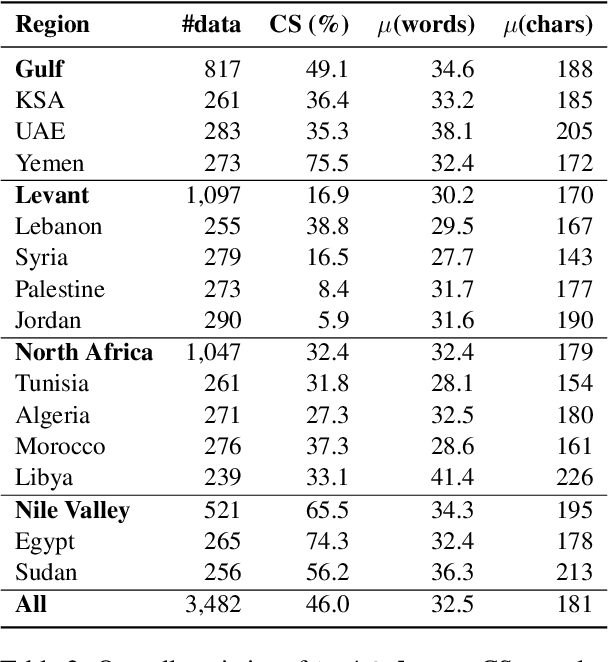
Despite progress in Arabic large language models, such as Jais and AceGPT, their evaluation on commonsense reasoning has largely relied on machine-translated datasets, which lack cultural depth and may introduce Anglocentric biases. Commonsense reasoning is shaped by geographical and cultural contexts, and existing English datasets fail to capture the diversity of the Arab world. To address this, we introduce \datasetname, a commonsense reasoning dataset in Modern Standard Arabic (MSA), covering cultures of 13 countries across the Gulf, Levant, North Africa, and the Nile Valley. The dataset was built from scratch by engaging native speakers to write and validate culturally relevant questions for their respective countries. \datasetname spans 12 daily life domains with 54 fine-grained subtopics, reflecting various aspects of social norms, traditions, and everyday experiences. Zero-shot evaluations show that open-weight language models with up to 32B parameters struggle to comprehend diverse Arab cultures, with performance varying across regions. These findings highlight the need for more culturally aware models and datasets tailored to the Arabic-speaking world.