 Add to Chrome
 Add to Firefox
 Add to Edge
Vision Transformer Adapters for Generalizable Multitask Learning
Aug 23, 2023
We introduce the first multitasking vision transformer adapters that learn generalizable task affinities which can be applied to novel tasks and domains. Integrated into an off-the-shelf vision transformer backbone, our adapters can simultaneously solve multiple dense vision tasks in a parameter-efficient manner, unlike existing multitasking transformers that are parametrically expensive. In contrast to concurrent methods, we do not require retraining or fine-tuning whenever a new task or domain is added. We introduce a task-adapted attention mechanism within our adapter framework that combines gradient-based task similarities with attention-based ones. The learned task affinities generalize to the following settings: zero-shot task transfer, unsupervised domain adaptation, and generalization without fine-tuning to novel domains. We demonstrate that our approach outperforms not only the existing convolutional neural network-based multitasking methods but also the vision transformer-based ones. Our project page is at \url{https://ivrl.github.io/VTAGML}.

Dense Multitask Learning to Reconfigure Comics
Jul 16, 2023In this paper, we develop a MultiTask Learning (MTL) model to achieve dense predictions for comics panels to, in turn, facilitate the transfer of comics from one publication channel to another by assisting authors in the task of reconfiguring their narratives. Our MTL method can successfully identify the semantic units as well as the embedded notion of 3D in comic panels. This is a significantly challenging problem because comics comprise disparate artistic styles, illustrations, layouts, and object scales that depend on the authors creative process. Typically, dense image-based prediction techniques require a large corpus of data. Finding an automated solution for dense prediction in the comics domain, therefore, becomes more difficult with the lack of ground-truth dense annotations for the comics images. To address these challenges, we develop the following solutions: 1) we leverage a commonly-used strategy known as unsupervised image-to-image translation, which allows us to utilize a large corpus of real-world annotations; 2) we utilize the results of the translations to develop our multitasking approach that is based on a vision transformer backbone and a domain transferable attention module; 3) we study the feasibility of integrating our MTL dense-prediction method with an existing retargeting method, thereby reconfiguring comics.
InpaintNeRF360: Text-Guided 3D Inpainting on Unbounded Neural Radiance Fields
May 24, 2023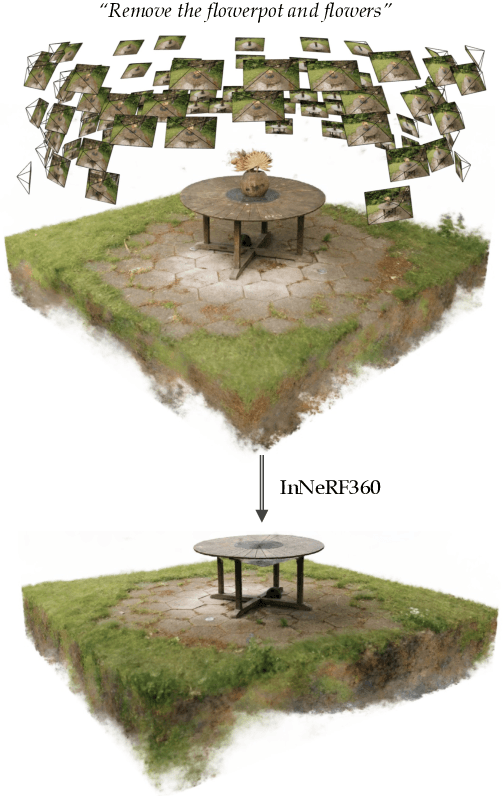
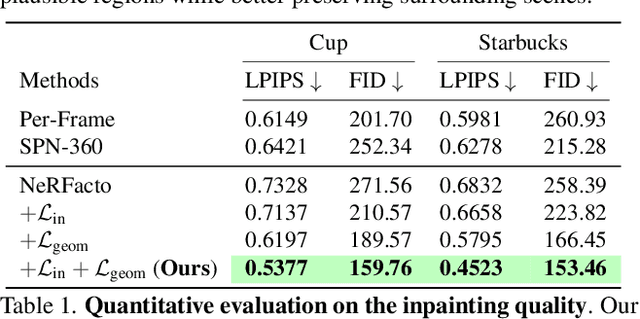
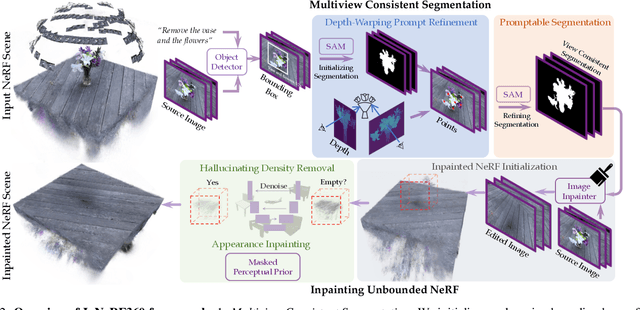
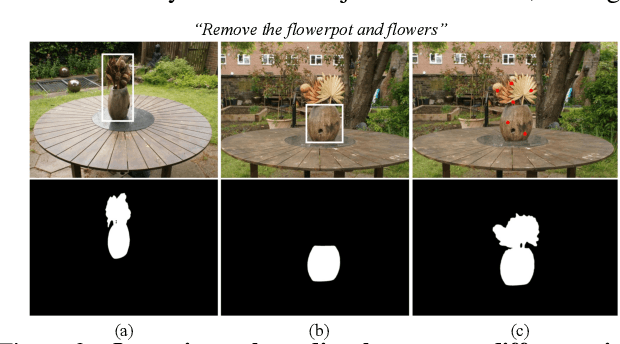
Neural Radiance Fields (NeRF) can generate highly realistic novel views. However, editing 3D scenes represented by NeRF across 360-degree views, particularly removing objects while preserving geometric and photometric consistency, remains a challenging problem due to NeRF's implicit scene representation. In this paper, we propose InpaintNeRF360, a unified framework that utilizes natural language instructions as guidance for inpainting NeRF-based 3D scenes.Our approach employs a promptable segmentation model by generating multi-modal prompts from the encoded text for multiview segmentation. We apply depth-space warping to enforce viewing consistency in the segmentations, and further refine the inpainted NeRF model using perceptual priors to ensure visual plausibility. InpaintNeRF360 is capable of simultaneously removing multiple objects or modifying object appearance based on text instructions while synthesizing 3D viewing-consistent and photo-realistic inpainting. Through extensive experiments on both unbounded and frontal-facing scenes trained through NeRF, we demonstrate the effectiveness of our approach and showcase its potential to enhance the editability of implicit radiance fields.
De-coupling and De-positioning Dense Self-supervised Learning
Mar 29, 2023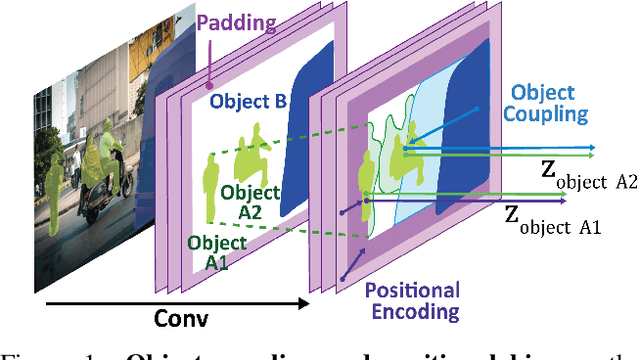


Dense Self-Supervised Learning (SSL) methods address the limitations of using image-level feature representations when handling images with multiple objects. Although the dense features extracted by employing segmentation maps and bounding boxes allow networks to perform SSL for each object, we show that they suffer from coupling and positional bias, which arise from the receptive field increasing with layer depth and zero-padding. We address this by introducing three data augmentation strategies, and leveraging them in (i) a decoupling module that aims to robustify the network to variations in the object's surroundings, and (ii) a de-positioning module that encourages the network to discard positional object information. We demonstrate the benefits of our method on COCO and on a new challenging benchmark, OpenImage-MINI, for object classification, semantic segmentation, and object detection. Our extensive experiments evidence the better generalization of our method compared to the SOTA dense SSL methods
Spatiotemporal Self-supervised Learning for Point Clouds in the Wild
Mar 28, 2023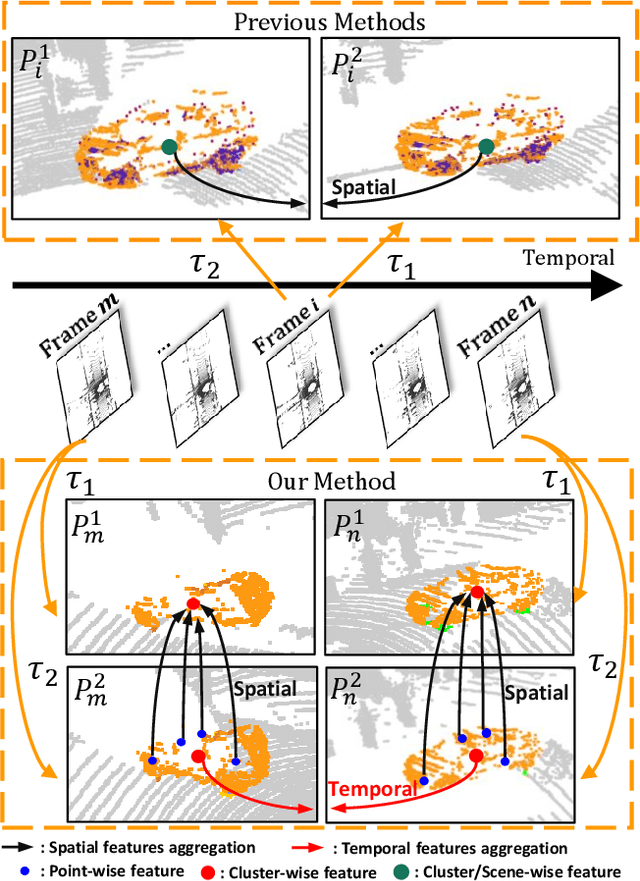
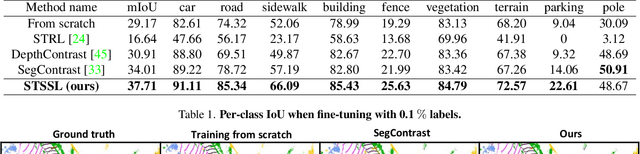
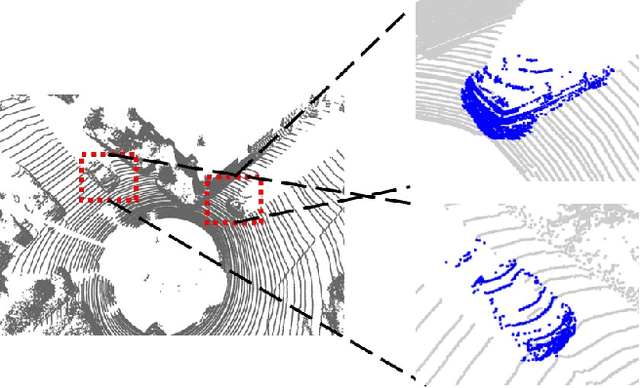
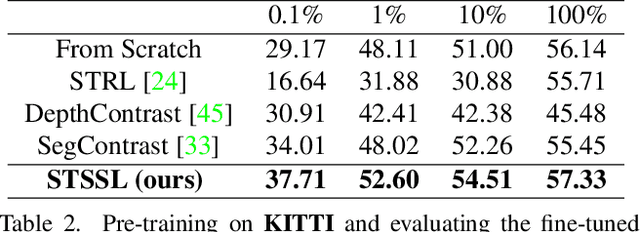
Self-supervised learning (SSL) has the potential to benefit many applications, particularly those where manually annotating data is cumbersome. One such situation is the semantic segmentation of point clouds. In this context, existing methods employ contrastive learning strategies and define positive pairs by performing various augmentation of point clusters in a single frame. As such, these methods do not exploit the temporal nature of LiDAR data. In this paper, we introduce an SSL strategy that leverages positive pairs in both the spatial and temporal domain. To this end, we design (i) a point-to-cluster learning strategy that aggregates spatial information to distinguish objects; and (ii) a cluster-to-cluster learning strategy based on unsupervised object tracking that exploits temporal correspondences. We demonstrate the benefits of our approach via extensive experiments performed by self-supervised training on two large-scale LiDAR datasets and transferring the resulting models to other point cloud segmentation benchmarks. Our results evidence that our method outperforms the state-of-the-art point cloud SSL methods.
NEMTO: Neural Environment Matting for Novel View and Relighting Synthesis of Transparent Objects
Mar 21, 2023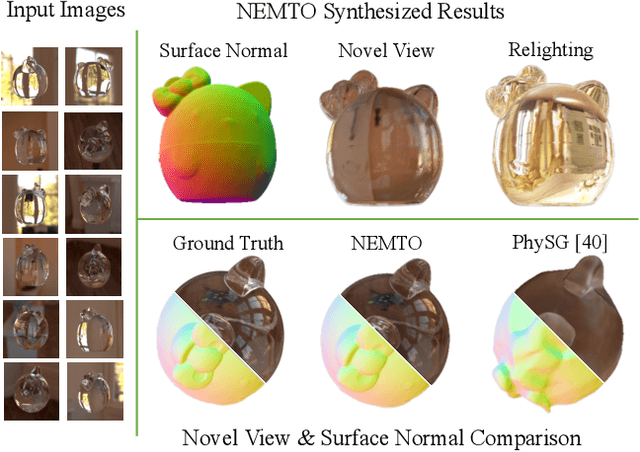
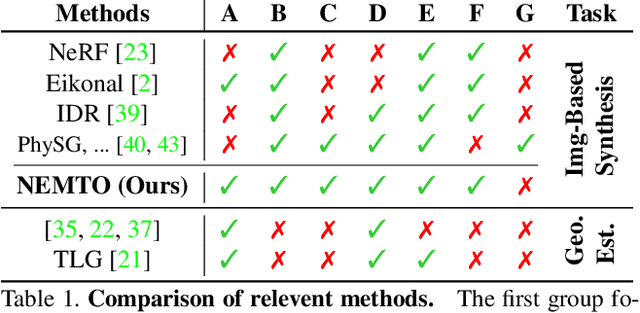
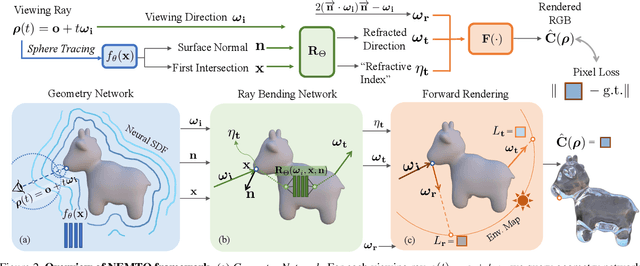
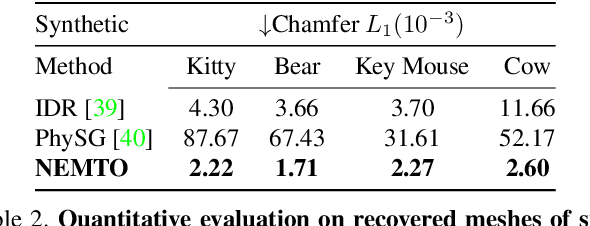
We propose NEMTO, the first end-to-end neural rendering pipeline to model 3D transparent objects with complex geometry and unknown indices of refraction. Commonly used appearance modeling such as the Disney BSDF model cannot accurately address this challenging problem due to the complex light paths bending through refractions and the strong dependency of surface appearance on illumination. With 2D images of the transparent object as input, our method is capable of high-quality novel view and relighting synthesis. We leverage implicit Signed Distance Functions (SDF) to model the object geometry and propose a refraction-aware ray bending network to model the effects of light refraction within the object. Our ray bending network is more tolerant to geometric inaccuracies than traditional physically-based methods for rendering transparent objects. We provide extensive evaluations on both synthetic and real-world datasets to demonstrate our high-quality synthesis and the applicability of our method.
TempSAL -- Uncovering Temporal Information for Deep Saliency Prediction
Jan 05, 2023Deep saliency prediction algorithms complement the object recognition features, they typically rely on additional information, such as scene context, semantic relationships, gaze direction, and object dissimilarity. However, none of these models consider the temporal nature of gaze shifts during image observation. We introduce a novel saliency prediction model that learns to output saliency maps in sequential time intervals by exploiting human temporal attention patterns. Our approach locally modulates the saliency predictions by combining the learned temporal maps. Our experiments show that our method outperforms the state-of-the-art models, including a multi-duration saliency model, on the SALICON benchmark. Our code will be publicly available on GitHub.
DSI2I: Dense Style for Unpaired Image-to-Image Translation
Dec 29, 2022Unpaired exemplar-based image-to-image (UEI2I) translation aims to translate a source image to a target image domain with the style of a target image exemplar, without ground-truth input-translation pairs. Existing UEI2I methods represent style using either a global, image-level feature vector, or one vector per object instance/class but requiring knowledge of the scene semantics. Here, by contrast, we propose to represent style as a dense feature map, allowing for a finer-grained transfer to the source image without requiring any external semantic information. We then rely on perceptual and adversarial losses to disentangle our dense style and content representations, and exploit unsupervised cross-domain semantic correspondences to warp the exemplar style to the source content. We demonstrate the effectiveness of our method on two datasets using standard metrics together with a new localized style metric measuring style similarity in a class-wise manner. Our results evidence that the translations produced by our approach are more diverse and closer to the exemplars than those of the state-of-the-art methods while nonetheless preserving the source content.
VolRecon: Volume Rendering of Signed Ray Distance Functions for Generalizable Multi-View Reconstruction
Dec 15, 2022


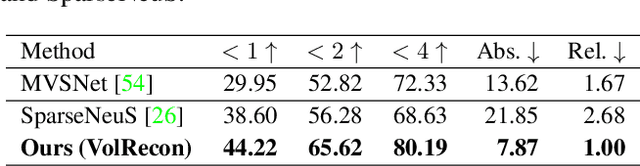
With the success of neural volume rendering in novel view synthesis, neural implicit reconstruction with volume rendering has become popular. However, most methods optimize per-scene functions and are unable to generalize to novel scenes. We introduce VolRecon, a generalizable implicit reconstruction method with Signed Ray Distance Function (SRDF). To reconstruct with fine details and little noise, we combine projection features, aggregated from multi-view features with a view transformer, and volume features interpolated from a coarse global feature volume. A ray transformer computes SRDF values of all the samples along a ray to estimate the surface location, which are used for volume rendering of color and depth. Extensive experiments on DTU and ETH3D demonstrate the effectiveness and generalization ability of our method. On DTU, our method outperforms SparseNeuS by about 30% in sparse view reconstruction and achieves comparable quality as MVSNet in full view reconstruction. Besides, our method shows good generalization ability on the large-scale ETH3D benchmark. Project page: https://fangjinhuawang.github.io/VolRecon.
DyNCA: Real-time Dynamic Texture Synthesis Using Neural Cellular Automata
Nov 21, 2022Current Dynamic Texture Synthesis (DyTS) models in the literature can synthesize realistic videos. However, these methods require a slow iterative optimization process to synthesize a single fixed-size short video, and they do not offer any post-training control over the synthesis process. We propose Dynamic Neural Cellular Automata (DyNCA), a framework for real-time and controllable dynamic texture synthesis. Our method is built upon the recently introduced NCA models, and can synthesize infinitely-long and arbitrary-size realistic texture videos in real-time. We quantitatively and qualitatively evaluate our model and show that our synthesized videos appear more realistic than the existing results. We improve the SOTA DyTS performance by $2\sim 4$ orders of magnitude. Moreover, our model offers several real-time and interactive video controls including motion speed, motion direction, and an editing brush tool.