 Add to Chrome
 Add to Firefox
 Add to Edge
Learning Earthquake Wave Arrival Time Picking from Labels with Inaccuracies
Jun 13, 2026
Inaccurately labeled training data, or "label noise", poses a significant threat to the integrity of supervised machine learning models. This corruption directly degrades performance by teaching the model erroneous mappings between features and labels, which leads to poor generalization and reduced accuracy on properly labeled validation and test data. Current seismological applications mainly rely on large-scale training sets or data augmentation to reduce the label-noise impact, which can be labor-intensive and costly. Here, we introduce a Label Noise-Contrastive Robust Learning (LaNCoR) approach that can effectively handle noisy labels in seismic signal processing tasks, without requiring large-scale training datasets. In this approach, the input waveform feature and label representation distributions are aligned in the feature space to correct mislabeling and reduce its impact on the training process. We present LaNCoR's performance on the task of P-phase arrival-time picking of real microseismic data using two baseline models and training approaches. Our results indicate that LaNCoR can improve performance by up to 28.8% across performance metrics. This approach holds great promise for model training in seismology and geosciences.

Leveraging LLMs and Social Media to Understand User Perception of Smartphone-Based Earthquake Early Warnings
Mar 24, 2026Android's Earthquake Alert (AEA) system provided timely early warnings to millions during the Mw 6.2 Marmara Ereglisi, Türkiye earthquake on April 23, 2025. This event, the largest in the region in 25 years, served as a critical real-world test for smartphone-based Earthquake Early Warning (EEW) systems. The AEA system successfully delivered alerts to users with high precision, offering over a minute of warning before the strongest shaking reached urban areas. This study leveraged Large Language Models (LLMs) to analyze more than 500 public social media posts from the X platform, extracting 42 distinct attributes related to user experience and behavior. Statistical analyses revealed significant relationships, notably a strong correlation between user trust and alert timeliness. Our results indicate a distinction between engineering and the user-centric definition of system accuracy. We found that timeliness is accuracy in the user's mind. Overall, this study provides actionable insights for optimizing alert design, public education campaigns, and future behavioral research to improve the effectiveness of such systems in seismically active regions.
TRACE: A Multi-Agent System for Autonomous Physical Reasoning in Seismological Science
Mar 22, 2026Inferring the physical mechanisms that govern earthquake sequences from indirect geophysical observations remains difficult, particularly across tectonically distinct environments where similar seismic patterns can reflect different underlying processes. Current interpretations rely heavily on the expert synthesis of catalogs, spatiotemporal statistics, and candidate physical models, limiting reproducibility and the systematic transfer of insight across settings. Here we present TRACE (Trans-perspective Reasoning and Automated Comprehensive Evaluator), a multi-agent system that combines large language model planning with formal seismological constraints to derive auditable, physically grounded mechanistic inference from raw observations. Applied to the 2019 Ridgecrest sequence, TRACE autonomously identifies stress-perturbation-induced delayed triggering, resolving the cascading interaction between the Mw 6.4 and Mw 7.1 mainshocks; in the Santorini-Kolumbo case, the system identifies a structurally guided intrusion model, distinguishing fault-channeled episodic migration from the continuous propagation expected in homogeneous crustal failure. By providing a generalizable logical infrastructure for interpreting heterogeneous seismic phenomena, TRACE advances the field from expert-dependent analysis toward knowledge-guided autonomous discovery in Earth sciences.
Gemini & Physical World: Large Language Models Can Estimate the Intensity of Earthquake Shaking from Multi-Modal Social Media Posts
May 29, 2024This paper presents a novel approach for estimating the ground shaking intensity using social media data and CCTV footage. Employing the Gemini Pro (Reid et al. 2024) model, a multi-modal language model, we demonstrate the ability to extract relevant information from unstructured data utilizing generative AI and natural language processing. The model output, in the form of Modified Mercalli Intensity (MMI) values, align well with independent observational data. Furthermore, our results suggest that beyond its advanced visual and auditory understanding abilities, Gemini appears to utilize additional sources of knowledge, including a simplified understanding of the general relationship between earthquake magnitude, distance, and MMI intensity, which it presumably acquired during its training, in its reasoning and decision-making processes. These findings raise intriguing questions about the extent of Gemini's general understanding of the physical world and its phenomena. The ability of Gemini to generate results consistent with established scientific knowledge highlights the potential of LLMs like Gemini in augmenting our understanding of complex physical phenomena such as earthquakes. More specifically, the results of this study highlight the potential of LLMs like Gemini to revolutionize citizen seismology by enabling rapid, effective, and flexible analysis of crowdsourced data from eyewitness accounts for assessing earthquake impact and providing crisis situational awareness. This approach holds great promise for improving early warning systems, disaster response, and overall resilience in earthquake-prone regions. This study provides a significant step toward harnessing the power of social media and AI for earthquake disaster mitigation.
Bayesian-Deep-Learning Estimation of Earthquake Location from Single-Station Observations
Dec 03, 2019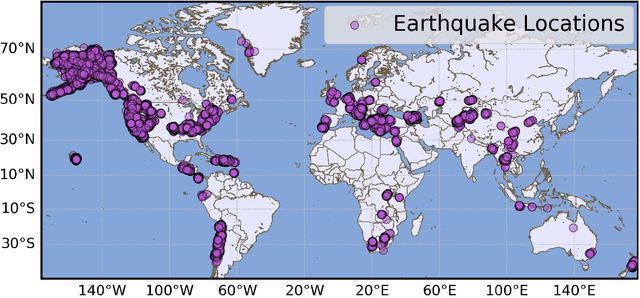
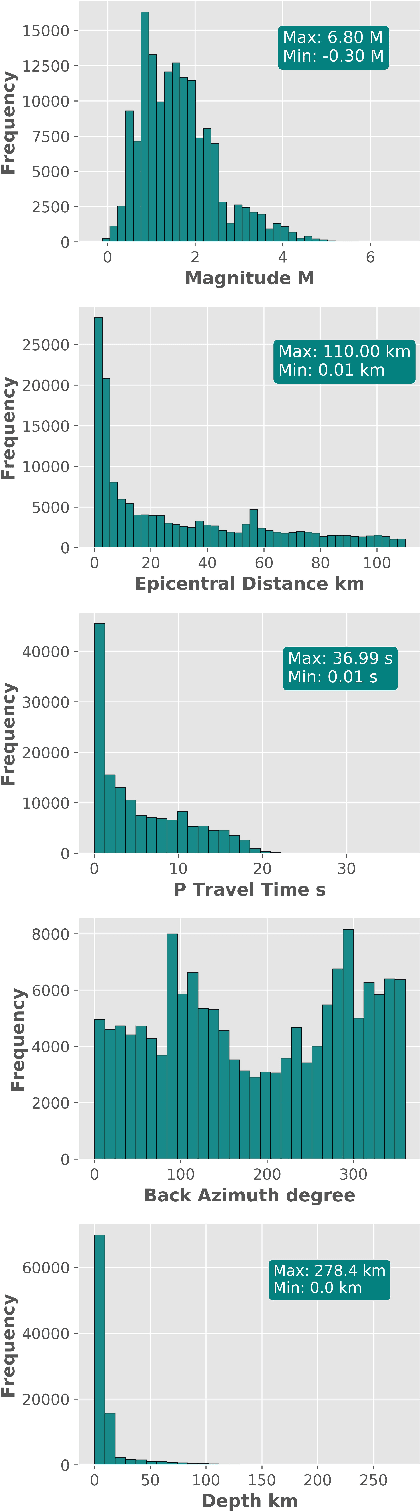
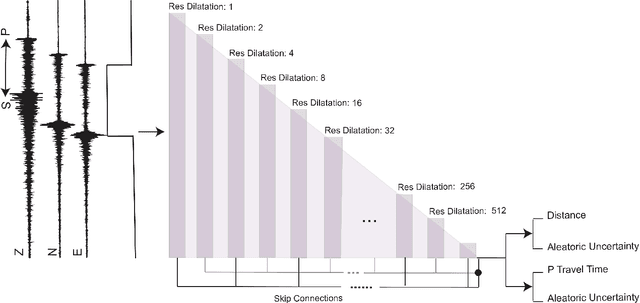
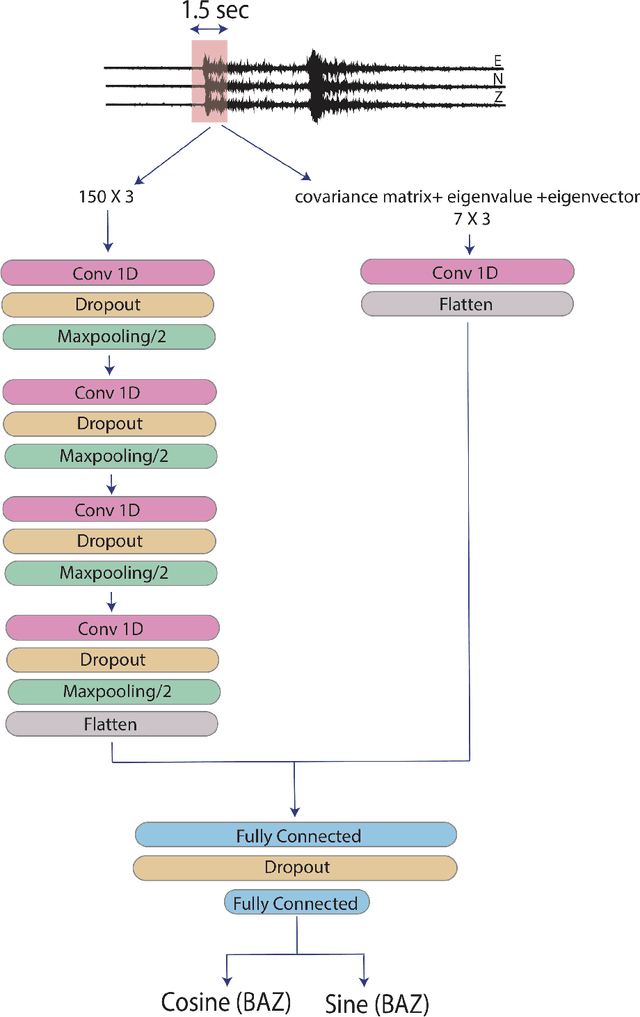
We present a deep learning method for single-station earthquake location, which we approach as a regression problem using two separate Bayesian neural networks. We use a multi-task temporal-convolutional neural network to learn epicentral distance and P travel time from 1-minute seismograms. The network estimates epicentral distance and P travel time with absolute mean errors of 0.23 km and 0.03 s respectively, along with their epistemic and aleatory uncertainties. We design a separate multi-input network using standard convolutional layers to estimate the back-azimuth angle, and its epistemic uncertainty. This network estimates the direction from which seismic waves arrive to the station with a mean error of 1 degree. Using this information, we estimate the epicenter, origin time, and depth along with their confidence intervals. We use a global dataset of earthquake signals recorded within 1 degree (~112 km) from the event to build the model and to demonstrate its performance. Our model can predict epicenter, origin time, and depth with mean errors of 7.3 km, 0.4 second, and 6.7 km respectively, at different locations around the world. Our approach can be used for fast earthquake source characterization with a limited number of observations, and also for estimating location of earthquakes that are sparsely recorded -- either because they are small or because stations are widely separated.
A Machine-Learning Approach for Earthquake Magnitude Estimation
Nov 14, 2019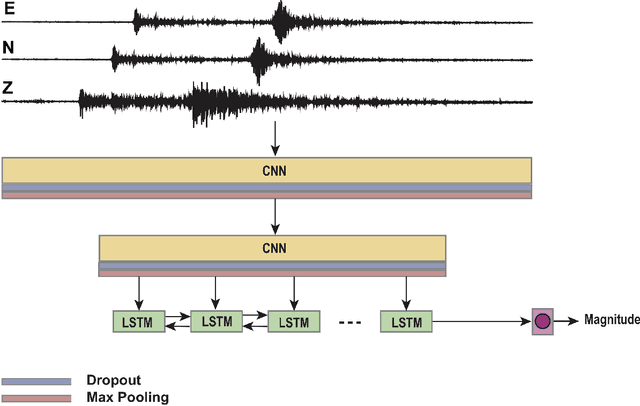
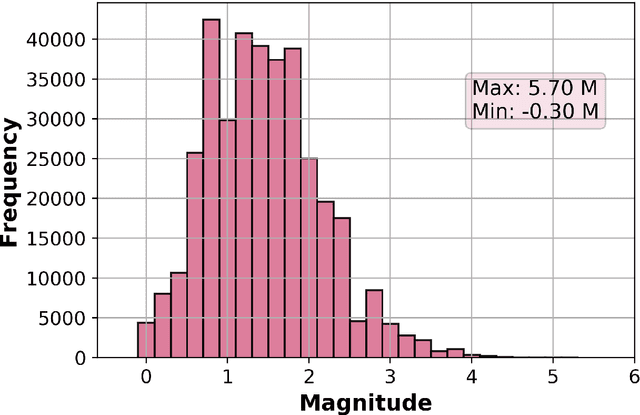
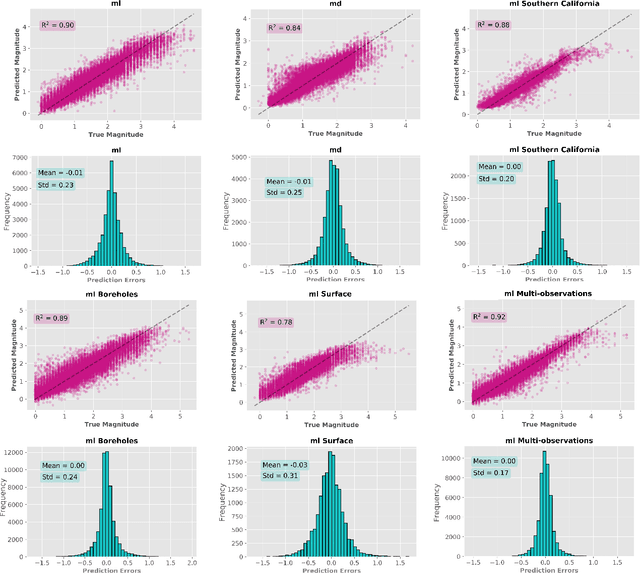
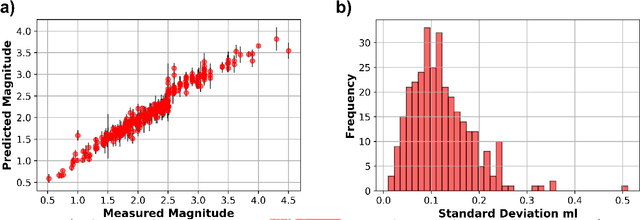
In this study we develop a single-station deep-learning approach for fast and reliable estimation of earthquake magnitude directly from raw waveforms. We design a regressor composed of convolutional and recurrent neural networks that is not sensitive to the data normalization, hence waveform amplitude information can be utilized during the training. Our network can predict earthquake magnitudes with an average error close to zero and standard deviation of ~0.2 based on single-station waveforms without instrument response correction. We test the network for both local and duration magnitude scales and show a station-based learning can be an effective approach for improving the performance. The proposed approach has a variety of potential applications from routine earthquake monitoring to early warning systems.
CRED: A Deep Residual Network of Convolutional and Recurrent Units for Earthquake Signal Detection
Oct 03, 2018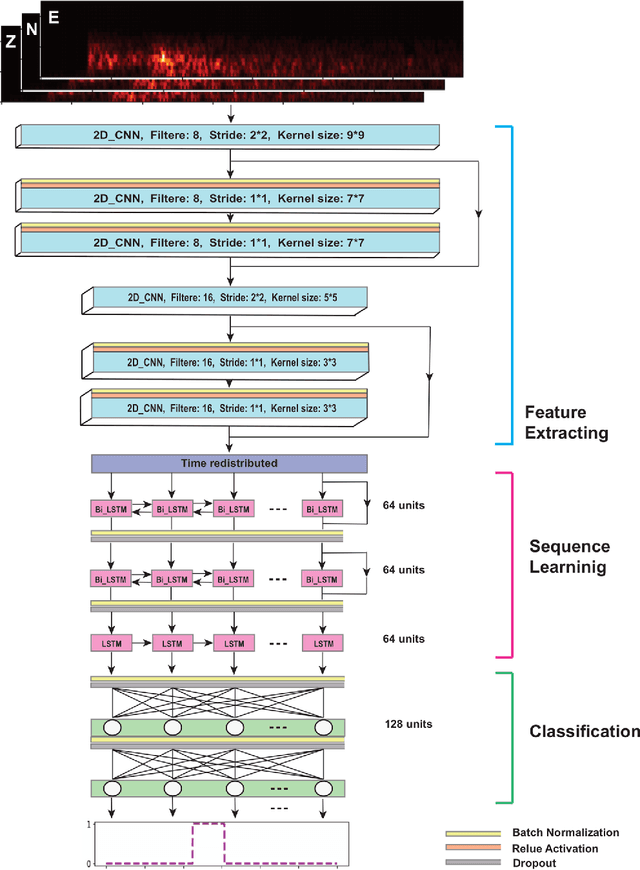
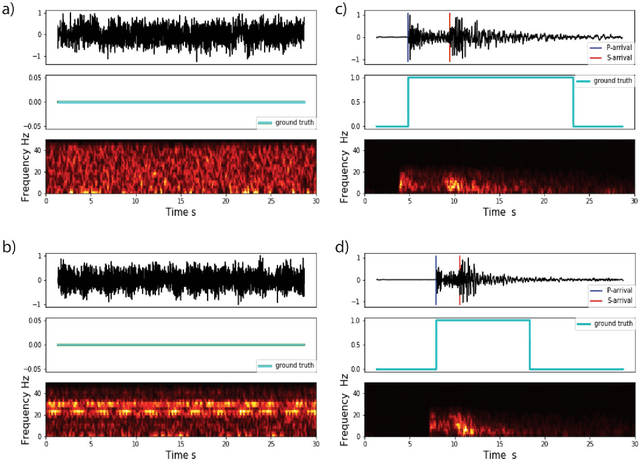
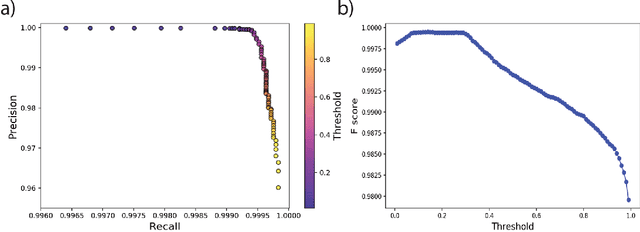
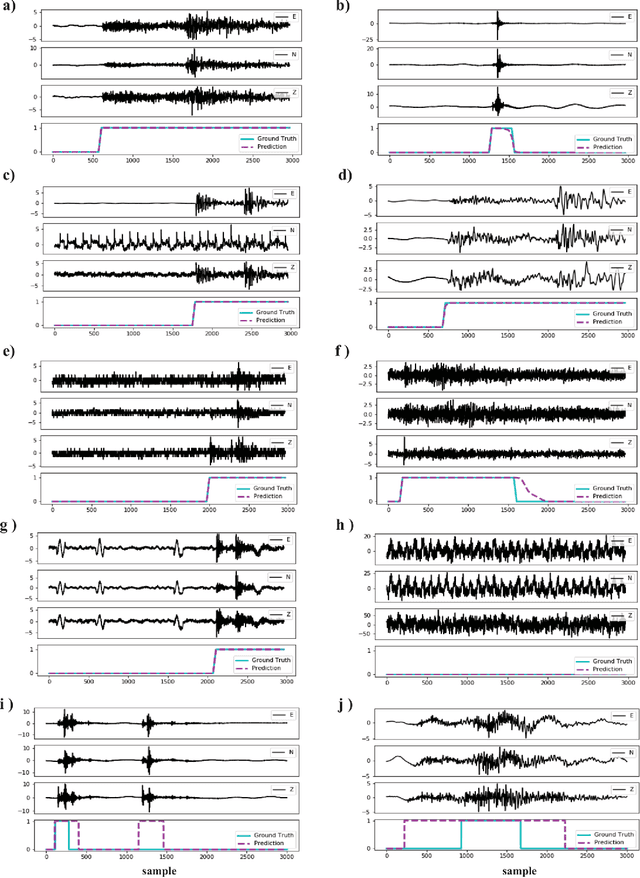
Earthquake signal detection is at the core of observational seismology. A good detection algorithm should be sensitive to small and weak events with a variety of waveform shapes, robust to background noise and non-earthquake signals, and efficient for processing large data volumes. Here, we introduce the Cnn-Rnn Earthquake Detector (CRED), a detector based on deep neural networks. The network uses a combination of convolutional layers and bi-directional long-short-term memory units in a residual structure. It learns the time-frequency characteristics of the dominant phases in an earthquake signal from three component data recorded on a single station. We train the network using 500,000 seismograms (250k associated with tectonic earthquakes and 250k identified as noise) recorded in Northern California and tested it with an F-score of 99.95. The robustness of the trained model with respect to the noise level and non-earthquake signals is shown by applying it to a set of semi-synthetic signals. The model is applied to one month of continuous data recorded at Central Arkansas to demonstrate its efficiency, generalization, and sensitivity. Our model is able to detect more than 700 microearthquakes as small as -1.3 ML induced during hydraulic fracturing far away than the training region. The performance of the model is compared with STA/LTA, template matching, and FAST algorithms. Our results indicate an efficient and reliable performance of CRED. This framework holds great promise in lowering the detection threshold while minimizing false positive detection rates.