 Add to Chrome
 Add to Firefox
 Add to Edge
Let's Have a Conversation: Designing and Evaluating LLM Agents for Interactive Optimization
Apr 03, 2026
Optimization is as much about modeling the right problem as solving it. Identifying the right objectives, constraints, and trade-offs demands extensive interaction between researchers and stakeholders. Large language models can empower decision-makers with optimization capabilities through interactive optimization agents that can propose, interpret and refine solutions. However, it is fundamentally harder to evaluate a conversation-based interaction than traditional one-shot approaches. This paper proposes a scalable and replicable methodology for evaluating optimization agents through conversations. We build LLM-powered decision agents that role-play diverse stakeholders, each governed by an internal utility function but communicating like a real decision-maker. We generate thousands of conversations in a school scheduling case study. Results show that one-shot evaluation is severely limiting: the same optimization agent converges to much higher-quality solutions through conversations. Then, this paper uses this methodology to demonstrate that tailored optimization agents, endowed with domain-specific prompts and structured tools, can lead to significant improvements in solution quality in fewer interactions, as compared to general-purpose chatbots. These findings provide evidence of the benefits of emerging solutions at the AI-optimization interface to expand the reach of optimization technologies in practice. They also uncover the impact of operations research expertise to facilitate interactive deployments through the design of effective and reliable optimization agents.

A Better Match for Drivers and Riders: Reinforcement Learning at Lyft
Oct 20, 2023To better match drivers to riders in our ridesharing application, we revised Lyft's core matching algorithm. We use a novel online reinforcement learning approach that estimates the future earnings of drivers in real time and use this information to find more efficient matches. This change was the first documented implementation of a ridesharing matching algorithm that can learn and improve in real time. We evaluated the new approach during weeks of switchback experimentation in most Lyft markets, and estimated how it benefited drivers, riders, and the platform. In particular, it enabled our drivers to serve millions of additional riders each year, leading to more than $30 million per year in incremental revenue. Lyft rolled out the algorithm globally in 2021.
Human-AI Interactions and Societal Pitfalls
Sep 19, 2023When working with generative artificial intelligence (AI), users may see productivity gains, but the AI-generated content may not match their preferences exactly. To study this effect, we introduce a Bayesian framework in which heterogeneous users choose how much information to share with the AI, facing a trade-off between output fidelity and communication cost. We show that the interplay between these individual-level decisions and AI training may lead to societal challenges. Outputs may become more homogenized, especially when the AI is trained on AI-generated content. And any AI bias may become societal bias. A solution to the homogenization and bias issues is to improve human-AI interactions, enabling personalized outputs without sacrificing productivity.
Prosper: image and robot-guided prostate brachytherapy
Apr 08, 2011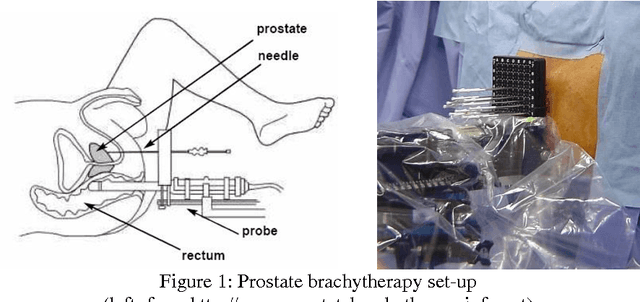
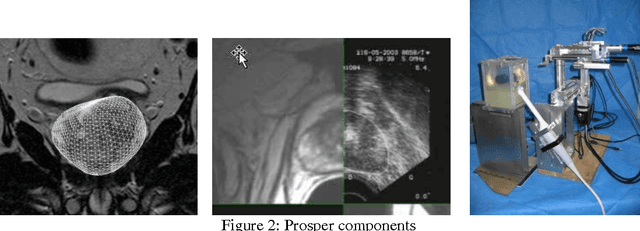
Brachytherapy for localized prostate cancer consists in destroying cancer by introducing iodine radioactive seeds into the gland through hollow needles. The planning of the position of the seeds and their introduction into the prostate is based on intra-operative ultrasound (US) imaging. We propose to optimize the global quality of the procedure by: i) using 3D US; ii) enhancing US data with MRI registration; iii) using a specially designed needle-insertion robot, connected to the imaging data. The imaging methods have been successfully tested on patient data while the robot accuracy has been evaluated on a realistic deformable phantom.