 Add to Chrome
 Add to Firefox
 Add to Edge
CCFM: Collision-Constrained Flow Matching for Safety-Critical Scenario Generation
Jul 05, 2026
Evaluation of autonomous vehicle (AV) planners in safety-critical closed-loop simulation is essential for real-world deployment. However, generating controllable safety-critical scenarios remains challenging. Existing approaches use soft guidance that provides only probabilistic preferences and cannot guarantee the satisfaction of geometric and severity constraints associated with specific collision types. We introduce Collision-Constrained Flow Matching (CCFM), a novel framework that guarantees precise collision control through hard physical constraints. CCFM consists of three key components: (i) a heuristic collision selector that optimally identifies an adversarial agent and collision type via composite scoring; (ii) structured hard constraints that explicitly define four collision types (rear-end, side, cut-in, head-on) through contact point, heading, and severity requirements; and (iii) a collision-constrained flow matching sampler that enforces the constraints via Gauss-Newton manifold projection. CCFM achieves collision rate up to 46.4% on nuScenes and 83.1% on nuPlan, significantly outperforming baselines while preserving realistic driving behavior. By enabling controllable collision characteristics in safety-critical scenario generation, CCFM provides a reliable foundation for AV safety evaluation and sim-to-real crash data generation. The code and implementation details are available at https://github.com/KELISBU/CCFM.

HMPDM: A Diffusion Model for Driving Video Prediction with Historical Motion Priors
Mar 28, 2026Video prediction is a useful function for autonomous driving, enabling intelligent vehicles to reliably anticipate how driving scenes will evolve and thereby supporting reasoning and safer planning. However, existing models are constrained by multi-stage training pipelines and remain insufficient in modeling the diverse motion patterns in real driving scenes, leading to degraded temporal consistency and visual quality. To address these challenges, this paper introduces the historical motion priors-informed diffusion model (HMPDM), a video prediction model that leverages historical motion priors to enhance motion understanding and temporal coherence. The proposed deep learning system introduces three key designs: (i) a Temporal-aware Latent Conditioning (TaLC) module for implicit historical motion injection; (ii) a Motion-aware Pyramid Encoder (MaPE) for multi-scale motion representation; (iii) a Self-Conditioning (SC) strategy for stable iterative denoising. Extensive experiments on the Cityscapes and KITTI benchmarks demonstrate that HMPDM outperforms state-of-the-art video prediction methods with efficiency, achieving a 28.2% improvement in FVD on Cityscapes under the same monocular RGB input configuration setting. The implementation codes are publicly available at https://github.com/KELISBU/HMPDM.
CrashChat: A Multimodal Large Language Model for Multitask Traffic Crash Video Analysis
Dec 21, 2025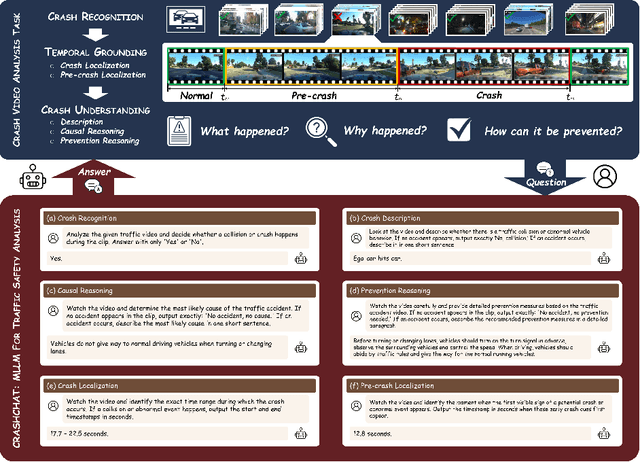
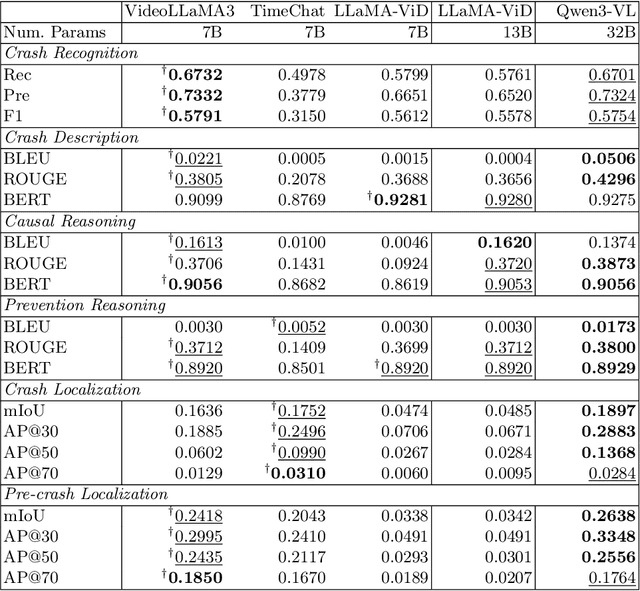
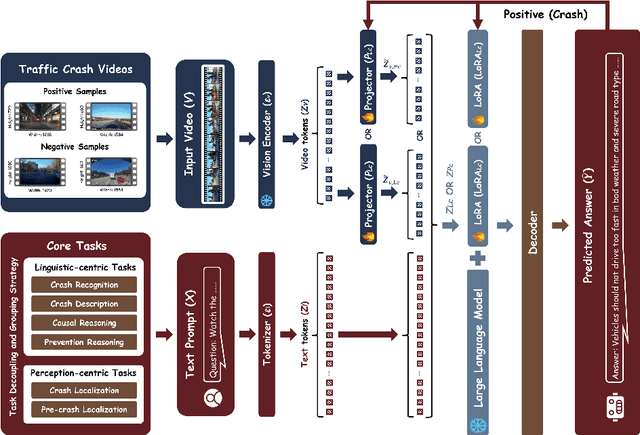
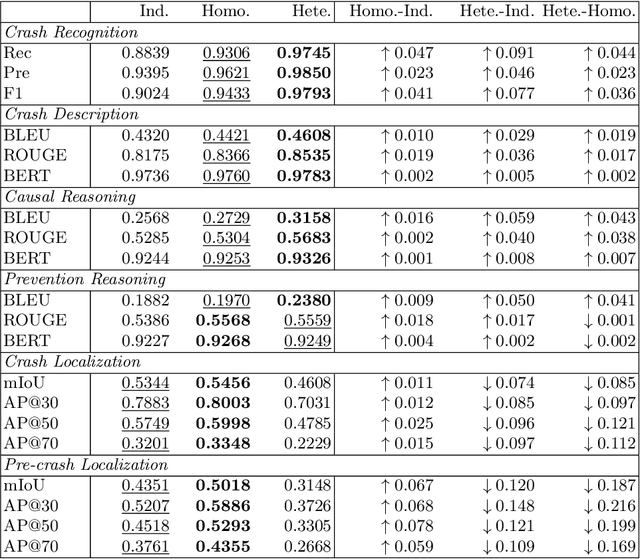
Automating crash video analysis is essential to leverage the growing availability of driving video data for traffic safety research and accountability attribution in autonomous driving. Crash video analysis is a challenging multitask problem due to the complex spatiotemporal dynamics of crash events in video data and the diverse analytical requirements involved. It requires capabilities spanning crash recognition, temporal grounding, and high-level video understanding. Existing models, however, cannot perform all these tasks within a unified framework, and effective training strategies for such models remain underexplored. To fill these gaps, this paper proposes CrashChat, a multimodal large language model (MLLM) for multitask traffic crash analysis, built upon VideoLLaMA3. CrashChat acquires domain-specific knowledge through instruction fine-tuning and employs a novel multitask learning strategy based on task decoupling and grouping, which maximizes the benefit of joint learning within and across task groups while mitigating negative transfer. Numerical experiments on consolidated public datasets demonstrate that CrashChat consistently outperforms existing MLLMs across model scales and traditional vision-based methods, achieving state-of-the-art performance. It reaches near-perfect accuracy in crash recognition, a 176\% improvement in crash localization, and a 40\% improvement in the more challenging pre-crash localization. Compared to general MLLMs, it substantially enhances textual accuracy and content coverage in crash description and reasoning tasks, with 0.18-0.41 increases in BLEU scores and 0.18-0.42 increases in ROUGE scores. Beyond its strong performance, CrashChat is a convenient, end-to-end analytical tool ready for practical implementation. The dataset and implementation code for CrashChat are available at https://github.com/Liangkd/CrashChat.