 Add to Chrome
 Add to Firefox
 Add to Edge
A Multi-Agent Framework for Zero-Dimensional Reduced-Order Model Planning
Jul 13, 2026
Zero-dimensional reduced-order models (0D ROMs) are central to multi-dimensional design workflows for high-end complex equipment. However, the planning process currently relies on manual expertise, limiting topological exploration and prolonging iterations. Even traditional optimization methods such as Genetic Algorithms (GA) are typically confined to local parameter tuning. Although Large Language Model (LLM) agents have shown promise in exploring large sample spaces, and frameworks such as Chain of Thought (CoT) and Reason and Act (ReAct) improve reasoning reliability, while Retrieval-Augmented Generation (RAG) overcomes domain knowledge barriers, a single agent still falls short for the long-horizon and highly coupled nature of complex 0D ROM planning. This paper proposes the Zero-dimensional reduced-order model CO-Planning framework (Z-COPA), a multi-agent architecture featuring a Symbolic Action Graph Engine (SAGE) and a MILP-Guided Navigation (MGN) optimizer. Its core innovation is a dedicated graph representation method that accurately encodes the 0D flow network topology, converting the empirical planning process into a rigorous graph structure optimization problem. We validate the forward and inverse design capabilities and generalization performance of Z-COPA on two real aircraft engine secondary-air systems, two IEEE power-distribution reconfiguration benchmarks, and two water-distribution network benchmarks. The results show superior task completion quality, obtaining the best performance in both forward and reverse design of air systems. Z-COPA disrupts the traditional 0D model planning paradigm, providing a new technical approach for exploring broader topological space and achieving highly automated, globally optimal air system architectures.

Question-Driven Graph Fusion Network For Visual Question Answering
Apr 03, 2022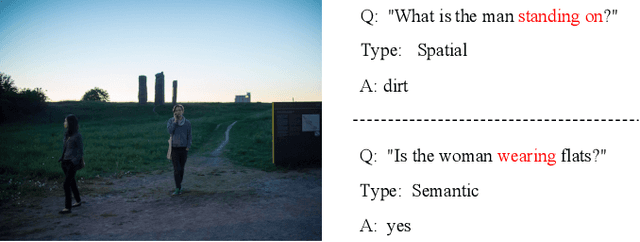
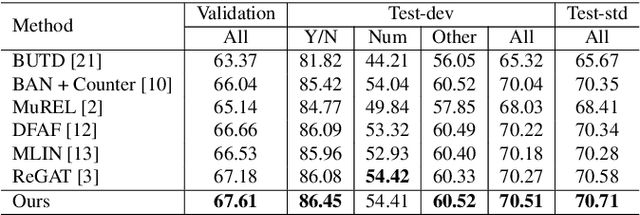
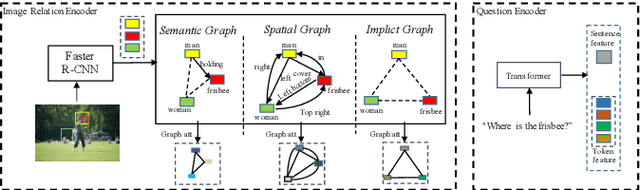
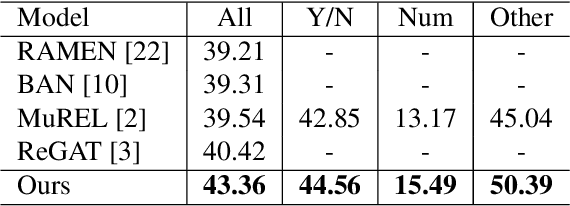
Existing Visual Question Answering (VQA) models have explored various visual relationships between objects in the image to answer complex questions, which inevitably introduces irrelevant information brought by inaccurate object detection and text grounding. To address the problem, we propose a Question-Driven Graph Fusion Network (QD-GFN). It first models semantic, spatial, and implicit visual relations in images by three graph attention networks, then question information is utilized to guide the aggregation process of the three graphs, further, our QD-GFN adopts an object filtering mechanism to remove question-irrelevant objects contained in the image. Experiment results demonstrate that our QD-GFN outperforms the prior state-of-the-art on both VQA 2.0 and VQA-CP v2 datasets. Further analysis shows that both the novel graph aggregation method and object filtering mechanism play a significant role in improving the performance of the model.
Co-VQA : Answering by Interactive Sub Question Sequence
Apr 02, 2022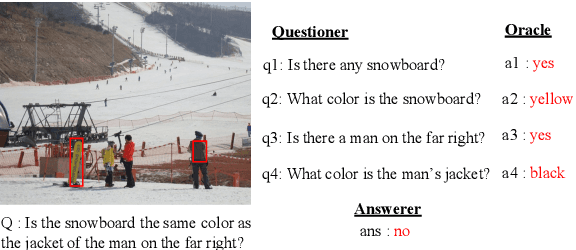
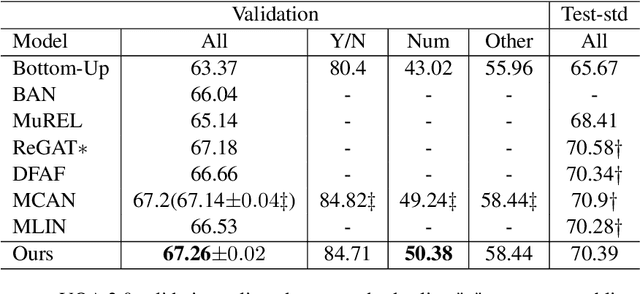
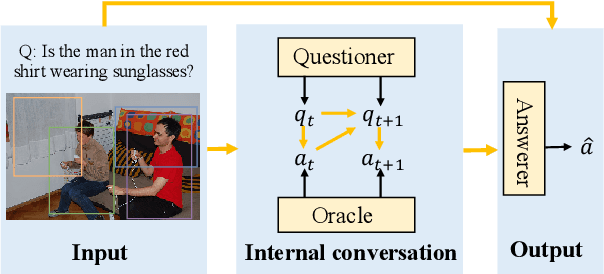
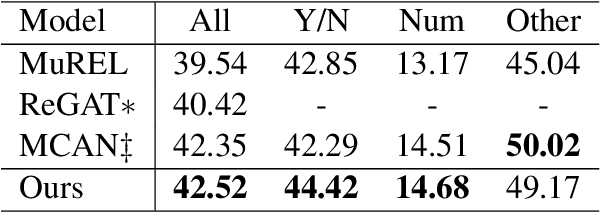
Most existing approaches to Visual Question Answering (VQA) answer questions directly, however, people usually decompose a complex question into a sequence of simple sub questions and finally obtain the answer to the original question after answering the sub question sequence(SQS). By simulating the process, this paper proposes a conversation-based VQA (Co-VQA) framework, which consists of three components: Questioner, Oracle, and Answerer. Questioner raises the sub questions using an extending HRED model, and Oracle answers them one-by-one. An Adaptive Chain Visual Reasoning Model (ACVRM) for Answerer is also proposed, where the question-answer pair is used to update the visual representation sequentially. To perform supervised learning for each model, we introduce a well-designed method to build a SQS for each question on VQA 2.0 and VQA-CP v2 datasets. Experimental results show that our method achieves state-of-the-art on VQA-CP v2. Further analyses show that SQSs help build direct semantic connections between questions and images, provide question-adaptive variable-length reasoning chains, and with explicit interpretability as well as error traceability.