 Add to Chrome
 Add to Firefox
 Add to Edge
Towards Professional Tennis Styles for Humanoid Robots with Adaptive Motion Planning and Tracking
Aug 20, 2026
Humanoid robots have recently demonstrated promising capabilities in real-world ball sports. However, achieving professional motion styles while maintaining strong task performance remains challenging. In this work, we propose AdaPT, an Adaptive Motion Planning and Tracking framework that learns professional tennis serving and rally styles directly from broadcast videos. This hierarchical design is motivated by the key insight that the planner generates stylistic kinematic motions, while the tracker executes them with minimal interference with planning. Despite its effectiveness in simulation, a substantial sim-to-real gap emerges: tracking performance inevitably degrades on real robots, and this degradation is partially overlooked by autoregressive planning and further compounded by noisy perception. To address these issues, our adaptation mechanism improves tracking robustness by learning to track randomized execution speeds, while conditioning the planner on a learned motion-speed adapter to mitigate compounding errors. Real-world experiments on the Unitree G1 demonstrate the effectiveness of our adaptation mechanism in bridging the sim-to-real gap. We further deploy AdaPT policies on the full-size Dobot Atom humanoid robot (1.7m) and demonstrate in-the-wild serving without motion capture. Beyond these results, our real-world experiments reveal both algorithmic and engineering insights for future humanoid ball-sports systems. Videos and code are available on our \href{https://humanoidtennis.github.io/AdaPT/}{project website}.

HiPHI: A Large-Scale Benchmark for High-Precision Human Motion and Object-Interaction
Aug 17, 2026Humanoid intelligence requires learning over an extremely diverse space of whole-body motions and physically grounded interactions. However, existing embodied datasets remain fundamentally limited: internet-scale video data lack precise physical states and interaction grounding, while laboratory motion datasets provide high fidelity but only narrow behavioral coverage. This mismatch creates a critical bottleneck for scalable humanoid policy learning. We present HiPHI, a 600+ hour scale high-fidelity whole-body human motion dataset designed to systematically maximize coverage of the human motion and interaction manifold. HiPHI is theoretically guided by FrameNet, a linguistic framework organizing human primitives. Created using an optical motion capture pipeline, HiPHI provides sub-millimeter spatial marker tracking accuracy for full-body human motion and mesh-level object trajectories. We further introduce a benchmark suite evaluating motion-space diversity, interaction grounding, object consistency, and physical AI applications. Our analyses demonstrate that HiPHI significantly expands motion coverage compared to existing motion datasets while maintaining high-fidelity interaction quality, and establishes a scalable data foundation for training, evaluating, and generalizing humanoid policies in real-world embodied tasks, where similar extensions are also applicable to motion prior models in computer graphics.
OmniContact: Chaining Meta-Skills via Contact Flow for Generalizable Humanoid Loco-Manipulation
Jun 24, 2026Learning long-horizon humanoid loco-manipulation poses a dual challenge: it requires not only the robust execution of meta-skills but also their seamless, closed-loop chaining equipped with autonomous recovery. Existing approaches remain limited: explicit humanoid-object interaction representations offer precision but are notoriously difficult for high-level planning, whereas implicit skill embeddings are compact but lack the interpretability required for reliable composition. We propose \ours, a hierarchical framework centered on \textbf{contact flow (CF)}, a compact representation consisting of key body trajectories and time-series binary contact signals. Leveraging this shared interface, our low-level policy \textbf{CF-Track} learns a unified library of loco-manipulation skills, while our high-level module \textbf{CF-Gen} heuristically synthesizes future contact-flow sequences. To support this setting, we additionally collect the OmniContact dataset, a MoCap-based HOI corpus for humanoid loco-manipulation (Appendix~\ref{sec:dataset}). Together, they enable robust execution, autonomous failure recovery, and flexible composition of meta-skills for long-horizon tasks. Experiments show that OmniContact achieves \(98.7\%\) success on \textit{Carry Box} and \(76.5\%\) on \textit{Push-Stack Boxes}, outperforming prior baselines by average margins of \(40.9\%\) in meta-skill and \(66.5\%\) in skill chaining. Besides, our framework naturally integrates with VLMs for semantic task decomposition, enabling complex, semantically grounded loco-manipulation behaviors, such as arranging scattered boxes into a heart shape.
Motion Capture from Inertial and Vision Sensors
Jul 23, 2024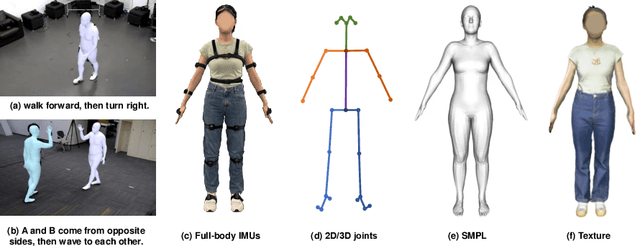
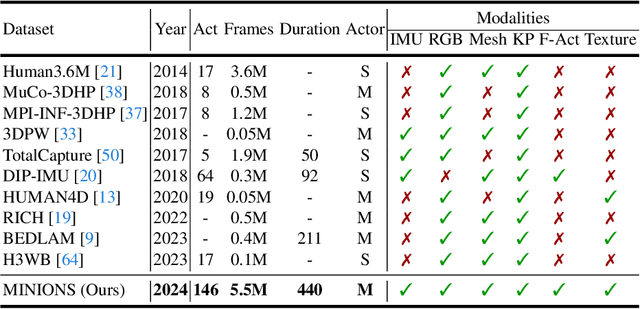
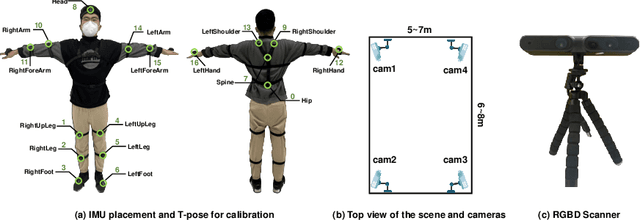
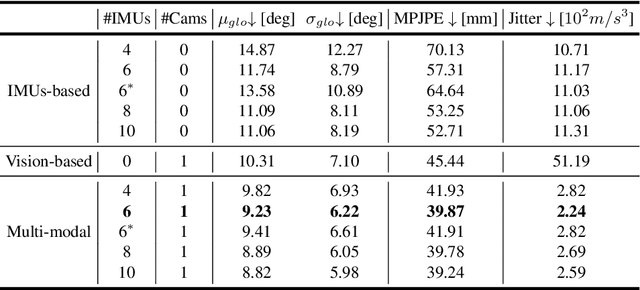
Human motion capture is the foundation for many computer vision and graphics tasks. While industrial motion capture systems with complex camera arrays or expensive wearable sensors have been widely adopted in movie and game production, consumer-affordable and easy-to-use solutions for personal applications are still far from mature. To utilize a mixture of a monocular camera and very few inertial measurement units (IMUs) for accurate multi-modal human motion capture in daily life, we contribute MINIONS in this paper, a large-scale Motion capture dataset collected from INertial and visION Sensors. MINIONS has several featured properties: 1) large scale of over five million frames and 400 minutes duration; 2) multi-modality data of IMUs signals and RGB videos labeled with joint positions, joint rotations, SMPL parameters, etc.; 3) a diverse set of 146 fine-grained single and interactive actions with textual descriptions. With the proposed MINIONS, we conduct experiments on multi-modal motion capture and explore the possibilities of consumer-affordable motion capture using a monocular camera and very few IMUs. The experiment results emphasize the unique advantages of inertial and vision sensors, showcasing the promise of consumer-affordable multi-modal motion capture and providing a valuable resource for further research and development.