 Add to Chrome
 Add to Firefox
 Add to Edge
Ling and Ring 2.6 Technical Report: Efficient and Instant Agentic Intelligence at Trillion-Parameter Scale
Jun 13, 2026
Efficient and scalable agentic intelligence requires models that can deliver both low-latency responses and strong reasoning capabilities while remaining practical to train, serve, and deploy. In this report, we present Ling-2.6 and Ring-2.6, a family of models designed to address this challenge at scale. Ling-2.6 is optimized for instant response generation and high capability per output token, whereas Ring-2.6 is tailored for deeper reasoning and more advanced agentic workflows. Instead of training from scratch, we upgrade the Ling-2.0 base model through architectural migration pre-training and large-scale post-training. This upgrade is guided by a unified co-design of model architecture, optimization objectives, serving systems, and agent training environments, enabling improvements in both model capability and deployment efficiency. At the architectural level, we introduce a hybrid linear attention design that integrates Lightning Attention with MLA, improving the efficiency of long-context training and decoding. To further enhance token efficiency, we optimize capability per output token through Evolutionary Chain-of-Thought, Linguistic Unit Policy Optimization, bidirectional preference alignment, and shortest-correct-response distillation. For agentic capabilities, we propose KPop, a reinforcement learning framework designed to support stable training of Ring-2.6-1T on large-scale environment-grounded data. KPop improves training efficiency through asynchronous scheduling across coding, search, tool use, and workflow execution, enabling scalable learning from complex agent-environment interactions. Together, Ling-2.6 and Ring-2.6 provide a practical pathway toward efficient, scalable, and open agentic systems. We open-source all checkpoints in the 2.6 family to support further research and development in practical agentic intelligence.

Unifying KV Cache Compression for Large Language Models with LeanKV
Dec 04, 2024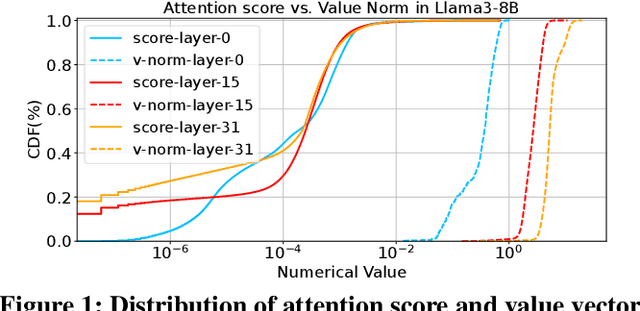
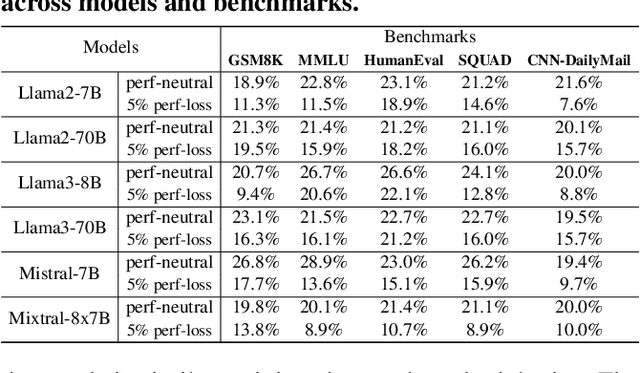


Large language models (LLMs) demonstrate exceptional performance but incur high serving costs due to substantial memory demands, with the key-value (KV) cache being a primary bottleneck. Existing KV cache compression methods, including quantization and pruning, struggle with limitations such as uniform treatment of keys and values and static memory allocation across attention heads. To address these challenges, we introduce LeanKV, a unified KV cache compression framework that enhances LLM serving efficiency without compromising accuracy through three innovations: (1) Hetero-KV quantization, which stores keys at a higher precision than values to reflect their greater impact on attention computations; (2) per-head dynamic sparsity, which allocates memory based on token importance per head and per request; and (3) unified KV compression, integrating mixed-precision quantization and selective pruning to enable a smooth tradeoff between model accuracy and memory efficiency. To efficiently support these techniques, LeanKV introduces systems optimizations including unified paging and on-GPU parallel memory management. Implemented on vLLM, LeanKV compresses the KV cache by $3.0\times$ to $5.0\times$ without accuracy loss and up to $11.0\times$ with under 5% accuracy loss, enhancing throughput by $1.9\times$ to $2.5\times$, and up to $6.9\times$.