 Add to Chrome
 Add to Firefox
 Add to Edge
GS-Surrogate: Deformable Gaussian Splatting for Parameter Space Exploration of Ensemble Simulations
Apr 07, 2026
Exploring ensemble simulations is increasingly important across many scientific domains. However, supporting flexible post-hoc exploration remains challenging due to the trade-off between storing the expensive raw data and flexibly adjusting visualization settings. Existing visualization surrogate models have improved this workflow, but they either operate in image space without an explicit 3D representation or rely on neural radiance fields that are computationally expensive for interactive exploration and encode all parameter-driven variations within a single implicit field. In this work, we introduce GS-Surrogate, a deformable Gaussian Splatting-based visualization surrogate for parameter-space exploration. Our method first constructs a canonical Gaussian field as a base 3D representation and adapts it through sequential parameter-conditioned deformations. By separating simulation-related variations from visualization-specific changes, this explicit formulation enables efficient and controllable adaptation to different visualization tasks, such as isosurface extraction and transfer function editing. We evaluate our framework on a range of simulation datasets, demonstrating that GS-Surrogate enables real-time and flexible exploration across both simulation and visualization parameter spaces.

A generalized forecasting solution to enable future insights of COVID-19 at sub-national level resolutions
Aug 21, 2021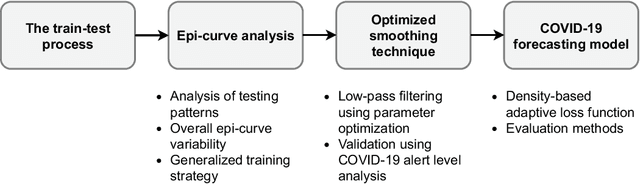
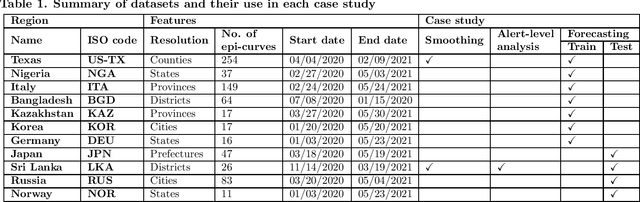
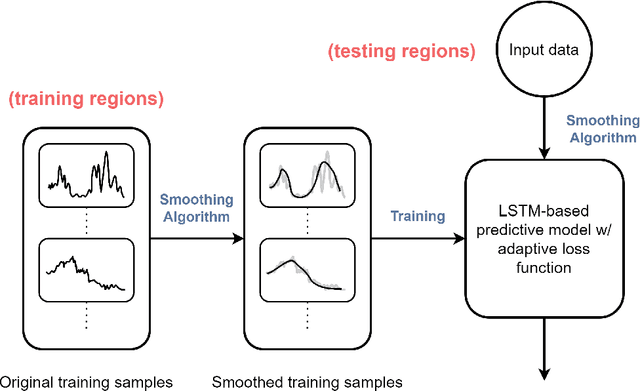
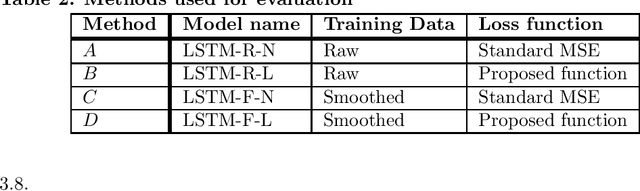
COVID-19 continues to cause a significant impact on public health. To minimize this impact, policy makers undertake containment measures that however, when carried out disproportionately to the actual threat, as a result if errorneous threat assessment, cause undesirable long-term socio-economic complications. In addition, macro-level or national level decision making fails to consider the localized sensitivities in small regions. Hence, the need arises for region-wise threat assessments that provide insights on the behaviour of COVID-19 through time, enabled through accurate forecasts. In this study, a forecasting solution is proposed, to predict daily new cases of COVID-19 in regions small enough where containment measures could be locally implemented, by targeting three main shortcomings that exist in literature; the unreliability of existing data caused by inconsistent testing patterns in smaller regions, weak deploy-ability of forecasting models towards predicting cases in previously unseen regions, and model training biases caused by the imbalanced nature of data in COVID-19 epi-curves. Hence, the contributions of this study are three-fold; an optimized smoothing technique to smoothen less deterministic epi-curves based on epidemiological dynamics of that region, a Long-Short-Term-Memory (LSTM) based forecasting model trained using data from select regions to create a representative and diverse training set that maximizes deploy-ability in regions with lack of historical data, and an adaptive loss function whilst training to mitigate the data imbalances seen in epi-curves. The proposed smoothing technique, the generalized training strategy and the adaptive loss function largely increased the overall accuracy of the forecast, which enables efficient containment measures at a more localized micro-level.