 Add to Chrome
 Add to Firefox
 Add to Edge
GS-Surrogate: Deformable Gaussian Splatting for Parameter Space Exploration of Ensemble Simulations
Apr 07, 2026
Exploring ensemble simulations is increasingly important across many scientific domains. However, supporting flexible post-hoc exploration remains challenging due to the trade-off between storing the expensive raw data and flexibly adjusting visualization settings. Existing visualization surrogate models have improved this workflow, but they either operate in image space without an explicit 3D representation or rely on neural radiance fields that are computationally expensive for interactive exploration and encode all parameter-driven variations within a single implicit field. In this work, we introduce GS-Surrogate, a deformable Gaussian Splatting-based visualization surrogate for parameter-space exploration. Our method first constructs a canonical Gaussian field as a base 3D representation and adapts it through sequential parameter-conditioned deformations. By separating simulation-related variations from visualization-specific changes, this explicit formulation enables efficient and controllable adaptation to different visualization tasks, such as isosurface extraction and transfer function editing. We evaluate our framework on a range of simulation datasets, demonstrating that GS-Surrogate enables real-time and flexible exploration across both simulation and visualization parameter spaces.

Learning Patterns in Sample Distributions for Monte Carlo Variance Reduction
Jun 01, 2019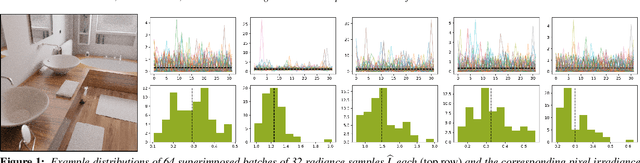
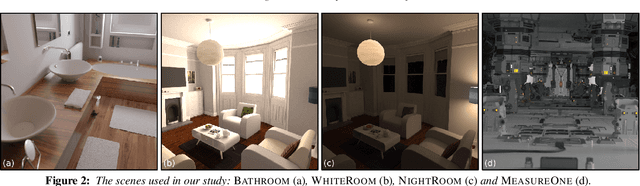
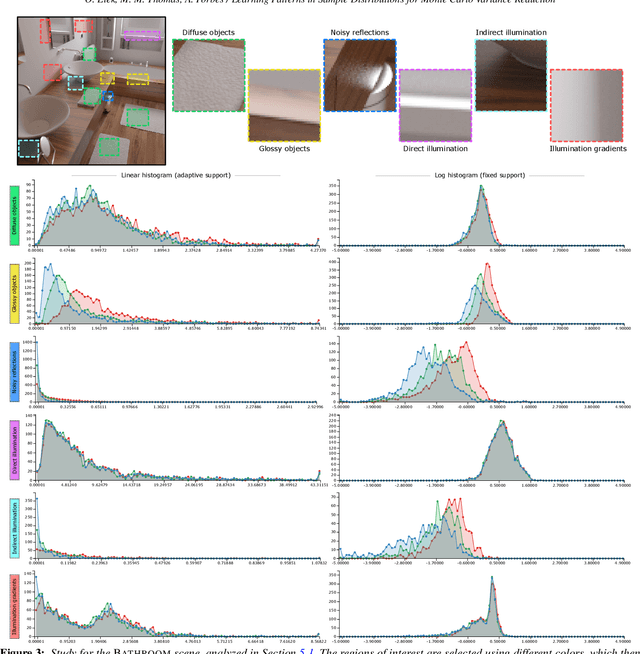
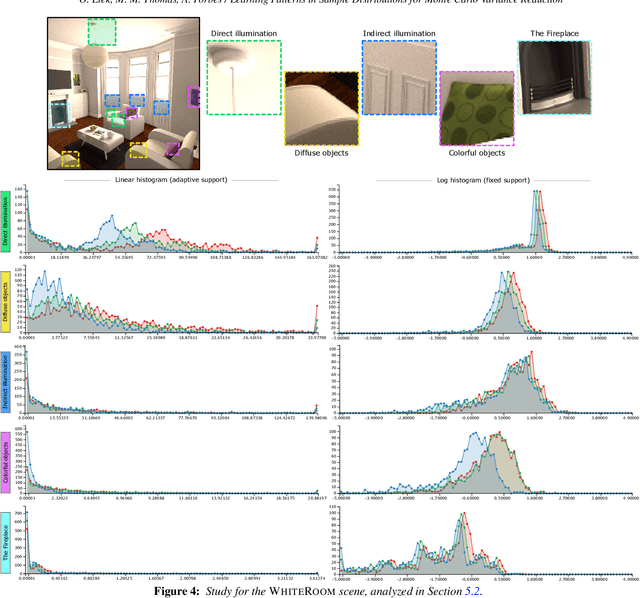
This paper investigates a novel a-posteriori variance reduction approach in Monte Carlo image synthesis. Unlike most established methods based on lateral filtering in the image space, our proposition is to produce the best possible estimate for each pixel separately, from all the samples drawn for it. To enable this, we systematically study the per-pixel sample distributions for diverse scene configurations. Noting that these are too complex to be characterized by standard statistical distributions (e.g. Gaussians), we identify patterns recurring in them and exploit those for training a variance-reduction model based on neural nets. In result, we obtain numerically better estimates compared to simple averaging of samples. This method is compatible with existing image-space denoising methods, as the improved estimates of our model can be used for further processing. We conclude by discussing how the proposed model could in future be extended for fully progressive rendering with constant memory footprint and scene-sensitive output.