 Add to Chrome
 Add to Firefox
 Add to Edge
Inertial Human Motion Capture: From Biomechanics to Recent Sensor Fusion Methods and Back
Jul 17, 2026
Inertial measurement units (IMUs) are a promising means to capture human motion, yet obtaining meaningful biomechanical quantities from IMU measurements remains non-trivial. This tutorial-style review focuses on kinematics and introduces four key aspects (inertial human motion capture objective, environmental conditions, subject & attributes, and motion characteristics) to determine how to translate biomechanical problems into adequate formulations for the fusion of inertial sensor measurements. We identify three fundamental challenges for kinematics estimation from IMUs: IMUs do not provide direct information about the joint angle, IMUs do not measure their own orientation, and real-world environments and dynamics compromise sensor reliability. Though there exist widely-used methods to overcome these challenges, they suffer from severe limitations in real-life applications, e.g., the need for sensor-to-segment calibration, and the fact that magnetic field disturbances degrade joint angle accuracy. The full potential for many use-cases hence remains untapped in terms of accuracy and reliability. We share insights into recently proposed methods, e.g. exploiting the human body's kinematic chain constraints, having the potential to overcome these limitations. We also present guiding questions related to the four key aspects and illustrate their use for navigating the methodological landscape for the use-case of lower-extremity joint angle estimation, for which we share open-access code and compare the traditional workflow with three alternatives. Our aim is to bridge the gap between the sensor fusion community developing methods for human motion capture and the biomechanics community in need of accurate, easy-to-use, and reliable methods to study human motion outside of the laboratory.

Physics-Guided Recurrent State-Space Neural Networks for Multi-Step Prediction
Jun 01, 2026State-space models are traditionally based on physical knowledge, but multi-step predictions from these physical models can be poor due to model inaccuracy. Black-box deep learning has shown promise as an alternative. However, these methods rely on the availability of large datasets and potentially available physical knowledge is neglected. We propose the PG-RSSNN, a physics-guided recurrent state-space neural network that incorporates recurrent structures to enable the use of non-saturating activation functions in multi-step prediction. It mitigates the vanishing gradients and eliminates the risk of numerical divergence in training seen in existing structures that feed back state estimates. Results across multiple systems with various physical model imperfections, from linear state-space models with Gaussian noise to a robotic arm and a cascaded water tank system, show that the proposed PG-RSSNN maintains stable training behavior, and improves multi-step predictions, as compared with black-box neural networks and physics-only models, even with limited training data and when physical models are only partially known.
A Lightweight and Accurate Spatial-Temporal Transformer for Traffic Forecasting
Jan 04, 2022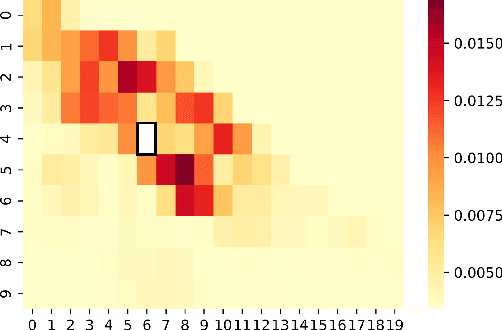
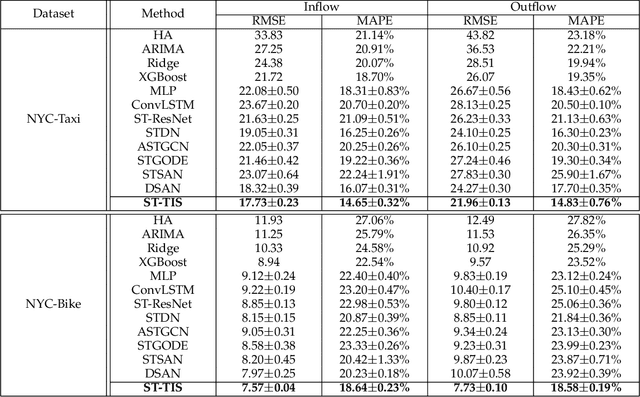
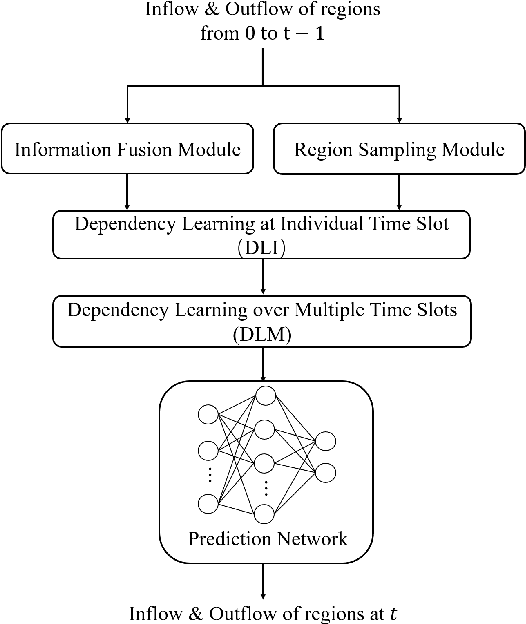
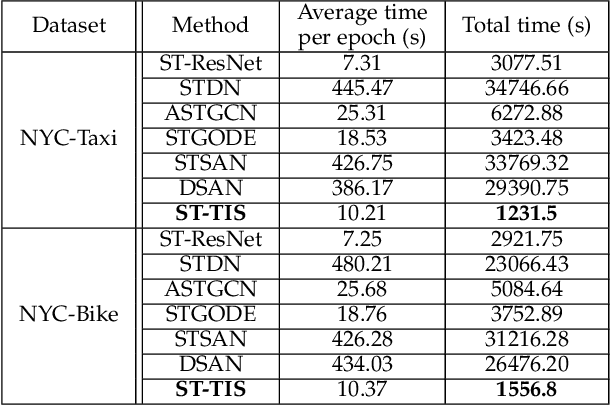
We study the forecasting problem for traffic with dynamic, possibly periodical, and joint spatial-temporal dependency between regions. Given the aggregated inflow and outflow traffic of regions in a city from time slots 0 to t-1, we predict the traffic at time t at any region. Prior arts in the area often consider the spatial and temporal dependencies in a decoupled manner or are rather computationally intensive in training with a large number of hyper-parameters to tune. We propose ST-TIS, a novel, lightweight, and accurate Spatial-Temporal Transformer with information fusion and region sampling for traffic forecasting. ST-TIS extends the canonical Transformer with information fusion and region sampling. The information fusion module captures the complex spatial-temporal dependency between regions. The region sampling module is to improve the efficiency and prediction accuracy, cutting the computation complexity for dependency learning from $O(n^2)$ to $O(n\sqrt{n})$, where n is the number of regions. With far fewer parameters than state-of-the-art models, the offline training of our model is significantly faster in terms of tuning and computation (with a reduction of up to $90\%$ on training time and network parameters). Notwithstanding such training efficiency, extensive experiments show that ST-TIS is substantially more accurate in online prediction than state-of-the-art approaches (with an average improvement of up to $9.5\%$ on RMSE, and $12.4\%$ on MAPE).
POI Alias Discovery in Delivery Addresses using User Locations
Sep 20, 2021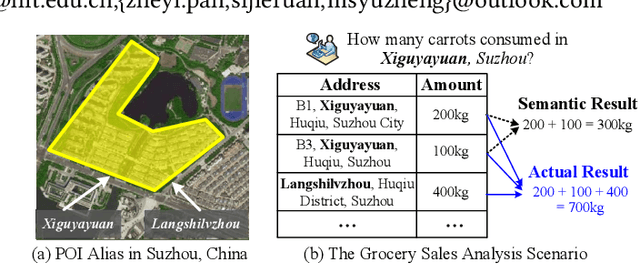
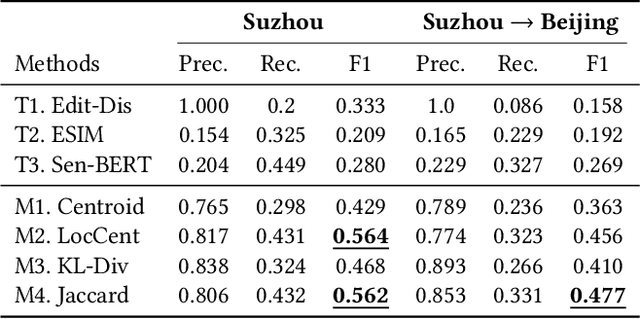
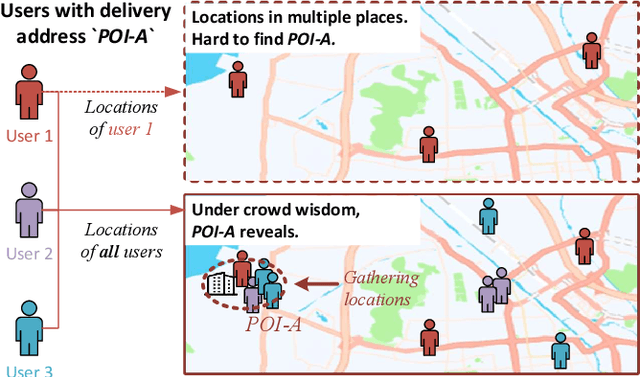
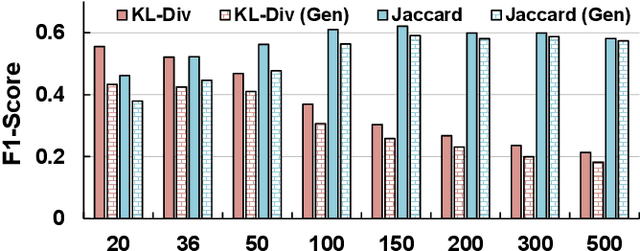
People often refer to a place of interest (POI) by an alias. In e-commerce scenarios, the POI alias problem affects the quality of the delivery address of online orders, bringing substantial challenges to intelligent logistics systems and market decision-making. Labeling the aliases of POIs involves heavy human labor, which is inefficient and expensive. Inspired by the observation that the users' GPS locations are highly related to their delivery address, we propose a ubiquitous alias discovery framework. Firstly, for each POI name in delivery addresses, the location data of its associated users, namely Mobility Profile are extracted. Then, we identify the alias relationship by modeling the similarity of mobility profiles. Comprehensive experiments on the large-scale location data and delivery address data from JD logistics validate the effectiveness.
Predicting Citywide Crowd Flows Using Deep Spatio-Temporal Residual Networks
Jan 10, 2017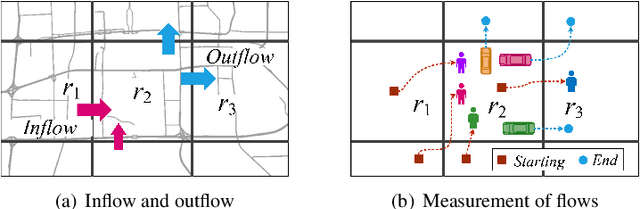

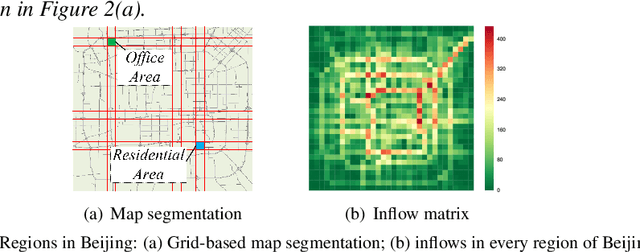
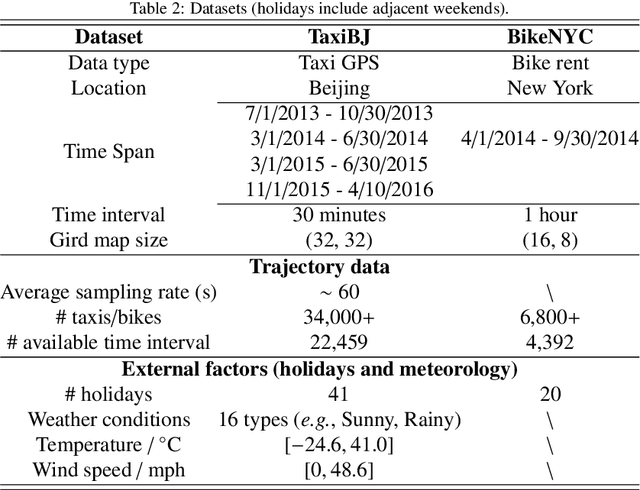
Forecasting the flow of crowds is of great importance to traffic management and public safety, and very challenging as it is affected by many complex factors, including spatial dependencies (nearby and distant), temporal dependencies (closeness, period, trend), and external conditions (e.g., weather and events). We propose a deep-learning-based approach, called ST-ResNet, to collectively forecast two types of crowd flows (i.e. inflow and outflow) in each and every region of a city. We design an end-to-end structure of ST-ResNet based on unique properties of spatio-temporal data. More specifically, we employ the residual neural network framework to model the temporal closeness, period, and trend properties of crowd traffic. For each property, we design a branch of residual convolutional units, each of which models the spatial properties of crowd traffic. ST-ResNet learns to dynamically aggregate the output of the three residual neural networks based on data, assigning different weights to different branches and regions. The aggregation is further combined with external factors, such as weather and day of the week, to predict the final traffic of crowds in each and every region. We have developed a real-time system based on Microsoft Azure Cloud, called UrbanFlow, providing the crowd flow monitoring and forecasting in Guiyang City of China. In addition, we present an extensive experimental evaluation using two types of crowd flows in Beijing and New York City (NYC), where ST-ResNet outperforms nine well-known baselines.