 Add to Chrome
 Add to Firefox
 Add to Edge
On the Scaling of PEFT: Towards Million Personal Models of Trillion Parameters
Jun 01, 2026
Parameter-efficient fine-tuning (PEFT) is usually treated as a cheaper alternative to full fine-tuning. We study a broader role: small trainable adapters as persistent local state on top of strong shared foundation models. In this framing, the base model provides shared competence while adapters carry instance-specific behavior such as preferences, skills, tool habits, and memory-like updates. We organize the problem around three scaling axes: Scale Up, where stronger shared priors make small local updates more useful; Scale Down, where we study how small adapters can be while remaining reliable; and Scale Out, where many persistent adapted instances coexist. MinT provides one infrastructure example for managing adapter identity, revision, provenance, evaluation, and serving residency. Together, the results suggest that PEFT can be a compact substrate for persistent personal models rather than only a budget substitute for full fine-tuning.

MinT: Managed Infrastructure for Training and Serving Millions of LLMs
May 13, 2026We present MindLab Toolkit (MinT), a managed infrastructure system for Low-Rank Adaptation (LoRA) post-training and online serving. MinT targets a setting where many trained policies are produced over a small number of expensive base-model deployments. Instead of materializing each policy as a merged full checkpoint, MinT keeps the base model resident and moves exported LoRA adapter revisions through rollout, update, export, evaluation, serving, and rollback, hiding distributed training, serving, scheduling, and data movement behind a service interface. MinT scales this path along three axes. Scale Up extends LoRA RL to frontier-scale dense and MoE architectures, including MLA and DSA attention paths, with training and serving validated beyond 1T total parameters. Scale Down moves only the exported LoRA adapter, which can be under 1% of base-model size in rank-1 settings; adapter-only handoff reduces the measured step by 18.3x on a 4B dense model and 2.85x on a 30B MoE, while concurrent multi-policy GRPO shortens wall time by 1.77x and 1.45x without raising peak memory. Scale Out separates durable policy addressability from CPU/GPU working sets: a tensor-parallel deployment supports 10^6-scale addressable catalogs (measured single-engine sweeps through 100K) and thousand-adapter active waves at cluster scale, with cold loading treated as scheduled service work and packed MoE LoRA tensors improving live engine loading by 8.5-8.7x. MinT thus manages million-scale LoRA policy catalogs while training and serving selected adapter revisions over shared 1T-class base models.
Memory-updated-based Framework for 100% Reliable Flexible Flat Cables Insertion
Feb 18, 2025Automatic assembly lines have increasingly replaced human labor in various tasks; however, the automation of Flexible Flat Cable (FFC) insertion remains unrealized due to its high requirement for effective feedback and dynamic operation, limiting approximately 11% of global industrial capacity. Despite lots of approaches, like vision-based tactile sensors and reinforcement learning, having been proposed, the implementation of human-like high-reliable insertion (i.e., with a 100% success rate in completed insertion) remains a big challenge. Drawing inspiration from human behavior in FFC insertion, which involves sensing three-dimensional forces, translating them into physical concepts, and continuously improving estimates, we propose a novel framework. This framework includes a sensing module for collecting three-dimensional tactile data, a perception module for interpreting this data into meaningful physical signals, and a memory module based on Bayesian theory for reliability estimation and control. This strategy enables the robot to accurately assess its physical state and generate reliable status estimations and corrective actions. Experimental results demonstrate that the robot using this framework can detect alignment errors of 0.5 mm with an accuracy of 97.92% and then achieve a 100% success rate in all completed tests after a few iterations. This work addresses the challenges of unreliable perception and control in complex insertion tasks, highlighting the path toward the development of fully automated production lines.
Design of a Double-joint Robotic Fish Using a Composite Linkage
Aug 13, 2024
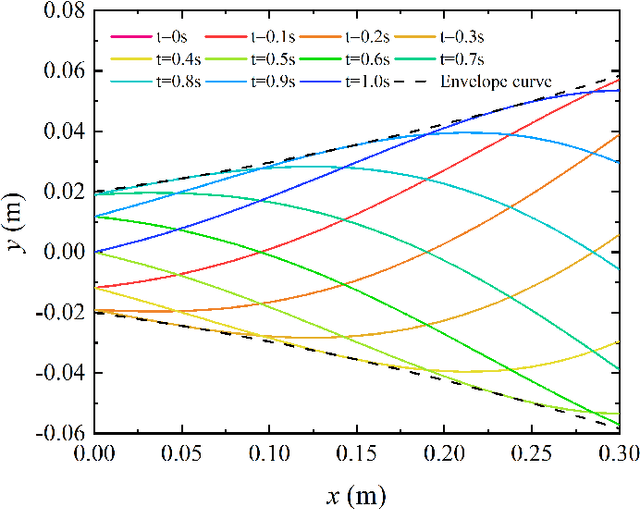


Robotic fish is one of the most promising directions of the new generation of underwater vehicles. Traditional biomimetic fish often mimic fish joints using tandem components like servos, which leads to increased volume, weight and control complexity. In this paper, a new double-joint robotic fish using a composite linkage was designed, where the propulsion mechanism transforms the single-degree-of-freedom rotation of the motor into a double-degree-of-freedom coupled motion, namely caudal peduncle translation and caudal fin rotation. Motion analysis of the propulsion mechanism demonstrates its ability to closely emulate the undulating movement observed in carangiform fish. Experimental results further validate the feasibility of the proposed propulsion mechanism. To improve propulsion efficiency, an analysis is conducted to explore the influence of swing angle amplitude and swing frequency on the swimming speed of the robotic fish. This examination establishes a practical foundation for future research on such robotic fish systems.