 Add to Chrome
 Add to Firefox
 Add to Edge
What Information Matters? Graph Out-of-Distribution Detection via Tri-Component Information Decomposition
May 14, 2026
Graph neural networks are widely used for node classification, but they remain vulnerable to out-of-distribution (OOD) shifts in node features and graph structure. Prior work established that methods trained with standard supervised learning (SL) objectives tend to capture spurious signals from either features and/or structure, leaving the model fragile under distributional changes. To address this, we propose TIDE, a novel and effective Tri-Component Information Decomposition framework that explicitly decomposes information into feature-specific, structure-specific and joint components. TIDE aims to preserve only the label-relevant part of the joint information while filtering out spurious feature- and structure-specific information, thereby enhancing the separation between in-distribution (ID) and OOD nodes. Beyond the framework, we provide theoretical and empirical analyses showing that an information bottleneck objective is preferable to standard SL for graph OOD detection, with higher ID confidence and a greater entropy gap between ID and OOD data. Extensive experiments across seven datasets confirm the efficacy of TIDE, achieving up to a 34% improvement in FPR95 over strong baselines while maintaining competitive ID accuracy.

GFMate: Empowering Graph Foundation Models with Test-time Prompt Tuning
May 14, 2026Graph prompt tuning has shown great potential in graph learning by introducing trainable prompts to enhance the model performance in conventional single-domain scenarios. Recent research has extended graph prompts to improve Graph Foundation Models (GFMs) by few-shot tuning auxiliary prompts. Despite their progress, most existing methods embed source-domain information into prompts, which serve either as input to GFMs or encoded during model pre-training. Such prompt entanglement with specific source domains and GFM pre-training strategy restricts their generalisability to other domains and different GFMs. Furthermore, existing GFM prompts merely rely on few-shot tuning for adaptation, neglecting the rich information in unlabelled target domain test data. Motivated by these insights, this paper aims to empower GFMs with pre-training-agnostic test-time graph prompt tuning, named GFMate. GFMate introduces centroid and layer prompts applied after pre-training on target domains, avoiding entanglement with specific source domains and model pre-training. In addition, a test-time complementary learning objective is devised to exploit both labelled and unlabelled target domain data for effective test-time prompt tuning. Extensive experiments on 12 benchmark datasets demonstrate the superior performance and efficiency of GFMate, achieving improvements of up to 30.63%. Code is available at https://github.com/YanJiangJerry/GFMate.
Block-R1: Rethinking the Role of Block Size in Multi-domain Reinforcement Learning for Diffusion Large Language Models
May 13, 2026Recently, reinforcement learning (RL) has been widely applied during post-training for diffusion large language models (dLLMs) to enhance reasoning with block-wise semi-autoregressive generation. Block size has therefore become a vital factor in dLLMs, since it determines the parallel decoding granularity and affects the rollout trajectories during RL optimisation, e.g., GRPO. Instead of investigating the effect of block size during inference on individual domains, this paper studies block size from a domain conflict perspective for dLLM RL post-training in multi-domain scenarios. The main contributions are: (1) a formulation of domain block size conflict in multi-domain RL for dLLMs, which will largely affect the post-training effectiveness for rollout-based RL methods; (2) a novel dataset, Block-R1-41K is constructed with a best-improved training block size for each sample, which also induces a Block Size Conflict Score to quantitatively measure the domain conflict; (3) a new benchmark, Block-R1, for flexible RL post-training for dLLMs in both single and cross domain; and (4) a simple yet powerful cross-domain post-training method with sample-level best-improved training block sizes. Extensive experiments on 13 distinct datasets, 7 latest RL algorithms and diverse dLLM backbones are comprehensively covered in Block-R1. The benchmark is open-sourced at https://github.com/YanJiangJerry/Block-R1 with the dataset released at https://huggingface.co/datasets/YanJiangJerry/Block-R1-41K.
Break the Block: Dynamic-size Reasoning Blocks for Diffusion Large Language Models via Monotonic Entropy Descent with Reinforcement Learning
May 04, 2026Recent diffusion large language models (dLLMs) have demonstrated both effectiveness and efficiency in reasoning via a block-based semi-autoregressive generation paradigm. Despite their progress, the fixed-size block generations remain a critical bottleneck for effective and coherent reasoning. 1. From a global perspective, different reasoning tasks would correspond to different optimal decoding block sizes, which makes a ``one-size-fits-all'' assumption ineffective. 2. Even within a single reasoning task, the rigid block partitioning would break the logical flow and reduce reasoning coherence. Through empirical observations, we reveal that for block-wise entropy, incorrect reasoning exhibits a fluctuating and unsteady trend between blocks, whereas the correctly generated tasks follow a consistent descending trend. Therefore, this paper proposes b1, a novel post-training framework for dLLMs that learns dynamic-size reasoning blocks via a Monotonic Entropy Descent objective with reinforcement learning to enhance reasoning coherence.b1 integrates seamlessly as a plug-and-play module with existing dLLM's post-training algorithms. Extensive experiments across various reasoning benchmarks showcase b1's consistent improvement over existing fixed-size block baselines. Our code has been released at https://github.com/YanJiangJerry/Block-R1.
When to Commit? Towards Variable-Size Self-Contained Blocks for Discrete Diffusion Language Models
Apr 27, 2026Discrete diffusion language models (dLLMs) enable parallel token updates with bidirectional attention, yet practical generation typically adopts blockwise semi-autoregressive decoding. This switch creates a training-inference mismatch: training denoises with full-sequence context, while inference commits tokens within a bounded block without future context. Therefore, decoding with fixed-size or heuristic-based blocks can lead to premature token commitments, as decisions are made without full access to future context that could alter those choices. Motivated by this, we propose self-containedness as a principled criterion for block commitment. A block is self-contained if its predictions remain consistent with Future-Aware (FA) or without No-Future (NF) access to future context, reframing block boundary selection as a test of self-containedness rather than a heuristic choice. Based on this principle, we introduce Variable-size Self-contained Blocks (VSB) for dLLMs. VSB scores and selects block boundaries using the divergence between token-level predictive distributions under NF and FA conditioning, which quantifies how predictions would change if future context were revealed. We provide theoretical justification linking self-containedness to predictive consistency, and extensive experiments validate VSB's efficacy over fixed-size and heuristic blockwise decoding.
TRN-R1-Zero: Text-rich Network Reasoning via LLMs with Reinforcement Learning Only
Apr 21, 2026Zero-shot reasoning on text-rich networks (TRNs) remains a challenging frontier, as models must integrate textual semantics with relational structure without task-specific supervision. While graph neural networks rely on fixed label spaces and supervised objectives, recent large language model (LLM)-based approaches often overlook graph context or depend on distillation from larger models, limiting generalisation. We propose TRN-R1-Zero, a post-training framework for TRN reasoning trained solely via reinforcement learning. TRN-R1-Zero directly optimises base LLMs using a Neighbour-aware Group Relative Policy Optimisation objective that dynamically adjusts rewards based on a novel margin gain metric for the informativeness of neighbouring signals, effectively guiding the model toward relational reasoning. Unlike prior methods, TRN-R1-Zero requires no supervised fine-tuning or chain-of-thought data generated from large reasoning models. Extensive experiments across citation, hyperlink, social and co-purchase TRN benchmarks demonstrate the superiority and robustness of TRN-R1-Zero. Moreover, relying strictly on node-level training, TRN-R1-Zero achieves zero-shot inference on edge- and graph-level tasks, extending beyond cross-domain transfer. The codebase is publicly available at https://github.com/superallen13/TRN-R1-Zero.
ReaKase-8B: Legal Case Retrieval via Knowledge and Reasoning Representations with LLMs
Oct 30, 2025Legal case retrieval (LCR) is a cornerstone of real-world legal decision making, as it enables practitioners to identify precedents for a given query case. Existing approaches mainly rely on traditional lexical models and pretrained language models to encode the texts of legal cases. Yet there are rich information in the relations among different legal entities as well as the crucial reasoning process that uncovers how legal facts and legal issues can lead to judicial decisions. Such relational reasoning process reflects the distinctive characteristics of each case that can distinguish one from another, mirroring the real-world judicial process. Naturally, incorporating such information into the precise case embedding could further enhance the accuracy of case retrieval. In this paper, a novel ReaKase-8B framework is proposed to leverage extracted legal facts, legal issues, legal relation triplets and legal reasoning for effective legal case retrieval. ReaKase-8B designs an in-context legal case representation learning paradigm with a fine-tuned large language model. Extensive experiments on two benchmark datasets from COLIEE 2022 and COLIEE 2023 demonstrate that our knowledge and reasoning augmented embeddings substantially improve retrieval performance over baseline models, highlighting the potential of integrating legal reasoning into legal case retrieval systems. The code has been released on https://github.com/yanran-tang/ReaKase-8B.
Does Homophily Help in Robust Test-time Node Classification?
Oct 25, 2025Homophily, the tendency of nodes from the same class to connect, is a fundamental property of real-world graphs, underpinning structural and semantic patterns in domains such as citation networks and social networks. Existing methods exploit homophily through designing homophily-aware GNN architectures or graph structure learning strategies, yet they primarily focus on GNN learning with training graphs. However, in real-world scenarios, test graphs often suffer from data quality issues and distribution shifts, such as domain shifts across users from different regions in social networks and temporal evolution shifts in citation network graphs collected over varying time periods. These factors significantly compromise the pre-trained model's robustness, resulting in degraded test-time performance. With empirical observations and theoretical analysis, we reveal that transforming the test graph structure by increasing homophily in homophilic graphs or decreasing it in heterophilic graphs can significantly improve the robustness and performance of pre-trained GNNs on node classifications, without requiring model training or update. Motivated by these insights, a novel test-time graph structural transformation method grounded in homophily, named GrapHoST, is proposed. Specifically, a homophily predictor is developed to discriminate test edges, facilitating adaptive test-time graph structural transformation by the confidence of predicted homophily scores. Extensive experiments on nine benchmark datasets under a range of test-time data quality issues demonstrate that GrapHoST consistently achieves state-of-the-art performance, with improvements of up to 10.92%. Our code has been released at https://github.com/YanJiangJerry/GrapHoST.
MARCO: A Cooperative Knowledge Transfer Framework for Personalized Cross-domain Recommendations
Oct 06, 2025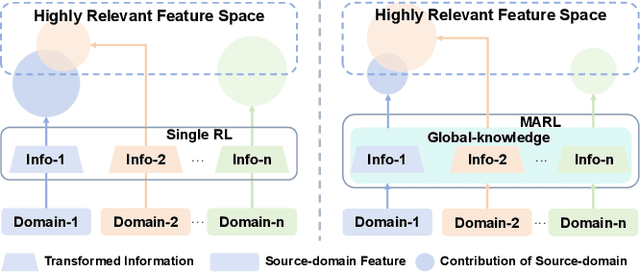
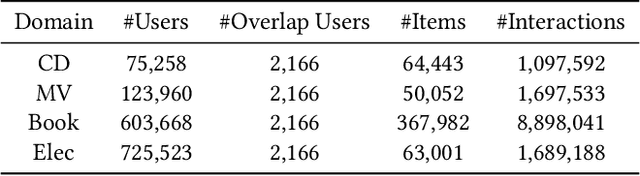
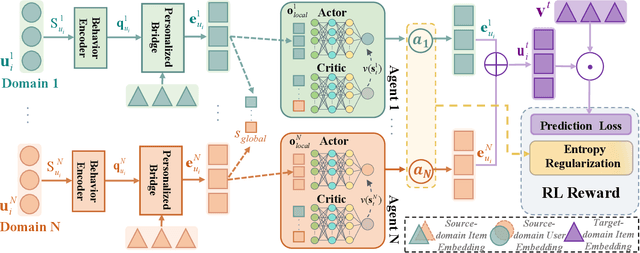
Recommender systems frequently encounter data sparsity issues, particularly when addressing cold-start scenarios involving new users or items. Multi-source cross-domain recommendation (CDR) addresses these challenges by transferring valuable knowledge from multiple source domains to enhance recommendations in a target domain. However, existing reinforcement learning (RL)-based CDR methods typically rely on a single-agent framework, leading to negative transfer issues caused by inconsistent domain contributions and inherent distributional discrepancies among source domains. To overcome these limitations, MARCO, a Multi-Agent Reinforcement Learning-based Cross-Domain recommendation framework, is proposed. It leverages cooperative multi-agent reinforcement learning, where each agent is dedicated to estimating the contribution from an individual source domain, effectively managing credit assignment and mitigating negative transfer. In addition, an entropy-based action diversity penalty is introduced to enhance policy expressiveness and stabilize training by encouraging diverse agents' joint actions. Extensive experiments across four benchmark datasets demonstrate MARCO's superior performance over state-of-the-art methods, highlighting its robustness and strong generalization capabilities. The code is at https://github.com/xiewilliams/MARCO.
ALSA: Anchors in Logit Space for Out-of-Distribution Accuracy Estimation
Aug 27, 2025Estimating model accuracy on unseen, unlabeled datasets is crucial for real-world machine learning applications, especially under distribution shifts that can degrade performance. Existing methods often rely on predicted class probabilities (softmax scores) or data similarity metrics. While softmax-based approaches benefit from representing predictions on the standard simplex, compressing logits into probabilities leads to information loss. Meanwhile, similarity-based methods can be computationally expensive and domain-specific, limiting their broader applicability. In this paper, we introduce ALSA (Anchors in Logit Space for Accuracy estimation), a novel framework that preserves richer information by operating directly in the logit space. Building on theoretical insights and empirical observations, we demonstrate that the aggregation and distribution of logits exhibit a strong correlation with the predictive performance of the model. To exploit this property, ALSA employs an anchor-based modeling strategy: multiple learnable anchors are initialized in logit space, each assigned an influence function that captures subtle variations in the logits. This allows ALSA to provide robust and accurate performance estimates across a wide range of distribution shifts. Extensive experiments on vision, language, and graph benchmarks demonstrate ALSA's superiority over both softmax- and similarity-based baselines. Notably, ALSA's robustness under significant distribution shifts highlights its potential as a practical tool for reliable model evaluation.