 Add to Chrome
 Add to Firefox
 Add to Edge
DA-WAM: Decision-Aligned Future Latents for Driving World Models
Aug 20, 2026
Anticipating how scenes evolve under ego actions is fundamental to safe autonomous driving, yet the full potential of world models for decision-making remains unrealized. The critical challenge lies in ensuring that future modeling is not merely predictive, but decision-informative: the predicted future must directly shape which trajectory is selected. Existing approaches decouple future representation learning from planning optimization, or share predicted states across trajectory candidates, thereby diluting the action-specific consequences that ought to guide selection. To bridge this gap, we propose DA-WAM, a framework that unifies predictive representation learning, action-conditioned future modeling, and trajectory scoring under a single decision-making objective. DA-WAM maintains predictive supervision throughout planner optimization via an online encoder and a stable momentum target, allowing future representations to co-evolve with the driving task. An action-conditioned predictor generates a distinct future latent state per trajectory candidate, which is then evaluated by a future-latent-conditioned factorized scorer. For the expert-matched trajectory, the predicted future latent is supervised by the observed future representation, while safety-critical hard negatives provide additional supervision near planning boundaries. Extensive experiments on NAVSIM-v1 and NAVSIM-v2 demonstrate state-of-the-art performance, while ablations and diagnostic analyses validate the key components.

LUNA-AD: Lightweight Uncertainty-Aware Language Model with Lifelong Learning for Autonomous Driving
Jun 07, 2026While large language models (LLMs) offer promising reasoning capabilities, their integration into safety-critical driving systems is hindered by limited reasoning diversity, high computational overhead, and static learning paradigms. To address these challenges, we propose LUNA-AD, a lightweight uncertainty-aware language model with lifelong learning for autonomous driving (AD). LUNA-AD features a tri-system architecture that reconciles complex multimodal behavioral reasoning, efficient deployment, and continual refinement. We design a multi-agent analytical system to generate uncertainty-aware decision-making demonstrations through diverse hypothesis exploration. A dual-head lightweight heuristic model is distilled to unify the inference of decision distributions and textual explanations while enabling efficient deployment. Furthermore, a reflection-driven lifelong learning mechanism operates on multimodal decision outputs and preserves strategic diversity, allowing for the refinement of candidate decisions and rationales via closed-loop feedback to enhance driving robustness. Extensive experiments on nuPlan benchmarks demonstrate that LUNA-AD achieves state-of-the-art success rates under both non-reactive and reactive modes, with drastically reduced inference latency compared to existing knowledge-driven AD frameworks.
Decision-Making with Lightweight Confidence-Aware Language Model for Autonomous Driving
May 25, 2026Large Language Models (LLMs) and Multimodal LLMs (MLLMs) have demonstrated immense potential in autonomous driving (AD) by offering human-like reasoning and open-world generalization. However, the excessive computational overhead and high inference latency of these massive models severely hinder their deployment in resource-constrained AD systems. To address this challenge, we propose a novel decision-making framework utilizing a lightweight confidence-aware language model, which bridges the gap between complex multimodal intention reasoning and efficient inference. Specifically, we design a multi-agent collaborative workflow, comprising action voting, confidence assessment, and summarization agents, to generate high-quality, confidence-annotated decision demonstrations via explicit Chain-of-Thought (CoT) reasoning. These demonstrations are then distilled into a lightweight language model featuring a dual-head architecture, enabling the joint prediction of decision probabilities and the generation of textual rationales. The distillation is realized via a confidence-aware fine-tuning strategy coupled with Retrieval Augmented Generation (RAG) to enhance the model's adaptability and data efficiency. Comprehensive closed-loop experiments on the nuPlan benchmark demonstrate that our approach achieves state-of-the-art (SOTA) success rates in both regular and long-tail scenarios while maintaining low inference latency.
Dynamic High-Order Control Barrier Functions with Diffuser for Safety-Critical Trajectory Planning at Signal-Free Intersections
Nov 29, 2024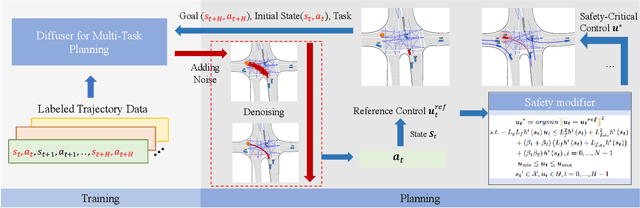

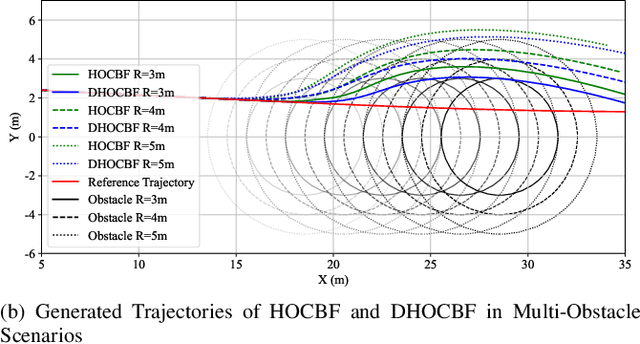
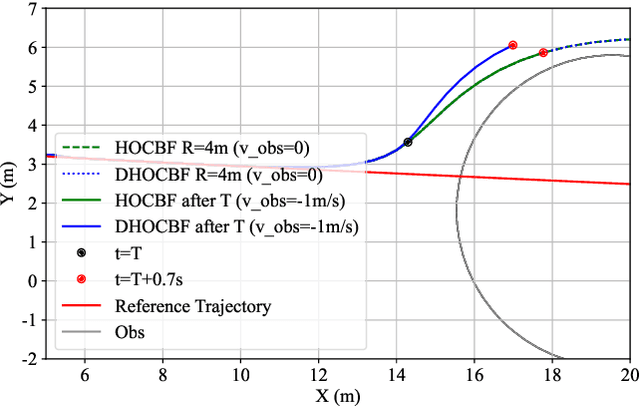
Planning safe and efficient trajectories through signal-free intersections presents significant challenges for autonomous vehicles (AVs), particularly in dynamic, multi-task environments with unpredictable interactions and an increased possibility of conflicts. This study aims to address these challenges by developing a robust, adaptive framework to ensure safety in such complex scenarios. Existing approaches often struggle to provide reliable safety mechanisms in dynamic and learn multi-task behaviors from demonstrations in signal-free intersections. This study proposes a safety-critical planning method that integrates Dynamic High-Order Control Barrier Functions (DHOCBF) with a diffusion-based model, called Dynamic Safety-Critical Diffuser (DSC-Diffuser), offering a robust solution for adaptive, safe, and multi-task driving in signal-free intersections. Our approach incorporates a goal-oriented, task-guided diffusion model, enabling the model to learn multiple driving tasks simultaneously from real-world data. To further ensure driving safety in dynamic environments, the proposed DHOCBF framework dynamically adjusts to account for the movements of surrounding vehicles, offering enhanced adaptability compared to traditional control barrier functions. Validity evaluations of DHOCBF, conducted through numerical simulations, demonstrate its robustness in adapting to variations in obstacle velocities, sizes, uncertainties, and locations, effectively maintaining driving safety across a wide range of complex and uncertain scenarios. Performance evaluations across various scenes confirm that DSC-Diffuser provides realistic, stable, and generalizable policies, equipping it with the flexibility to adapt to diverse driving tasks.
Neural Operators for Boundary Stabilization of Stop-and-go Traffic
Dec 16, 2023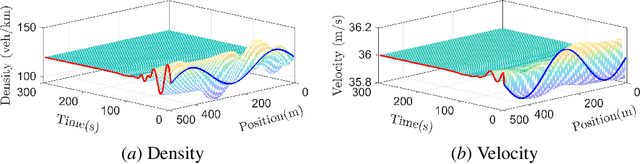
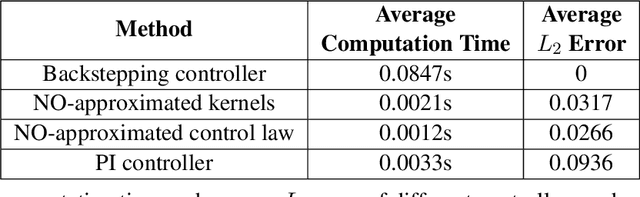
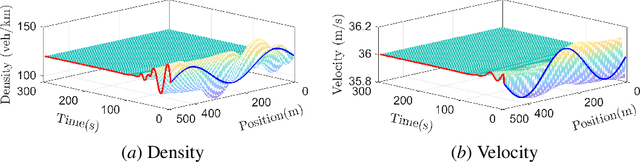
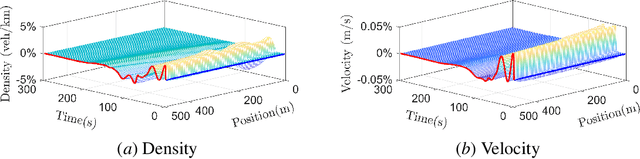
This paper introduces a novel approach to PDE boundary control design using neural operators to alleviate stop-and-go instabilities in congested traffic flow. Our framework leverages neural operators to design control strategies for traffic flow systems. The traffic dynamics are described by the Aw-Rascle-Zhang (ARZ) model, which comprises a set of second-order coupled hyperbolic partial differential equations (PDEs). Backstepping method is widely used for boundary control of such PDE systems. The PDE model-based control design can be time-consuming and require intensive depth of expertise since it involves constructing and solving backstepping control kernels. To overcome these challenges, we present two distinct neural operator (NO) learning schemes aimed at stabilizing the traffic PDE system. The first scheme embeds NO-approximated gain kernels within a predefined backstepping controller, while the second one directly learns a boundary control law. The Lyapunov analysis is conducted to evaluate the stability of the NO-approximated gain kernels and control law. It is proved that the NO-based closed-loop system is practical stable under certain approximation accuracy conditions in NO-learning. To validate the efficacy of the proposed approach, simulations are conducted to compare the performance of the two neural operator controllers with a PDE backstepping controller and a Proportional Integral (PI) controller. While the NO-approximated methods exhibit higher errors compared to the backstepping controller, they consistently outperform the PI controller, demonstrating faster computation speeds across all scenarios. This result suggests that neural operators can significantly expedite and simplify the process of obtaining boundary controllers in traffic PDE systems.