 Add to Chrome
 Add to Firefox
 Add to Edge
Step 3.5 Flash: Open Frontier-Level Intelligence with 11B Active Parameters
Feb 11, 2026
We introduce Step 3.5 Flash, a sparse Mixture-of-Experts (MoE) model that bridges frontier-level agentic intelligence and computational efficiency. We focus on what matters most when building agents: sharp reasoning and fast, reliable execution. Step 3.5 Flash pairs a 196B-parameter foundation with 11B active parameters for efficient inference. It is optimized with interleaved 3:1 sliding-window/full attention and Multi-Token Prediction (MTP-3) to reduce the latency and cost of multi-round agentic interactions. To reach frontier-level intelligence, we design a scalable reinforcement learning framework that combines verifiable signals with preference feedback, while remaining stable under large-scale off-policy training, enabling consistent self-improvement across mathematics, code, and tool use. Step 3.5 Flash demonstrates strong performance across agent, coding, and math tasks, achieving 85.4% on IMO-AnswerBench, 86.4% on LiveCodeBench-v6 (2024.08-2025.05), 88.2% on tau2-Bench, 69.0% on BrowseComp (with context management), and 51.0% on Terminal-Bench 2.0, comparable to frontier models such as GPT-5.2 xHigh and Gemini 3.0 Pro. By redefining the efficiency frontier, Step 3.5 Flash provides a high-density foundation for deploying sophisticated agents in real-world industrial environments.

Prediction of GPU Failures Under Deep Learning Workloads
Jan 27, 2022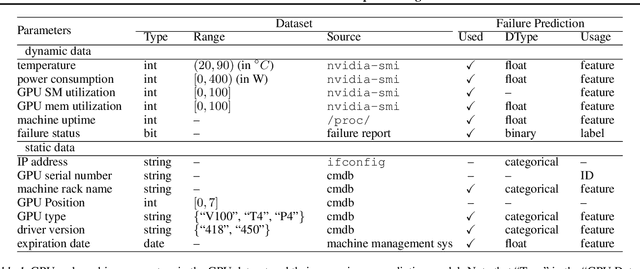
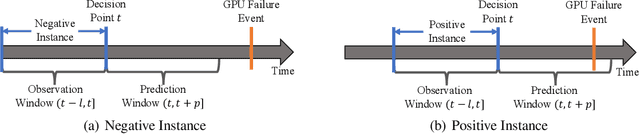
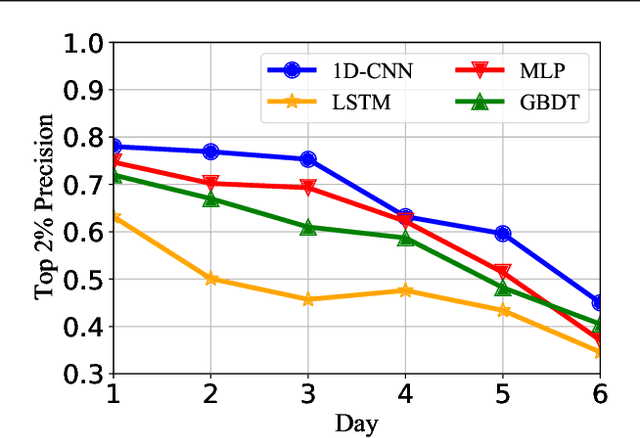
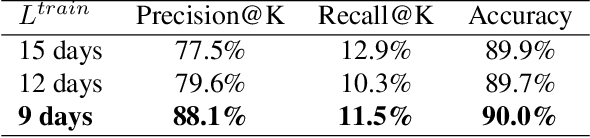
Graphics processing units (GPUs) are the de facto standard for processing deep learning (DL) tasks. Meanwhile, GPU failures, which are inevitable, cause severe consequences in DL tasks: they disrupt distributed trainings, crash inference services, and result in service level agreement violations. To mitigate the problem caused by GPU failures, we propose to predict failures by using ML models. This paper is the first to study prediction models of GPU failures under large-scale production deep learning workloads. As a starting point, we evaluate classic prediction models and observe that predictions of these models are both inaccurate and unstable. To improve the precision and stability of predictions, we propose several techniques, including parallel and cascade model-ensemble mechanisms and a sliding training method. We evaluate the performances of our various techniques on a four-month production dataset including 350 million entries. The results show that our proposed techniques improve the prediction precision from 46.3\% to 84.0\%.