 Add to Chrome
 Add to Firefox
 Add to Edge
Fast Object Removal Attacks on Safety-Critical Video-based Perception Systems
Aug 03, 2026
By leveraging data from video-based perception systems, intelligent transportation systems (ITS) support safety-critical applications that improve road safety. However, adversaries may manipulate video frames to compromise downstream perception modules, causing failures in safety-critical functions and increasing risks to vulnerable road users. This paper presents a novel attack model and an end-to-end framework for near-real-time targeted object removal attack on a video-based safety-critical system. The end-to-end attack pipeline consists of four stages: localizing targets in each frame, retrieving coherent patches from earlier frames, blending them using context-aware alpha compositing, and reconstructing attacked frames. Experiments at an intersection on the South Carolina Connected Vehicle Testbed (SC-CVT) show that reconstructed frames have high global similarity to the originals, with frame-level Peak Signal to Noise Ratio (PSNR) above 40 dB and Structural Similarity Index Measure (SSIM) above 0.996. Using the YOLO-based detector, the attack reduces object detections by up to 97.59% and achieves a frame-level attack success rate of 94.48%. Across the evaluated detectors and frame resolutions, the mean execution time ranges from 0.074 to 0.172 seconds per frame on GPU hardware, indicating near-real-time performance in testing. The forensic evaluation using several pretrained tamper-detection models shows limited ability to distinguish reconstructed from authentic frames. The findings suggest that video-based perception is vulnerable to stealthy object removal attacks that can degrade the performance of safety-critical applications by reducing object detectability. These findings can help develop mitigation strategies against adversarial object removal attacks that threaten safety-critical applications, such as vision-based pedestrian safety systems.

Fine-Tuning Dynamics of In-Context Factual Recall in Transformers
May 26, 2026In-context learning \ -- performing tasks based on examples given in the prompt \ -- is an important capability that has emerged in large language models and has received significant attention in both theory and practice. Existing theoretical work often focuses on settings where the learning uses information purely from the prompt. However, many practical instances of in-context learning require the model to retrieve factual knowledge stored in the model's parameters, with the context serving to identify which knowledge is relevant. In this work, we study how in-context learning leverages factual knowledge recall. We formalize this behavior by introducing the \emph{in-context factual recall (IC-recall)} task, where a transformer is provided a context of (subject, answer) pairs generated from a hidden relation, along with a query subject, and must both infer this hidden relation and retrieve the corresponding answer. Factual knowledge is modeled by the transformer having access to a simple pre-constructed MLP associative memory storing (subject, relation, answer) triplets. We analyze the supervised fine-tuning dynamics of a one-layer transformer on IC-recall data and prove that the model successfully performs IC-recall by converging to a particular pairwise attention pattern. This fine-tuning stage requires a very small number of samples \ -- only polylogarithmic in the number of stored knowledge triplets. Experiments verify our theoretical predictions and show that the pairwise attention pattern emerges even when the MLP layer is pretrained instead of constructed.
Learning-Augmented Algorithms for $k$-median via Online Learning
Mar 18, 2026The field of learning-augmented algorithms seeks to use ML techniques on past instances of a problem to inform an algorithm designed for a future instance. In this paper, we introduce a novel model for learning-augmented algorithms inspired by online learning. In this model, we are given a sequence of instances of a problem and the goal of the learning-augmented algorithm is to use prior instances to propose a solution to a future instance of the problem. The performance of the algorithm is measured by its average performance across all the instances, where the performance on a single instance is the ratio between the cost of the algorithm's solution and that of an optimal solution for that instance. We apply this framework to the classic $k$-median clustering problem, and give an efficient learning algorithm that can approximately match the average performance of the best fixed $k$-median solution in hindsight across all the instances. We also experimentally evaluate our algorithm and show that its empirical performance is close to optimal, and also that it automatically adapts the solution to a dynamically changing sequence.
ReCaLL: Membership Inference via Relative Conditional Log-Likelihoods
Jun 23, 2024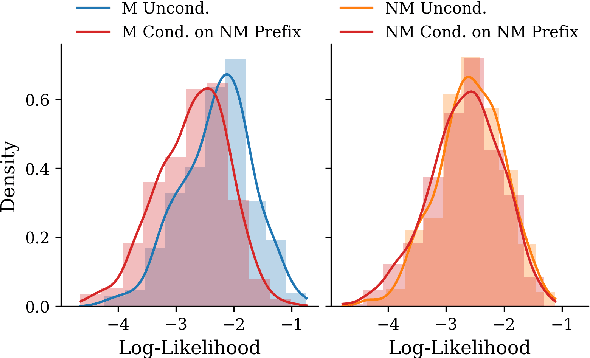
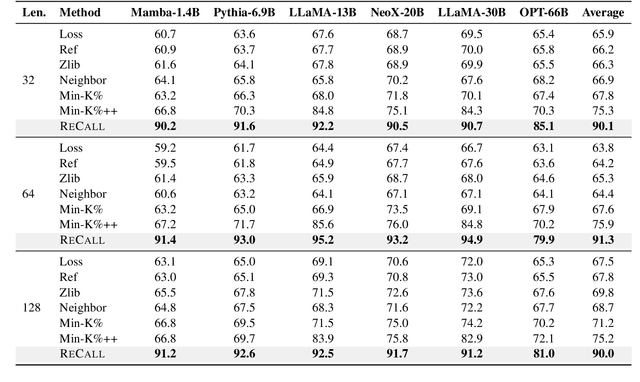

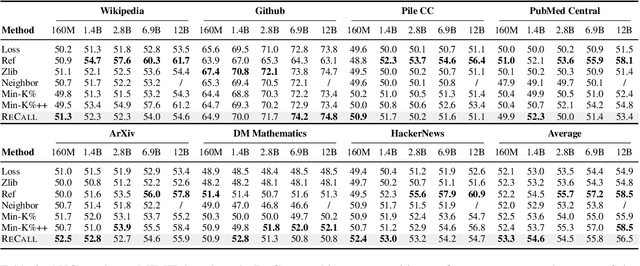
The rapid scaling of large language models (LLMs) has raised concerns about the transparency and fair use of the pretraining data used for training them. Detecting such content is challenging due to the scale of the data and limited exposure of each instance during training. We propose ReCaLL (Relative Conditional Log-Likelihood), a novel membership inference attack (MIA) to detect LLMs' pretraining data by leveraging their conditional language modeling capabilities. ReCaLL examines the relative change in conditional log-likelihoods when prefixing target data points with non-member context. Our empirical findings show that conditioning member data on non-member prefixes induces a larger decrease in log-likelihood compared to non-member data. We conduct comprehensive experiments and show that ReCaLL achieves state-of-the-art performance on the WikiMIA dataset, even with random and synthetic prefixes, and can be further improved using an ensemble approach. Moreover, we conduct an in-depth analysis of LLMs' behavior with different membership contexts, providing insights into how LLMs leverage membership information for effective inference at both the sequence and token level.
Reassessing How to Compare and Improve the Calibration of Machine Learning Models
Jun 06, 2024
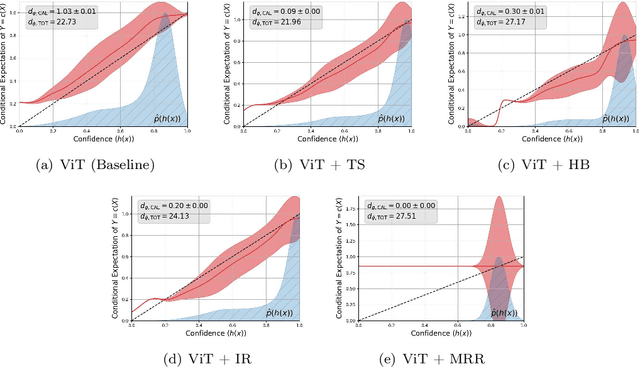
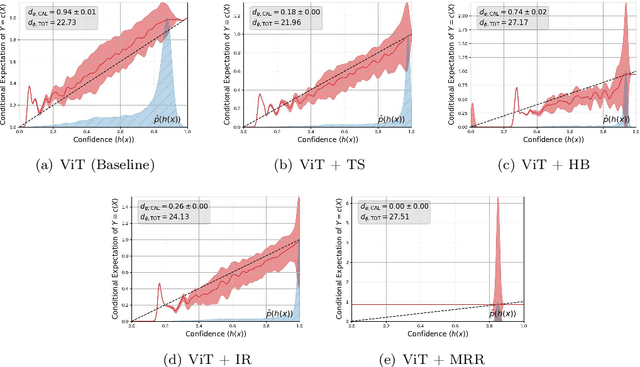
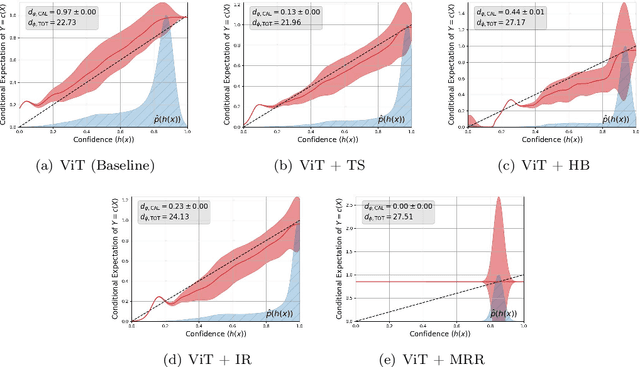
A machine learning model is calibrated if its predicted probability for an outcome matches the observed frequency for that outcome conditional on the model prediction. This property has become increasingly important as the impact of machine learning models has continued to spread to various domains. As a result, there are now a dizzying number of recent papers on measuring and improving the calibration of (specifically deep learning) models. In this work, we reassess the reporting of calibration metrics in the recent literature. We show that there exist trivial recalibration approaches that can appear seemingly state-of-the-art unless calibration and prediction metrics (i.e. test accuracy) are accompanied by additional generalization metrics such as negative log-likelihood. We then derive a calibration-based decomposition of Bregman divergences that can be used to both motivate a choice of calibration metric based on a generalization metric, and to detect trivial calibration. Finally, we apply these ideas to develop a new extension to reliability diagrams that can be used to jointly visualize calibration as well as the estimated generalization error of a model.
How Does Gradient Descent Learn Features -- A Local Analysis for Regularized Two-Layer Neural Networks
Jun 03, 2024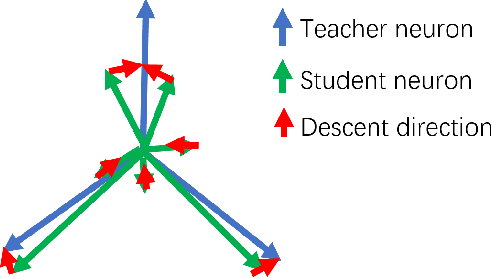
The ability of learning useful features is one of the major advantages of neural networks. Although recent works show that neural network can operate in a neural tangent kernel (NTK) regime that does not allow feature learning, many works also demonstrate the potential for neural networks to go beyond NTK regime and perform feature learning. Recently, a line of work highlighted the feature learning capabilities of the early stages of gradient-based training. In this paper we consider another mechanism for feature learning via gradient descent through a local convergence analysis. We show that once the loss is below a certain threshold, gradient descent with a carefully regularized objective will capture ground-truth directions. Our results demonstrate that feature learning not only happens at the initial gradient steps, but can also occur towards the end of training.
Robust Second-Order Nonconvex Optimization and Its Application to Low Rank Matrix Sensing
Mar 12, 2024Finding an approximate second-order stationary point (SOSP) is a well-studied and fundamental problem in stochastic nonconvex optimization with many applications in machine learning. However, this problem is poorly understood in the presence of outliers, limiting the use of existing nonconvex algorithms in adversarial settings. In this paper, we study the problem of finding SOSPs in the strong contamination model, where a constant fraction of datapoints are arbitrarily corrupted. We introduce a general framework for efficiently finding an approximate SOSP with \emph{dimension-independent} accuracy guarantees, using $\widetilde{O}({D^2}/{\epsilon})$ samples where $D$ is the ambient dimension and $\epsilon$ is the fraction of corrupted datapoints. As a concrete application of our framework, we apply it to the problem of low rank matrix sensing, developing efficient and provably robust algorithms that can tolerate corruptions in both the sensing matrices and the measurements. In addition, we establish a Statistical Query lower bound providing evidence that the quadratic dependence on $D$ in the sample complexity is necessary for computationally efficient algorithms.
Linear Transformers are Versatile In-Context Learners
Feb 21, 2024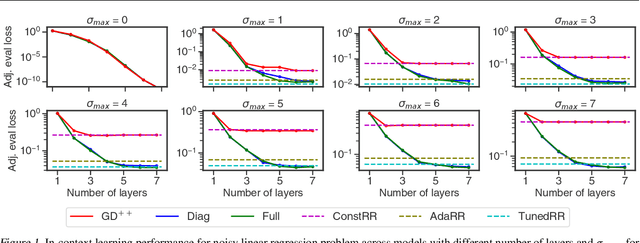


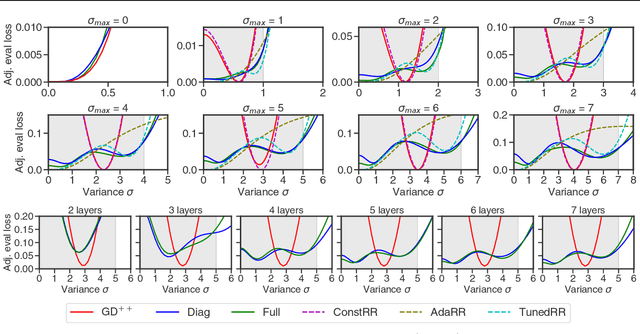
Recent research has demonstrated that transformers, particularly linear attention models, implicitly execute gradient-descent-like algorithms on data provided in-context during their forward inference step. However, their capability in handling more complex problems remains unexplored. In this paper, we prove that any linear transformer maintains an implicit linear model and can be interpreted as performing a variant of preconditioned gradient descent. We also investigate the use of linear transformers in a challenging scenario where the training data is corrupted with different levels of noise. Remarkably, we demonstrate that for this problem linear transformers discover an intricate and highly effective optimization algorithm, surpassing or matching in performance many reasonable baselines. We reverse-engineer this algorithm and show that it is a novel approach incorporating momentum and adaptive rescaling based on noise levels. Our findings show that even linear transformers possess the surprising ability to discover sophisticated optimization strategies.
Mean-Field Analysis for Learning Subspace-Sparse Polynomials with Gaussian Input
Feb 14, 2024In this work, we study the mean-field flow for learning subspace-sparse polynomials using stochastic gradient descent and two-layer neural networks, where the input distribution is standard Gaussian and the output only depends on the projection of the input onto a low-dimensional subspace. We propose a basis-free generalization of the merged-staircase property in Abbe et al. (2022) and establish a necessary condition for the SGD-learnability. In addition, we prove that the condition is almost sufficient, in the sense that a condition slightly stronger than the necessary condition can guarantee the exponential decay of the loss functional to zero.
For Better or For Worse? Learning Minimum Variance Features With Label Augmentation
Feb 10, 2024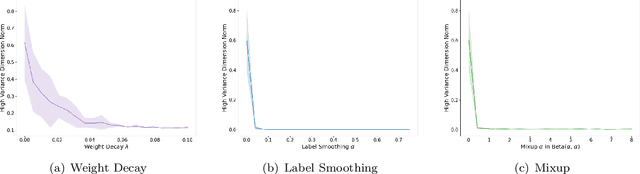
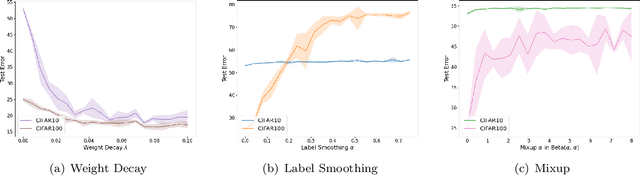
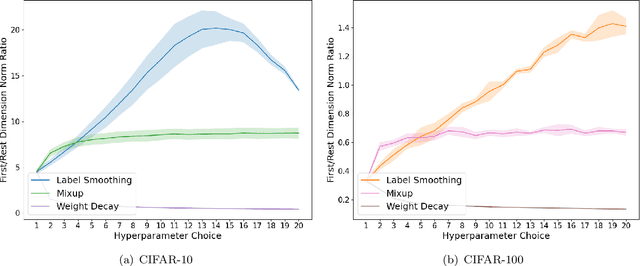
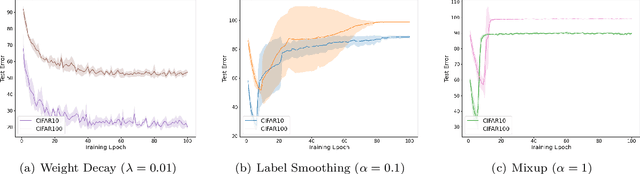
Data augmentation has been pivotal in successfully training deep learning models on classification tasks over the past decade. An important subclass of data augmentation techniques - which includes both label smoothing and Mixup - involves modifying not only the input data but also the input label during model training. In this work, we analyze the role played by the label augmentation aspect of such methods. We prove that linear models on linearly separable data trained with label augmentation learn only the minimum variance features in the data, while standard training (which includes weight decay) can learn higher variance features. An important consequence of our results is negative: label smoothing and Mixup can be less robust to adversarial perturbations of the training data when compared to standard training. We verify that our theory reflects practice via a range of experiments on synthetic data and image classification benchmarks.