 Add to Chrome
 Add to Firefox
 Add to Edge
Nemotron 3 Ultra: Open, Efficient Mixture-of-Experts Hybrid Mamba-Transformer Model for Agentic Reasoning
Jun 12, 2026
We introduce Nemotron 3 Ultra, a 550 billion total and 55 billion active parameter Mixture-of-Experts Hybrid Mamba-Attention language model. We pre-trained Nemotron 3 Ultra on 20 trillion text tokens, then extended the context length to 1M tokens, and post-trained using Supervised Fine Tuning (SFT), Reinforcement Learning (RL), and Multi-teacher On-Policy Distillation (MOPD). Nemotron 3 Ultra is our most capable model yet, employing multiple key technologies - LatentMoE, Multi Token Prediction (MTP), NVFP4 pre-training, multi-environment RLVR, MOPD, and reasoning budget control. Nemotron 3 Ultra achieves up to ~6x higher inference throughput as compared to state-of-the-art publicly available LLMs while attaining on-par accuracy. The state-of-the-art accuracy, high inference throughput, and 1M token context length make Nemotron 3 Ultra ideal for long-running autonomous agentic tasks. We open-source the base, post-trained, and quantized checkpoints, along with the training data and recipe on HuggingFace.

Workspace Optimization: How to Train Your Agent
May 10, 2026Modern agents built on frontier language models often cannot adapt their weights. What, then, remains trainable? We argue it is the agent's \emph{workspace}, the structured external substrate it reads, writes, and tests; we call its evolution workspace optimization. Workspace optimization targets hard multi-turn environments where a frontier model has strong priors but cannot solve the task in a single shot, so the agent must learn through interaction. We propose a principled way to evolve the workspace, mirroring the structure of weight-space training: artifacts in place of parameters, evidence in place of data, counterexamples in place of losses, and textual feedback in place of gradients. We instantiate the idea in DreamTeam, a multi-agent harness for ARC-AGI-3 whose roles build an executable world model, plan, hypothesize, probe, strategize, and route failures. On the current 25-game ARC-AGI-3 public set under the official scoring protocol and averaged over two independent runs, DreamTeam improves the SOTA protocol-matched agent's score from 36% to 38.4%, while using 31% fewer environment actions per game.
Retrieval from Within: An Intrinsic Capability of Attention-Based Models
May 07, 2026Retrieval-augmented generation (RAG) typically treats retrieval and generation as separate systems. We ask whether an attention-based encoder-decoder can instead retrieve directly from its own internal representations. We introduce INTRA (INTrinsic Retrieval via Attention), a framework where decoder attention queries score pre-encoded evidence chunks that are then directly reused as context for generation. By construction, INTRA unifies retrieval and generation, eliminating the retriever-generator mismatch typical of RAG pipelines. This design also amortizes context encoding by reusing precomputed encoder states across queries. On question-answering benchmarks, INTRA outperforms strong engineered retrieval pipelines on both evidence recall and end-to-end answer quality. Our results demonstrate that attention-based models already possess a retrieval mechanism that can be elicited, rather than added as an external module.
Normalized Architectures are Natively 4-Bit
May 07, 2026Training large language models at 4-bit precision is critical for efficiency. We show that nGPT, an architecture that constrains weights and hidden representations to the unit hypersphere, is inherently more robust to low-precision arithmetic. This removes the need for interventions-such as applying random Hadamard transforms and performing per-tensor scaling calculations-to preserve model quality, and it enables stable end-to-end NVFP4 training. We validate this approach on both a 1.2B dense model and hybrid (Mamba-Transformer) MoE models of up to 3B/30B parameters. We trace this robustness to the dot product: while quantization noise remains largely uncorrelated in both standard and normalized architectures, the signal behaves differently. In nGPT, the hypersphere constraint enhances weak positive correlations among the element-wise products, leading to a constructive accumulation of the signal across the hidden dimension while the noise continues to average out. This yields a higher effective signal-to-noise ratio and a flatter loss landscape, with the effect strengthening as the hidden dimension grows, suggesting increasing advantages at scale. A reference implementation is available at https://github.com/anonymous452026/ngpt-nvfp4
FP4 All the Way: Fully Quantized Training of LLMs
May 25, 2025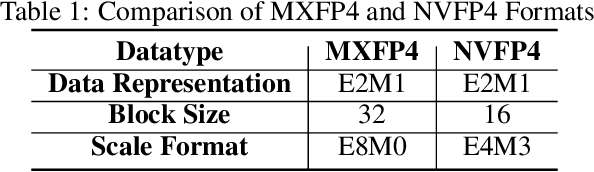
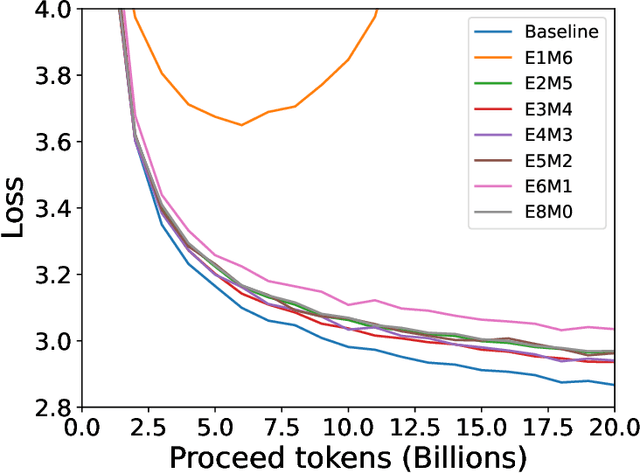
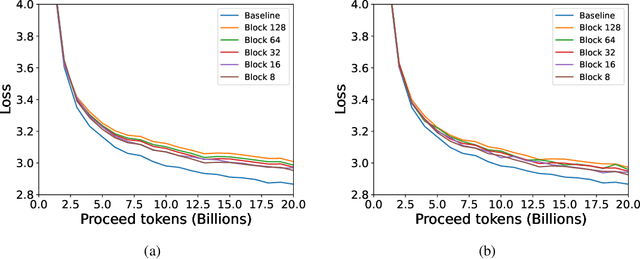

We demonstrate, for the first time, fully quantized training (FQT) of large language models (LLMs) using predominantly 4-bit floating-point (FP4) precision for weights, activations, and gradients on datasets up to 200 billion tokens. We extensively investigate key design choices for FP4, including block sizes, scaling formats, and rounding methods. Our analysis shows that the NVFP4 format, where each block of 16 FP4 values (E2M1) shares a scale represented in E4M3, provides optimal results. We use stochastic rounding for backward and update passes and round-to-nearest for the forward pass to enhance stability. Additionally, we identify a theoretical and empirical threshold for effective quantized training: when the gradient norm falls below approximately $\sqrt{3}$ times the quantization noise, quantized training becomes less effective. Leveraging these insights, we successfully train a 7-billion-parameter model on 256 Intel Gaudi2 accelerators. The resulting FP4-trained model achieves downstream task performance comparable to a standard BF16 baseline, confirming that FP4 training is a practical and highly efficient approach for large-scale LLM training. A reference implementation is supplied in https://github.com/Anonymous1252022/fp4-all-the-way .
EXAQ: Exponent Aware Quantization For LLMs Acceleration
Oct 04, 2024


Quantization has established itself as the primary approach for decreasing the computational and storage expenses associated with Large Language Models (LLMs) inference. The majority of current research emphasizes quantizing weights and activations to enable low-bit general-matrix-multiply (GEMM) operations, with the remaining non-linear operations executed at higher precision. In our study, we discovered that following the application of these techniques, the primary bottleneck in LLMs inference lies in the softmax layer. The softmax operation comprises three phases: exponent calculation, accumulation, and normalization, Our work focuses on optimizing the first two phases. We propose an analytical approach to determine the optimal clipping value for the input to the softmax function, enabling sub-4-bit quantization for LLMs inference. This method accelerates the calculations of both $e^x$ and $\sum(e^x)$ with minimal to no accuracy degradation. For example, in LLaMA1-30B, we achieve baseline performance with 2-bit quantization on the well-known "Physical Interaction: Question Answering" (PIQA) dataset evaluation. This ultra-low bit quantization allows, for the first time, an acceleration of approximately 4x in the accumulation phase. The combination of accelerating both $e^x$ and $\sum(e^x)$ results in a 36.9% acceleration in the softmax operation.
DropCompute: simple and more robust distributed synchronous training via compute variance reduction
Jun 18, 2023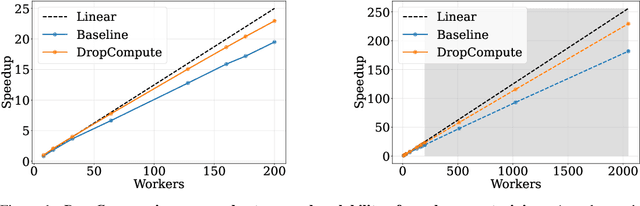
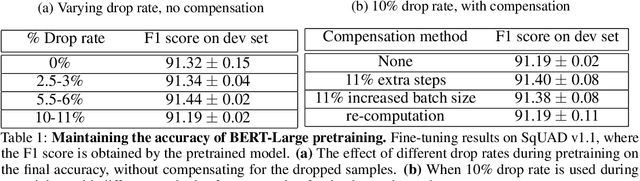
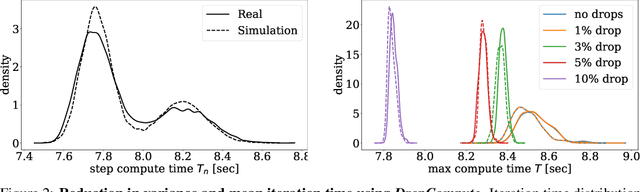
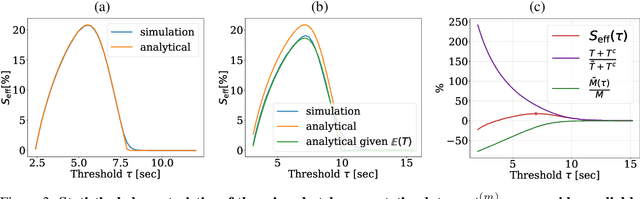
Background: Distributed training is essential for large scale training of deep neural networks (DNNs). The dominant methods for large scale DNN training are synchronous (e.g. All-Reduce), but these require waiting for all workers in each step. Thus, these methods are limited by the delays caused by straggling workers. Results: We study a typical scenario in which workers are straggling due to variability in compute time. We find an analytical relation between compute time properties and scalability limitations, caused by such straggling workers. With these findings, we propose a simple yet effective decentralized method to reduce the variation among workers and thus improve the robustness of synchronous training. This method can be integrated with the widely used All-Reduce. Our findings are validated on large-scale training tasks using 200 Gaudi Accelerators.
Optimal Fine-Grained N:M sparsity for Activations and Neural Gradients
Mar 21, 2022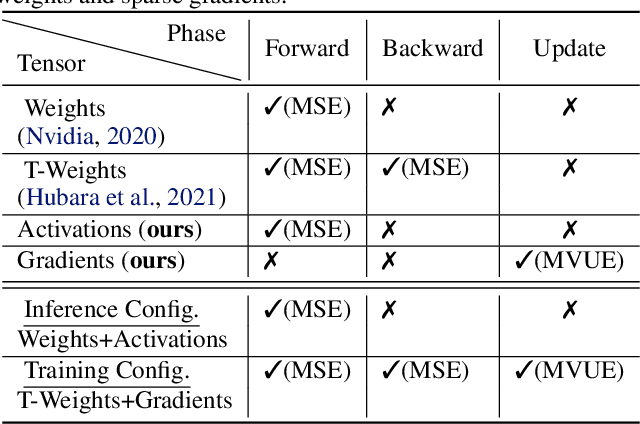
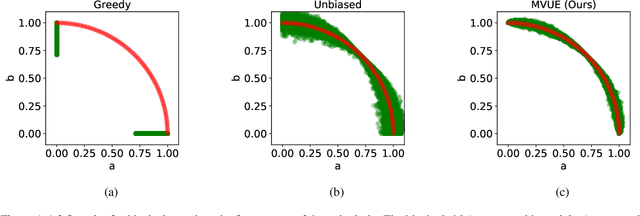
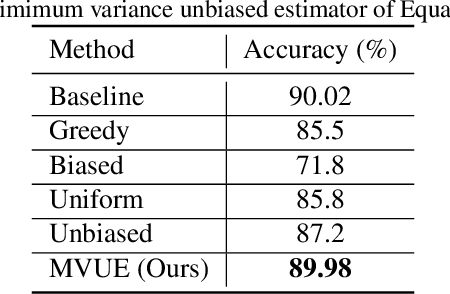
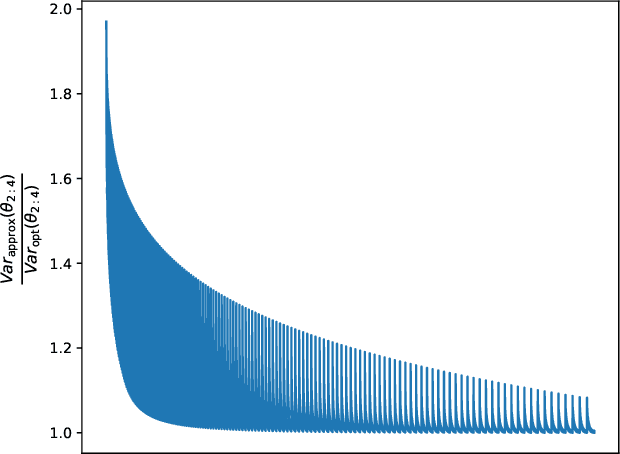
In deep learning, fine-grained N:M sparsity reduces the data footprint and bandwidth of a General Matrix multiply (GEMM) by x2, and doubles throughput by skipping computation of zero values. So far, it was only used to prune weights. We examine how this method can be used also for activations and their gradients (i.e., "neural gradients"). To this end, we first establish tensor-level optimality criteria. Previous works aimed to minimize the mean-square-error (MSE) of each pruned block. We show that while minimization of the MSE works fine for pruning the activations, it catastrophically fails for the neural gradients. Instead, we show that optimal pruning of the neural gradients requires an unbiased minimum-variance pruning mask. We design such specialized masks, and find that in most cases, 1:2 sparsity is sufficient for training, and 2:4 sparsity is usually enough when this is not the case. Further, we suggest combining several such methods together in order to speed up training even more. A reference implementation is supplied in https://github.com/brianchmiel/Act-and-Grad-structured-sparsity.
Energy awareness in low precision neural networks
Feb 06, 2022
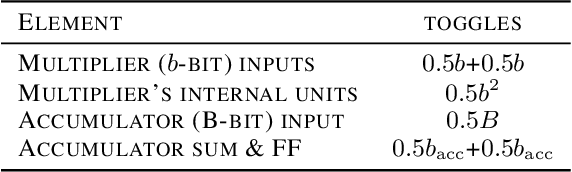


Power consumption is a major obstacle in the deployment of deep neural networks (DNNs) on end devices. Existing approaches for reducing power consumption rely on quite general principles, including avoidance of multiplication operations and aggressive quantization of weights and activations. However, these methods do not take into account the precise power consumed by each module in the network, and are therefore not optimal. In this paper we develop accurate power consumption models for all arithmetic operations in the DNN, under various working conditions. We reveal several important factors that have been overlooked to date. Based on our analysis, we present PANN (power-aware neural network), a simple approach for approximating any full-precision network by a low-power fixed-precision variant. Our method can be applied to a pre-trained network, and can also be used during training to achieve improved performance. In contrast to previous methods, PANN incurs only a minor degradation in accuracy w.r.t. the full-precision version of the network, even when working at the power-budget of a 2-bit quantized variant. In addition, our scheme enables to seamlessly traverse the power-accuracy trade-off at deployment time, which is a major advantage over existing quantization methods that are constrained to specific bit widths.
On Recoverability of Graph Neural Network Representations
Jan 30, 2022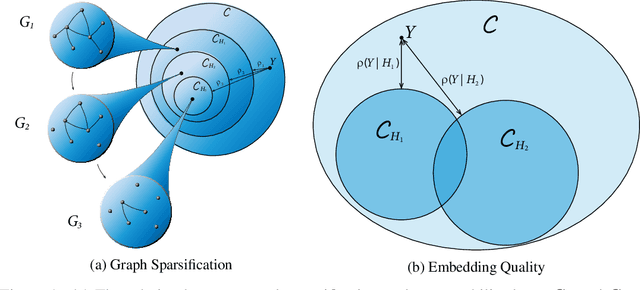
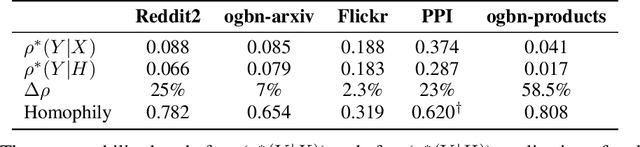
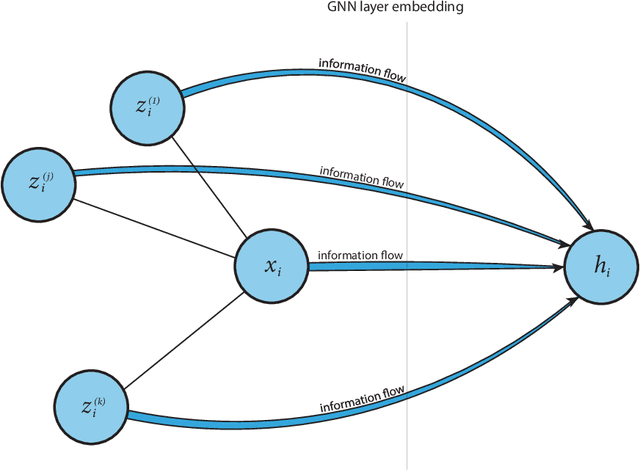

Despite their growing popularity, graph neural networks (GNNs) still have multiple unsolved problems, including finding more expressive aggregation methods, propagation of information to distant nodes, and training on large-scale graphs. Understanding and solving such problems require developing analytic tools and techniques. In this work, we propose the notion of recoverability, which is tightly related to information aggregation in GNNs, and based on this concept, develop the method for GNN embedding analysis. We define recoverability theoretically and propose a method for its efficient empirical estimation. We demonstrate, through extensive experimental results on various datasets and different GNN architectures, that estimated recoverability correlates with aggregation method expressivity and graph sparsification quality. Therefore, we believe that the proposed method could provide an essential tool for understanding the roots of the aforementioned problems, and potentially lead to a GNN design that overcomes them. The code to reproduce our experiments is available at https://github.com/Anonymous1252022/Recoverability