 Add to Chrome
 Add to Firefox
 Add to Edge
MISTac: A Vision-Based Tactile Sensor for Minimally Invasive Surgery
Aug 14, 2026
Minimally invasive and robot-assisted surgery offer many advantages over traditional open surgery, but deprive surgeons of tactile feedback and the ability to palpate tissue with their fingers. To address this lack of tactile feedback, we introduce the MISTac, a high resolution vision-based tactile sensor specifically designed for palpation in MIS. The sensor has a replaceable sensor tip with a diameter of 8 mm which allows it to fit through the trocars used in minimally invasive surgery. Its modular 3D-printed case design allows the use of bulky off-the-shelf illumination and imaging hardware that can easily be exchanged and upgraded. The sensor has an optical resolution of 176.68 $μm$, a tactile resolution of 250 $μm$, and can resolve forces as little as 24.3 mN. An in vivo study with the sensor shows its usability in minimally invasive surgery. We trained a machine learning model with the tactile data collected in the trial on a tissue classification task achieving an aggregate accuracy of ~84% in a leave-one-out cross validation. Tactile sensors have the potential to one day aid surgeons during minimally invasive surgery with tasks such as tissue classification or intra-operative tumor localization; MISTac is a small step towards this vision. We open-source MISTac at https://github.com/lasr-lab/mistac

HoLLiE C -- A Multifunctional Bimanual Mobile Robot Supporting Versatile Care Applications
Dec 11, 2023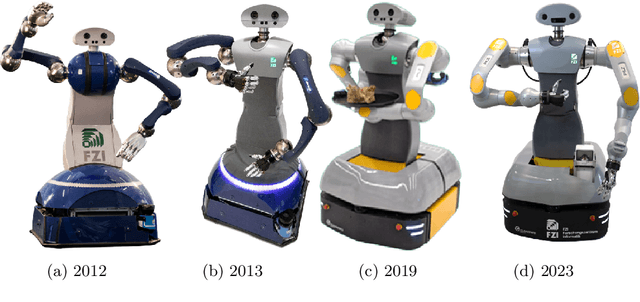
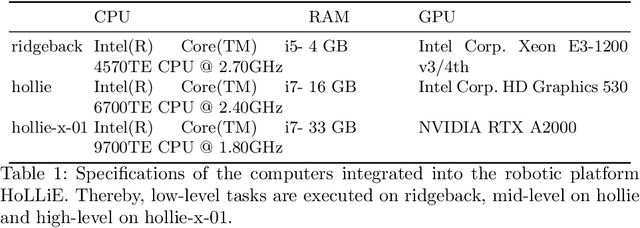
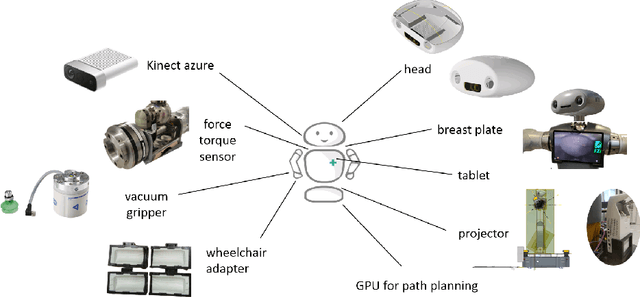
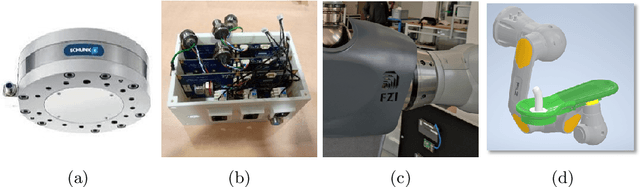
Care robotics as a research field has developed a lot in recent years, driven by the rapidly increasing need for it. However, these technologies are mostly limited to a very concrete and usually relatively simple use case. The bimanual robot House of Living Labs intelligent Escort (HoLLiE) includes an omnidirectional mobile platform. This paper presents how HoLLiE is adapted, by flexible software and hardware modules, for different care applications. The design goal of HoLLiE was to be human-like but abstract enough to ensure a high level of acceptance, which is very advantageous for its use in hospitals. After a short retrospect of previous generations of HoLLiE, it is highlighted how the current version is equipped with a variety of additional sensors and actuators to allow a wide range of possible applications. Then, the software stack of HoLLiE is depicted, with the focus on navigation and force sensitive intention recognition.