 Add to Chrome
 Add to Firefox
 Add to Edge
Leveraging Avatar Fingerprinting: A Multi-Generator Photorealistic Talking-Head Public Database and Benchmark
Mar 27, 2026
Recent advances in photorealistic avatar generation have enabled highly realistic talking-head avatars, raising security concerns regarding identity impersonation in AI-mediated communication. To advance in this challenging problem, the task of avatar fingerprinting aims to determine whether two avatar videos are driven by the same human operator or not. However, current public databases in the literature are scarce and based solely on old-fashioned talking-head avatar generators, not representing realistic scenarios for the current task of avatar fingerprinting. To overcome this situation, the present article introduces AVAPrintDB, a new publicly available multi-generator talking-head avatar database for avatar fingerprinting. AVAPrintDB is constructed from two audiovisual corpora and three state-of-the-art avatar generators (GAGAvatar, LivePortrait, HunyuanPortrait), representing different synthesis paradigms, and includes both self- and cross-reenactments to simulate legitimate usage and impersonation scenarios. Building on this database, we also define a standardized and reproducible benchmark for avatar fingerprinting, considering public state-of-the-art avatar fingerprinting systems and exploring novel methods based on Foundation Models (DINOv2 and CLIP). Also, we conduct a comprehensive analysis under generator and dataset shift. Our results show that, while identity-related motion cues persist across synthetic avatars, current avatar fingerprinting systems remain highly sensitive to changes in the synthesis pipeline and source domain. The AVAPrintDB, benchmark protocols, and avatar fingerprinting systems are publicly available to facilitate reproducible research.

Is It Really You? Exploring Biometric Verification Scenarios in Photorealistic Talking-Head Avatar Videos
Aug 01, 2025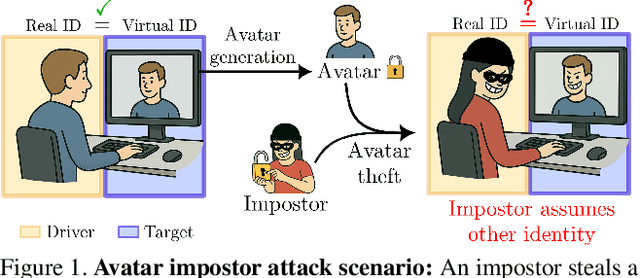
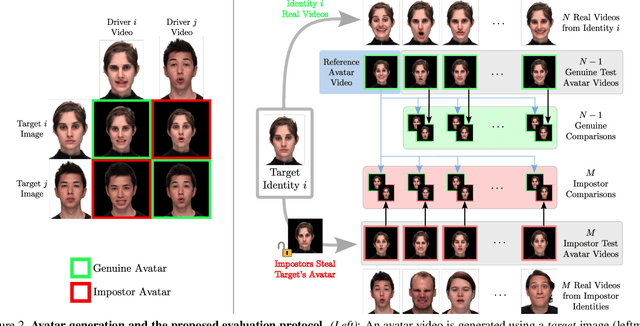
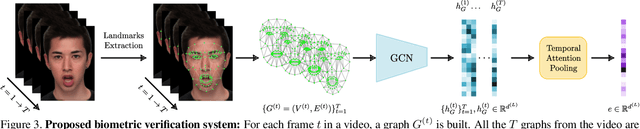
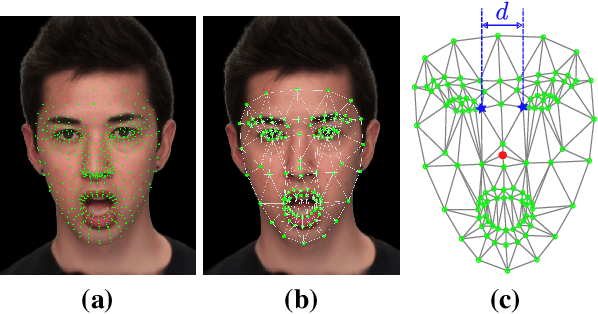
Photorealistic talking-head avatars are becoming increasingly common in virtual meetings, gaming, and social platforms. These avatars allow for more immersive communication, but they also introduce serious security risks. One emerging threat is impersonation: an attacker can steal a user's avatar-preserving their appearance and voice-making it nearly impossible to detect its fraudulent usage by sight or sound alone. In this paper, we explore the challenge of biometric verification in such avatar-mediated scenarios. Our main question is whether an individual's facial motion patterns can serve as reliable behavioral biometrics to verify their identity when the avatar's visual appearance is a facsimile of its owner. To answer this question, we introduce a new dataset of realistic avatar videos created using a state-of-the-art one-shot avatar generation model, GAGAvatar, with genuine and impostor avatar videos. We also propose a lightweight, explainable spatio-temporal Graph Convolutional Network architecture with temporal attention pooling, that uses only facial landmarks to model dynamic facial gestures. Experimental results demonstrate that facial motion cues enable meaningful identity verification with AUC values approaching 80%. The proposed benchmark and biometric system are available for the research community in order to bring attention to the urgent need for more advanced behavioral biometric defenses in avatar-based communication systems.