 Add to Chrome
 Add to Firefox
 Add to Edge
An Efficient Near-Optimal Algorithm for Adversarial $m$-Set Bandits
Aug 12, 2026
We study adversarial combinatorial bandits with $m$-set actions, where at each round the learner selects $m$ out of $d$ items and observes only the aggregate loss of the selected items. The resulting action set contains $K=\binom{d}{m}$ elements and can therefore be exponentially large. Nevertheless, the loss of every action is determined by the same $d$-dimensional vector of item losses. We propose a computationally efficient algorithm that exploits this structure without explicitly enumerating the action set. Against adaptive non-anticipating adversaries, it guarantees, with probability at least $1-δ$, regret against the best fixed action of \[ R_T = O\left(\sqrt{dT\log(K/δ)}\right). \] This matches the high-probability regret bound of the finite-action EXP3-KW algorithm of Zimmert and Lattimore, whose direct implementation may require exponential space. Our algorithm instead represents each sampling distribution with $d$ parameters and runs in polynomial time without enumerating the action set. Thus, it resolves the open problem posed by Maiti et al.

New Bounds for the Last Iterate of the Stochastic subGradient Method
Jun 23, 2026We study the last iterate of the stochastic subgradient method for one-dimensional convex Lipschitz objectives. For a fixed horizon $n$, we consider the standard fixed stepsizes $η=Θ(1/\sqrt n)$. We prove that, for such stepsize policies, under additive i.i.d. subgradient noise with uniformly bounded variance, the last iterate features an optimization error of order $1/\sqrt n$, thereby removing the extra $(\log n)$ factor present in existing generic bounds. On the other hand, we show that without the i.i.d. assumption, the optimization error can be of order $(\log n)/\sqrt n$. Thus, under the uniformly bounded variance assumption alone, the last iterate of SsGM is suboptimal even in dimension one, resolving negatively an open problem posed in Koren and Segal, COLT, 2020.
Repeated Bilateral Trade: The Quest for Fairness
Jun 13, 2026We study repeated bilateral trade from a fairness perspective. At each round, a fresh seller-buyer pair arrives, and the platform posts a price before observing the traders' valuations. Trade occurs only if both agents accept the price. Rather than maximizing only the gain from trade, we consider platforms that seek balanced divisions of the generated surplus. We show that natural fairness desiderata lead to a one-parameter Rawls-to-Nash family of fair-gain objectives, obtained by aggregating the seller's and buyer's net gains through nonpositive Hölder means. Unlike the standard gain-from-trade objective and the Rawlsian fair-gain objective studied in prior work, our proposed objectives induce a new statistical structure in which expected rewards are recovered from threshold feedback through a two-dimensional singular-kernel integral identity. This leads to a nonstandard pure-exploration problem whose natural estimators are rectangular double sums with row-column dependence and singular weights. Assuming independent i.i.d. seller and buyer valuation sequences with arbitrary unknown marginals, we characterize the optimal learning rates for the whole Rawls-to-Nash family of fair-gain objectives, giving matching fixed-confidence sample-complexity and regret bounds up to polylogarithmic factors.
Two-Action Apple Tasting with Switching Costs
Jun 02, 2026We study the two-action apple-tasting problem with switching costs against an oblivious adversary. In an equivalent normalized formulation, at each round the learner chooses between a revealing action and a blind action: the revealing action gives reward $0$ and reveals the hidden value $x_t\in[-1,1]$ of the blind action; the blind action gives reward $x_t$ but reveals nothing. The learner pays one unit whenever they switches actions, and regret is measured against the best fixed action in hindsight. General feedback-graph algorithms with switching costs give $\widetilde O(T^{2/3})$ regret guarantees for this problem. The two-action apple-tasting graph was the natural candidate for the missing $Ω(T^{2/3})$ obstruction in the switching-cost classification: such a lower bound would have transferred to a large family of still-unclassified feedback graphs. We prove that this obstruction is not there: the oblivious minimax expected regret for this problem satisfies \[ \frac{1}{2\sqrt3}\cdot\sqrt T \le R_T^\star \le 2\sqrt{3}\cdot \sqrt{T}. \]
Optimal Gap-Dependent Regret for Private Stochastic Decision-Theoretic Online Learning
May 27, 2026We study stochastic decision-theoretic online learning with full information and event-level pure differential privacy. A COLT open problem of Hu and Mehta asks to determine the optimal gap-dependent regret rate for stochastic decision-theoretic online learning under pure event-level differential privacy. For $K$ actions, losses in $[0,1]$, and a unique best action separated from the second-best action by gap $Δ_{\min}$, the known lower bound is of order $ \frac{\log K}{\min\{Δ_{\min},\varepsilon\}}, $ or equivalently, up to universal constants, of order \[ \frac{\log K}{Δ_{\min}}+\frac{\log K}{\varepsilon}. \] We give a horizon-free pure-DP algorithm and prove the explicit regret bound \[ \operatorname{Reg}_T \le 1000 \cdot \left(\frac{\log K}{Δ_{\min}}+\frac{\log K}{\varepsilon}\right) \] for every horizon $T$. The numerical constant is not optimized. The algorithm partitions time into blocks of exponentially increasing size, plays a single action throughout each block, and chooses the next action by an exponential mechanism applied to a data-independent random prefix of the previous block. The random prefix converts block regret into a sum, over all prefix lengths, of softmax selection errors. A single entropy-potential argument controls all privacy-dominated large-gap actions at cost $\log K/\varepsilon$.
A Tight Regret Analysis of Non-Parametric Repeated Contextual Brokerage
Mar 03, 2025We study a contextual version of the repeated brokerage problem. In each interaction, two traders with private valuations for an item seek to buy or sell based on the learner's-a broker-proposed price, which is informed by some contextual information. The broker's goal is to maximize the traders' net utility-also known as the gain from trade-by minimizing regret compared to an oracle with perfect knowledge of traders' valuation distributions. We assume that traders' valuations are zero-mean perturbations of the unknown item's current market value-which can change arbitrarily from one interaction to the next-and that similar contexts will correspond to similar market prices. We analyze two feedback settings: full-feedback, where after each interaction the traders' valuations are revealed to the broker, and limited-feedback, where only transaction attempts are revealed. For both feedback types, we propose algorithms achieving tight regret bounds. We further strengthen our performance guarantees by providing a tight 1/2-approximation result showing that the oracle that knows the traders' valuation distributions achieves at least 1/2 of the gain from trade of the omniscient oracle that knows in advance the actual realized traders' valuations.
Market Making without Regret
Nov 21, 2024
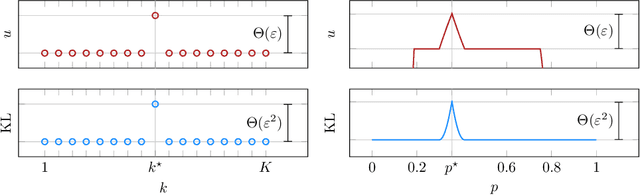
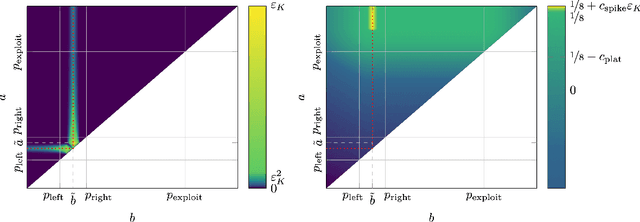
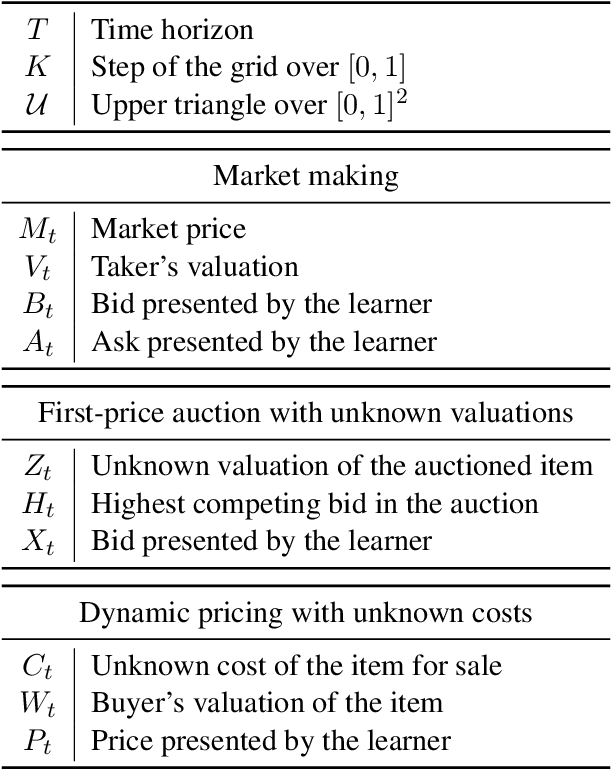
We consider a sequential decision-making setting where, at every round $t$, a market maker posts a bid price $B_t$ and an ask price $A_t$ to an incoming trader (the taker) with a private valuation for one unit of some asset. If the trader's valuation is lower than the bid price, or higher than the ask price, then a trade (sell or buy) occurs. If a trade happens at round $t$, then letting $M_t$ be the market price (observed only at the end of round $t$), the maker's utility is $M_t - B_t$ if the maker bought the asset, and $A_t - M_t$ if they sold it. We characterize the maker's regret with respect to the best fixed choice of bid and ask pairs under a variety of assumptions (adversarial, i.i.d., and their variants) on the sequence of market prices and valuations. Our upper bound analysis unveils an intriguing connection relating market making to first-price auctions and dynamic pricing. Our main technical contribution is a lower bound for the i.i.d. case with Lipschitz distributions and independence between prices and valuations. The difficulty in the analysis stems from the unique structure of the reward and feedback functions, allowing an algorithm to acquire information by graduating the "cost of exploration" in an arbitrary way.
Fair Online Bilateral Trade
May 22, 2024In online bilateral trade, a platform posts prices to incoming pairs of buyers and sellers that have private valuations for a certain good. If the price is lower than the buyers' valuation and higher than the sellers' valuation, then a trade takes place. Previous work focused on the platform perspective, with the goal of setting prices maximizing the gain from trade (the sum of sellers' and buyers' utilities). Gain from trade is, however, potentially unfair to traders, as they may receive highly uneven shares of the total utility. In this work we enforce fairness by rewarding the platform with the fair gain from trade, defined as the minimum between sellers' and buyers' utilities. After showing that any no-regret learning algorithm designed to maximize the sum of the utilities may fail badly with fair gain from trade, we present our main contribution: a complete characterization of the regret regimes for fair gain from trade when, after each interaction, the platform only learns whether each trader accepted the current price. Specifically, we prove the following regret bounds: $\Theta(\ln T)$ in the deterministic setting, $\Omega(T)$ in the stochastic setting, and $\tilde{\Theta}(T^{2/3})$ in the stochastic setting when sellers' and buyers' valuations are independent of each other. We conclude by providing tight regret bounds when, after each interaction, the platform is allowed to observe the true traders' valuations.
Trading Volume Maximization with Online Learning
May 21, 2024We explore brokerage between traders in an online learning framework. At any round $t$, two traders meet to exchange an asset, provided the exchange is mutually beneficial. The broker proposes a trading price, and each trader tries to sell their asset or buy the asset from the other party, depending on whether the price is higher or lower than their private valuations. A trade happens if one trader is willing to sell and the other is willing to buy at the proposed price. Previous work provided guidance to a broker aiming at enhancing traders' total earnings by maximizing the gain from trade, defined as the sum of the traders' net utilities after each interaction. In contrast, we investigate how the broker should behave to maximize the trading volume, i.e., the total number of trades. We model the traders' valuations as an i.i.d. process with an unknown distribution. If the traders' valuations are revealed after each interaction (full-feedback), and the traders' valuations cumulative distribution function (cdf) is continuous, we provide an algorithm achieving logarithmic regret and show its optimality up to constant factors. If only their willingness to sell or buy at the proposed price is revealed after each interaction ($2$-bit feedback), we provide an algorithm achieving poly-logarithmic regret when the traders' valuations cdf is Lipschitz and show that this rate is near-optimal. We complement our results by analyzing the implications of dropping the regularity assumptions on the unknown traders' valuations cdf. If we drop the continuous cdf assumption, the regret rate degrades to $\Theta(\sqrt{T})$ in the full-feedback case, where $T$ is the time horizon. If we drop the Lipschitz cdf assumption, learning becomes impossible in the $2$-bit feedback case.
An Online Learning Theory of Brokerage
Oct 18, 2023
We investigate brokerage between traders from an online learning perspective. At any round $t$, two traders arrive with their private valuations, and the broker proposes a trading price. Unlike other bilateral trade problems already studied in the online learning literature, we focus on the case where there are no designated buyer and seller roles: each trader will attempt to either buy or sell depending on the current price of the good. We assume the agents' valuations are drawn i.i.d. from a fixed but unknown distribution. If the distribution admits a density bounded by some constant $M$, then, for any time horizon $T$: $\bullet$ If the agents' valuations are revealed after each interaction, we provide an algorithm achieving regret $M \log T$ and show this rate is optimal, up to constant factors. $\bullet$ If only their willingness to sell or buy at the proposed price is revealed after each interaction, we provide an algorithm achieving regret $\sqrt{M T}$ and show this rate is optimal, up to constant factors. Finally, if we drop the bounded density assumption, we show that the optimal rate degrades to $\sqrt{T}$ in the first case, and the problem becomes unlearnable in the second.