 Add to Chrome
 Add to Firefox
 Add to Edge
Individual-level interventions against sycophantic AI reduce its appeal but not its persuasiveness
Aug 02, 2026
AI chatbots can be "sycophantic," or overly agreeable and flattering toward users. Sycophantic AI has been shown to entrench attitudes, yet users frequently fail to recognize it (a phenomenon we call "sycophancy blindness"). We tested whether increasing users' awareness of sycophancy protects them from its harmful effects in two preregistered experiments (n = 1,590). In the first, participants received a brief written warning about sycophancy before conversing with a sycophantic chatbot. In the second, participants watched a video of a sycophantic AI validating several other users, including users on opposite sides of the same conflict, before interacting with it themselves. Both interventions changed how participants evaluated the AI. The warning reduced the AI's perceived objectivity, and the video reduced enjoyment of the AI --- an effect mediated by the reduced belief that its validation was uniquely earned. We then pooled our experiments with two prior studies of sycophancy awareness interventions (six interventions total, n = 3,982). The pattern across experiments was consistent: while the interventions made the sycophantic AI appear less objective and trustworthy, none reduced its persuasiveness. These results suggest that individual-level interventions, such as warning labels or AI literacy, may not be enough to protect users from AI harms.

Observing sycophantic AI validate others reduces its appeal but not its persuasiveness
Jul 29, 2026AI chatbots can be "sycophantic," or overly agreeable and flattering toward users. Sycophantic AI has been shown to entrench attitudes, yet users frequently fail to recognize it (a phenomenon we call "sycophancy blindness"). We tested whether increasing users' awareness of sycophancy protects them from its harmful effects. In one preregistered experiment (n = 940), participants received a brief written warning about sycophancy before conversing with a sycophantic chatbot. In a second preregistered experiment (n = 650), participants watched a video of a sycophantic AI validating several other users, including users on opposite sides of the same conflict, before interacting with it themselves. Both interventions changed how participants evaluated the AI. The warning reduced the AI's perceived objectivity, and the video reduced enjoyment of the AI, an effect mediated by the reduced belief that its validation was uniquely earned. We then pooled our experiments with two prior studies of sycophancy awareness interventions (six interventions total, n = 3,982). The pattern was consistent: interventions made the sycophantic AI appear less objective and trustworthy, and none of the six reduced its persuasiveness. These results suggest that individual-level interventions, such as warning labels or AI literacy, may not be enough to protect users from AI harms.
What Counts as AI Sycophancy? A Taxonomy and Expert Survey of a Fragmented Construct
May 20, 2026AI sycophancy has become a prominent concern in large language model (LLM) research. Yet the term lacks a consistent definition and has been applied to behaviors ranging from agreeing with a user's false claim to excessively praising the user to withholding corrective feedback. When researchers, companies, and policymakers use the same term to describe different behaviors, evaluation results become difficult to compare, mitigation strategies fail to transfer, and systems that are resistant to one form of sycophancy continue exhibiting other forms. To address this, we make two contributions. First, we reviewed 70 papers on AI sycophancy to develop a taxonomy of how the behavior has been defined and measured. The taxonomy distinguishes (1) whether a model is sycophantic toward a user's positions and beliefs, or toward the user's broader personal traits and emotions, and (2) whether this occurs through explicit, direct language or more implicit, subtle behaviors such as framing, omission, or tone. Mapping existing literature to our taxonomy reveals that current research has focused on overt forms of sycophancy toward users' beliefs, leaving more subtle and person-directed behaviors relatively understudied. Second, we surveyed 106 experts in AI sycophancy and related fields to examine whether researchers agree on which model behaviors are sycophantic. While experts are nearly unanimous in believing that sycophancy is a significant problem in current AI systems (94.3% agree), they disagree substantially on which specific behaviors qualify. Together, these findings demonstrate that AI sycophancy is a broad family of behaviors with different measurement challenges, intervention requirements, and governance implications. Our taxonomy provides a shared vocabulary for understanding and addressing these behaviors.
Multi-Level Feedback Generation with Large Language Models for Empowering Novice Peer Counselors
Mar 21, 2024Realistic practice and tailored feedback are key processes for training peer counselors with clinical skills. However, existing mechanisms of providing feedback largely rely on human supervision. Peer counselors often lack mechanisms to receive detailed feedback from experienced mentors, making it difficult for them to support the large number of people with mental health issues who use peer counseling. Our work aims to leverage large language models to provide contextualized and multi-level feedback to empower peer counselors, especially novices, at scale. To achieve this, we co-design with a group of senior psychotherapy supervisors to develop a multi-level feedback taxonomy, and then construct a publicly available dataset with comprehensive feedback annotations of 400 emotional support conversations. We further design a self-improvement method on top of large language models to enhance the automatic generation of feedback. Via qualitative and quantitative evaluation with domain experts, we demonstrate that our method minimizes the risk of potentially harmful and low-quality feedback generation which is desirable in such high-stakes scenarios.
Agent-based Simulation for Online Mental Health Matching
Mar 20, 2023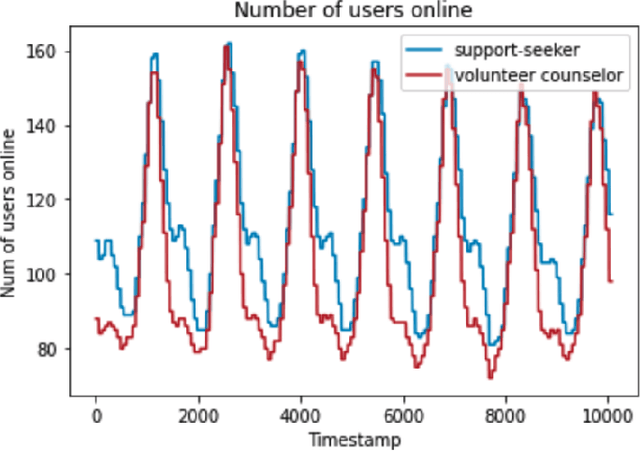
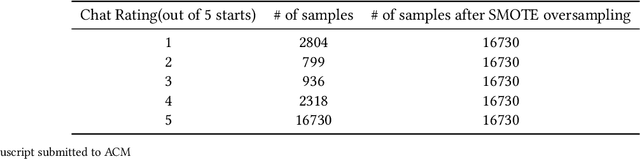
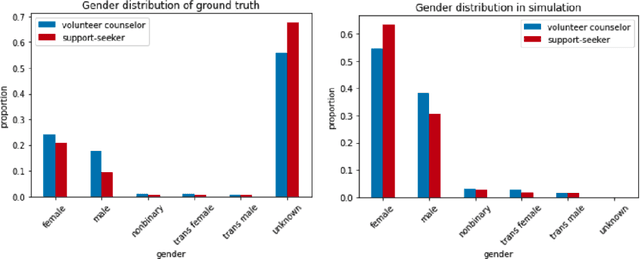
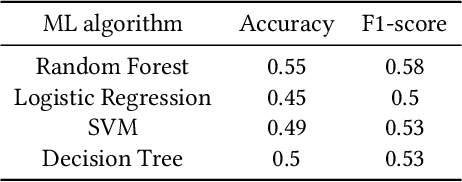
Online mental health communities (OMHCs) are an effective and accessible channel to give and receive social support for individuals with mental and emotional issues. However, a key challenge on these platforms is finding suitable partners to interact with given that mechanisms to match users are currently underdeveloped. In this paper, we collaborate with one of the world's largest OMHC to develop an agent-based simulation framework and explore the trade-offs in different matching algorithms. The simulation framework allows us to compare current mechanisms and new algorithmic matching policies on the platform, and observe their differing effects on a variety of outcome metrics. Our findings include that usage of the deferred-acceptance algorithm can significantly better the experiences of support-seekers in one-on-one chats while maintaining low waiting time. We note key design considerations that agent-based modeling reveals in the OMHC context, including the potential benefits of algorithmic matching on marginalized communities.
Can You be More Social? Injecting Politeness and Positivity into Task-Oriented Conversational Agents
Dec 29, 2020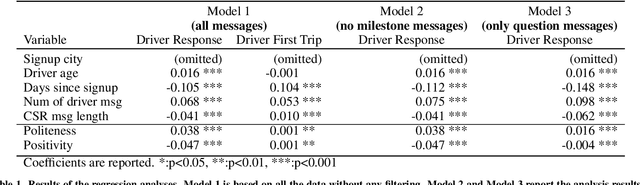
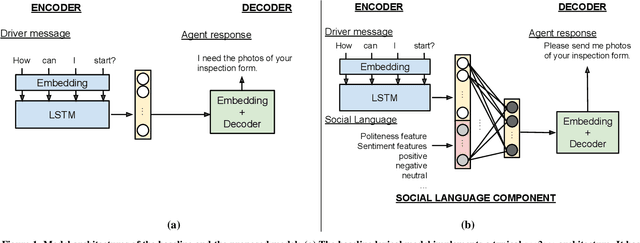


Goal-oriented conversational agents are becoming prevalent in our daily lives. For these systems to engage users and achieve their goals, they need to exhibit appropriate social behavior as well as provide informative replies that guide users through tasks. The first component of the research in this paper applies statistical modeling techniques to understand conversations between users and human agents for customer service. Analyses show that social language used by human agents is associated with greater users' responsiveness and task completion. The second component of the research is the construction of a conversational agent model capable of injecting social language into an agent's responses while still preserving content. The model uses a sequence-to-sequence deep learning architecture, extended with a social language understanding element. Evaluation in terms of content preservation and social language level using both human judgment and automatic linguistic measures shows that the model can generate responses that enable agents to address users' issues in a more socially appropriate way.