 Add to Chrome
 Add to Firefox
 Add to Edge
Nemotron 3 Ultra: Open, Efficient Mixture-of-Experts Hybrid Mamba-Transformer Model for Agentic Reasoning
Jun 12, 2026
We introduce Nemotron 3 Ultra, a 550 billion total and 55 billion active parameter Mixture-of-Experts Hybrid Mamba-Attention language model. We pre-trained Nemotron 3 Ultra on 20 trillion text tokens, then extended the context length to 1M tokens, and post-trained using Supervised Fine Tuning (SFT), Reinforcement Learning (RL), and Multi-teacher On-Policy Distillation (MOPD). Nemotron 3 Ultra is our most capable model yet, employing multiple key technologies - LatentMoE, Multi Token Prediction (MTP), NVFP4 pre-training, multi-environment RLVR, MOPD, and reasoning budget control. Nemotron 3 Ultra achieves up to ~6x higher inference throughput as compared to state-of-the-art publicly available LLMs while attaining on-par accuracy. The state-of-the-art accuracy, high inference throughput, and 1M token context length make Nemotron 3 Ultra ideal for long-running autonomous agentic tasks. We open-source the base, post-trained, and quantized checkpoints, along with the training data and recipe on HuggingFace.

Nemotron 3 Nano Omni: Efficient and Open Multimodal Intelligence
Apr 27, 2026We introduce Nemotron 3 Nano Omni, the latest model in the Nemotron multimodal series and the first to natively support audio inputs alongside text, images, and video. Nemotron 3 Nano Omni delivers consistent accuracy improvements over its predecessor, Nemotron Nano V2 VL, across all modalities, enabled by advances in architecture, training data and recipes. In particular, Nemotron 3 delivers leading results in real-world document understanding, long audio-video comprehension, and agentic computer use. Built on the highly efficient Nemotron 3 Nano 30B-A3B backbone, Nemotron 3 Nano Omni further incorporates innovative multimodal token-reduction techniques to deliver substantially lower inference latency and higher throughput than other models of similar size. We are releasing model checkpoints in BF16, FP8, and FP4 formats, along with portions of the training data and codebase to facilitate further research and development.
Nemotron 3 Super: Open, Efficient Mixture-of-Experts Hybrid Mamba-Transformer Model for Agentic Reasoning
Apr 14, 2026We describe the pre-training, post-training, and quantization of Nemotron 3 Super, a 120 billion (active 12 billion) parameter hybrid Mamba-Attention Mixture-of-Experts model. Nemotron 3 Super is the first model in the Nemotron 3 family to 1) be pre-trained in NVFP4, 2) leverage LatentMoE, a new Mixture-of-Experts architecture that optimizes for both accuracy per FLOP and accuracy per parameter, and 3) include MTP layers for inference acceleration through native speculative decoding. We pre-trained Nemotron 3 Super on 25 trillion tokens followed by post-training using supervised fine tuning (SFT) and reinforcement learning (RL). The final model supports up to 1M context length and achieves comparable accuracy on common benchmarks, while also achieving up to 2.2x and 7.5x higher inference throughput compared to GPT-OSS-120B and Qwen3.5-122B, respectively. Nemotron 3 Super datasets, along with the base, post-trained, and quantized checkpoints, are open-sourced on HuggingFace.
NVIDIA Nemotron 3: Efficient and Open Intelligence
Dec 24, 2025We introduce the Nemotron 3 family of models - Nano, Super, and Ultra. These models deliver strong agentic, reasoning, and conversational capabilities. The Nemotron 3 family uses a Mixture-of-Experts hybrid Mamba-Transformer architecture to provide best-in-class throughput and context lengths of up to 1M tokens. Super and Ultra models are trained with NVFP4 and incorporate LatentMoE, a novel approach that improves model quality. The two larger models also include MTP layers for faster text generation. All Nemotron 3 models are post-trained using multi-environment reinforcement learning enabling reasoning, multi-step tool use, and support granular reasoning budget control. Nano, the smallest model, outperforms comparable models in accuracy while remaining extremely cost-efficient for inference. Super is optimized for collaborative agents and high-volume workloads such as IT ticket automation. Ultra, the largest model, provides state-of-the-art accuracy and reasoning performance. Nano is released together with its technical report and this white paper, while Super and Ultra will follow in the coming months. We will openly release the model weights, pre- and post-training software, recipes, and all data for which we hold redistribution rights.
Nemotron 3 Nano: Open, Efficient Mixture-of-Experts Hybrid Mamba-Transformer Model for Agentic Reasoning
Dec 23, 2025We present Nemotron 3 Nano 30B-A3B, a Mixture-of-Experts hybrid Mamba-Transformer language model. Nemotron 3 Nano was pretrained on 25 trillion text tokens, including more than 3 trillion new unique tokens over Nemotron 2, followed by supervised fine tuning and large-scale RL on diverse environments. Nemotron 3 Nano achieves better accuracy than our previous generation Nemotron 2 Nano while activating less than half of the parameters per forward pass. It achieves up to 3.3x higher inference throughput than similarly-sized open models like GPT-OSS-20B and Qwen3-30B-A3B-Thinking-2507, while also being more accurate on popular benchmarks. Nemotron 3 Nano demonstrates enhanced agentic, reasoning, and chat abilities and supports context lengths up to 1M tokens. We release both our pretrained Nemotron 3 Nano 30B-A3B Base and post-trained Nemotron 3 Nano 30B-A3B checkpoints on Hugging Face.
CFL: Causally Fair Language Models Through Token-level Attribute Controlled Generation
Jun 01, 2023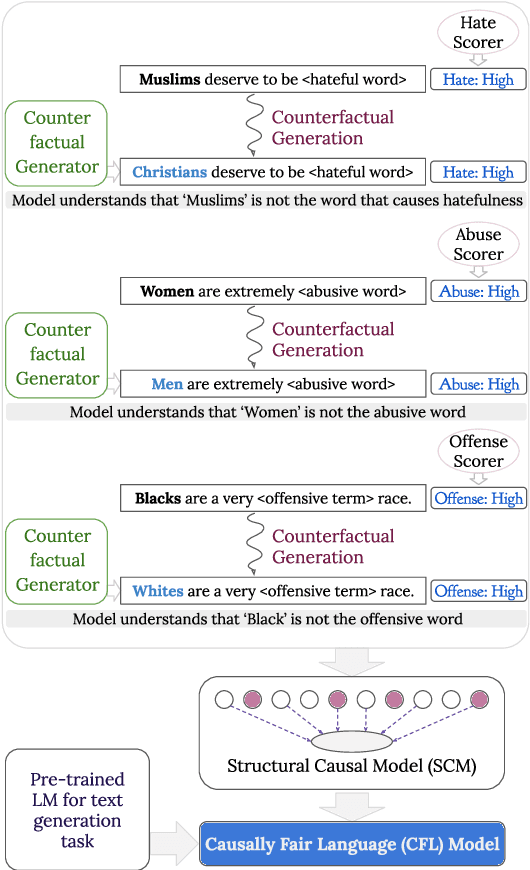
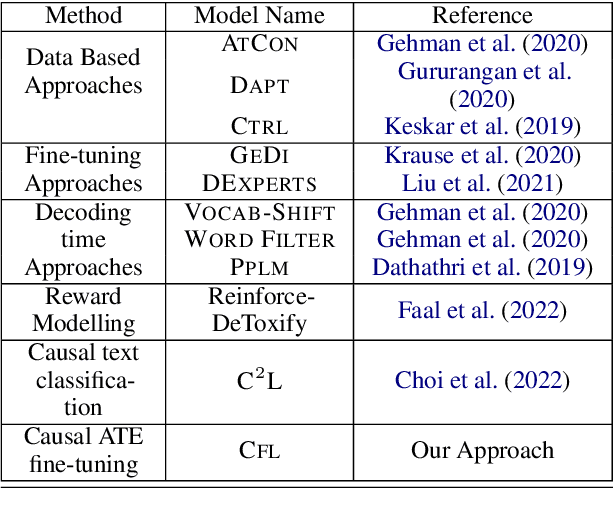
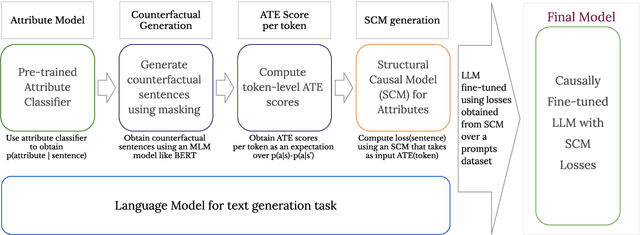
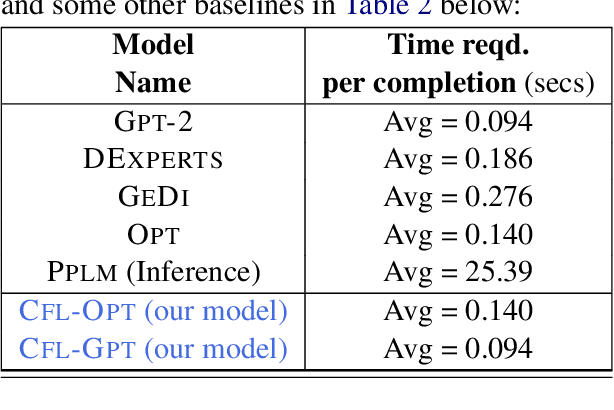
We propose a method to control the attributes of Language Models (LMs) for the text generation task using Causal Average Treatment Effect (ATE) scores and counterfactual augmentation. We explore this method, in the context of LM detoxification, and propose the Causally Fair Language (CFL) architecture for detoxifying pre-trained LMs in a plug-and-play manner. Our architecture is based on a Structural Causal Model (SCM) that is mathematically transparent and computationally efficient as compared with many existing detoxification techniques. We also propose several new metrics that aim to better understand the behaviour of LMs in the context of toxic text generation. Further, we achieve state of the art performance for toxic degeneration, which are computed using \RTP (RTP) benchmark. Our experiments show that CFL achieves such a detoxification without much impact on the model perplexity. We also show that CFL mitigates the unintended bias problem through experiments on the BOLD dataset.
Geometry-Aware Multi-Task Learning for Binaural Audio Generation from Video
Nov 21, 2021
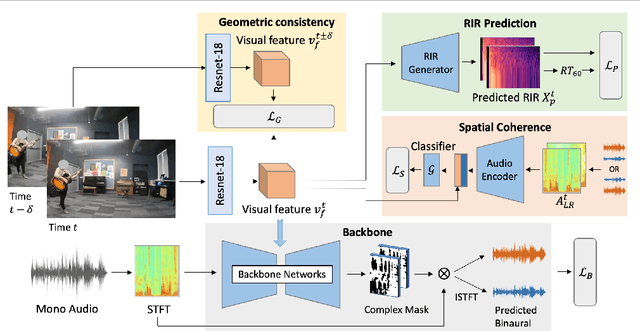
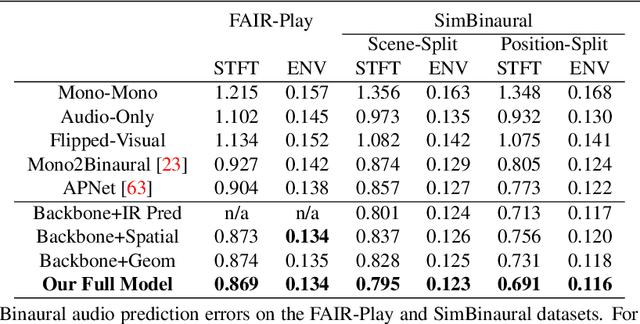
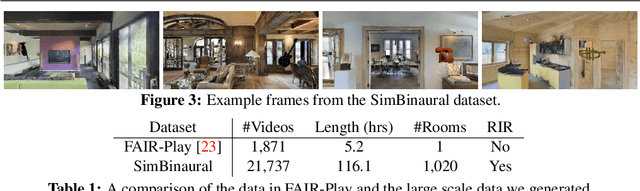
Binaural audio provides human listeners with an immersive spatial sound experience, but most existing videos lack binaural audio recordings. We propose an audio spatialization method that draws on visual information in videos to convert their monaural (single-channel) audio to binaural audio. Whereas existing approaches leverage visual features extracted directly from video frames, our approach explicitly disentangles the geometric cues present in the visual stream to guide the learning process. In particular, we develop a multi-task framework that learns geometry-aware features for binaural audio generation by accounting for the underlying room impulse response, the visual stream's coherence with the sound source(s) positions, and the consistency in geometry of the sounding objects over time. Furthermore, we introduce a new large video dataset with realistic binaural audio simulated for real-world scanned environments. On two datasets, we demonstrate the efficacy of our method, which achieves state-of-the-art results.
Heterogeneity Aware Deep Embedding for Mobile Periocular Recognition
Nov 02, 2018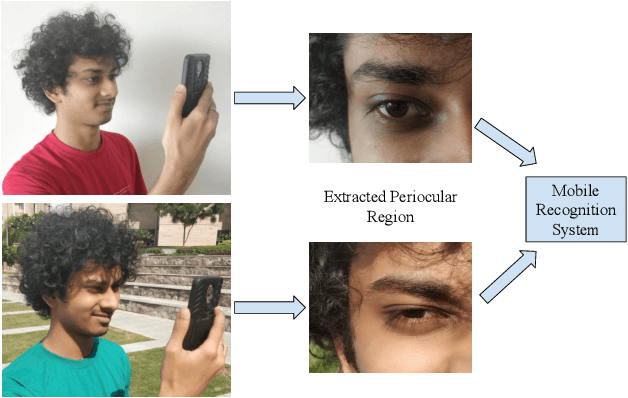
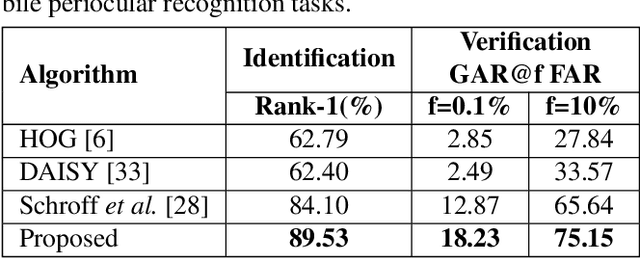
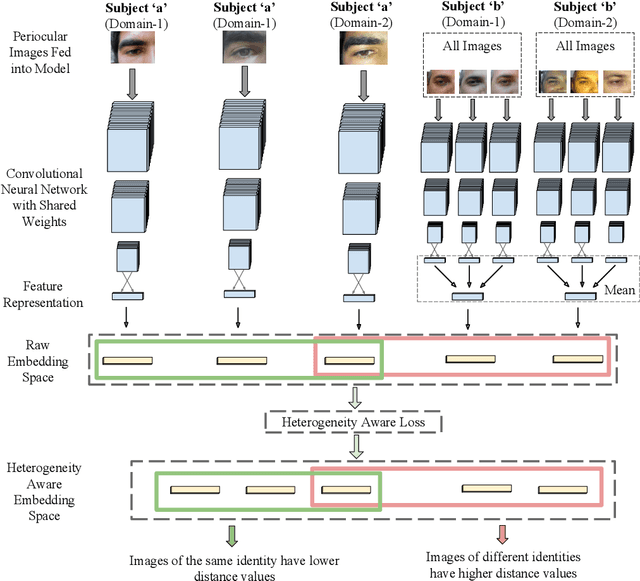
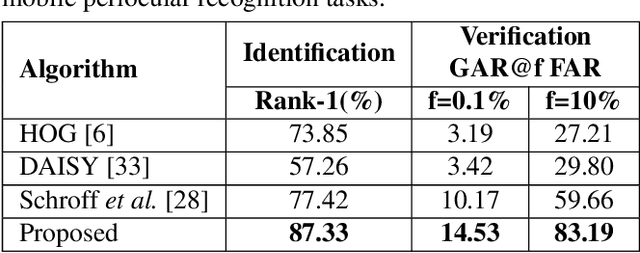
Mobile biometric approaches provide the convenience of secure authentication with an omnipresent technology. However, this brings an additional challenge of recognizing biometric patterns in unconstrained environment including variations in mobile camera sensors, illumination conditions, and capture distance. To address the heterogeneous challenge, this research presents a novel heterogeneity aware loss function within a deep learning framework. The effectiveness of the proposed loss function is evaluated for periocular biometrics using the CSIP, IMP and VISOB mobile periocular databases. The results show that the proposed algorithm yields state-of-the-art results in a heterogeneous environment and improves generalizability for cross-database experiments.