 Add to Chrome
 Add to Firefox
 Add to Edge
Identifying Informative Environments for Cognition Parameter Inference via Bayesian Experimental Design
Aug 03, 2026
Computational cognitive modeling seeks to infer latent cognitive mechanisms underlying observed behavior. Bayesian inverse planning provides a principled framework for such inference, but its success depends critically on the experimental environment. Existing approaches typically treat environments as fixed, leaving open the question of which cognitive experiments are most informative for cognition parameter inference. We formulate the design of cognitive planning experiments as a Bayesian Experimental Design (BED) problem, treating the experimental environment as the design variable. We establish an exact Monte Carlo BED benchmark and introduce an amortized Bayesian experimental design framework for efficient posterior inference and design evaluation. Experiments on the Mouselab-MDP process-tracing paradigm show that amortized BED closely matches the environment rankings of exact Monte Carlo BED while substantially reducing computational cost. We further show that no single environment is uniformly optimal across cognitive inference objectives, revealing trade-offs between expected information gain, posterior recoverability, and information efficiency. These results provide a principled framework for designing informative cognitive experiments for Bayesian parameter inference.

A Minimal Model of Bounded Trade-Off Screening in Multi-Attribute Choice
Jun 11, 2026Human decision-making often involves choosing between multi-attribute alternatives, yet classical models assume fully compensatory utility aggregation despite evidence that people reject options with poor performance on critical attributes. We propose a bounded trade-off reasoning framework in which decisions are governed by a screening process that evaluates the balance between gains and losses across attributes. The model introduces a trade-off tolerance parameter that controls acceptable imbalance and can vary across contexts. Through simulation, we show that this mechanism produces preference patterns that differ from standard utility-based models and captures context-dependent variation in trade-off behavior. These results establish bounded trade-off screening as a plausible computational mechanism for multi-attribute choice and generate testable predictions for future behavioral studies.
Understanding Human Actions through the Lens of Executable Models
Apr 20, 2026Human-centred systems require an understanding of human actions in the physical world. Temporally extended sequences of actions are intentional and structured, yet existing methods for recognising what actions are performed often do not attempt to capture their structure, particularly how the actions are executed. This, however, is crucial for assessing the quality of the action's execution and its differences from other actions. To capture the internal mechanics of actions, we introduce a domain-specific language EXACT that represents human motions as underspecified motion programs, interpreted as reward-generating functions for zero-shot policy inference using forward-backwards representations. By leveraging the compositional nature of EXACT motion programs, we combine individual policies into an executable neuro-symbolic model that uses program structure for compositional modelling. We evaluate the utility of the proposed pipeline for creating executable action models by analysing motion-capture data to understand human actions, for the tasks of human action segmentation and action anomaly detection. Our results show that the use of executable action models improves data efficiency and captures intuitive relationships between actions compared with monolithic, task-specific approaches.
Mixture-Model Preference Learning for Many-Objective Bayesian Optimization
Mar 30, 2026Preference-based many-objective optimization faces two obstacles: an expanding space of trade-offs and heterogeneous, context-dependent human value structures. Towards this, we propose a Bayesian framework that learns a small set of latent preference archetypes rather than assuming a single fixed utility function, modelling them as components of a Dirichlet-process mixture with uncertainty over both archetypes and their weights. To query efficiently, we designing hybrid queries that target information about (i) mode identity and (ii) within-mode trade-offs. Under mild assumptions, we provide a simple regret guarantee for the resulting mixture-aware Bayesian optimization procedure. Empirically, our method outperforms standard baselines on synthetic and real-world many-objective benchmarks, and mixture-aware diagnostics reveal structure that regret alone fails to capture.
HyperHawkes: Hypernetwork based Neural Temporal Point Process
Oct 01, 2022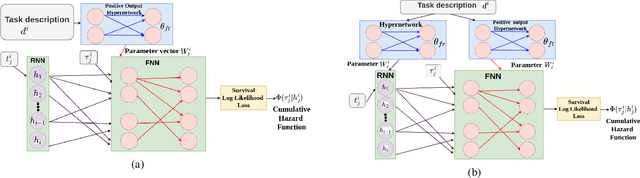
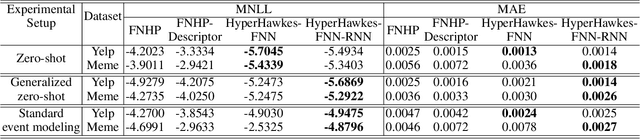

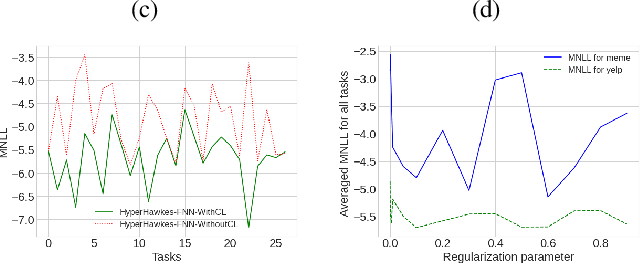
Temporal point process serves as an essential tool for modeling time-to-event data in continuous time space. Despite having massive amounts of event sequence data from various domains like social media, healthcare etc., real world application of temporal point process faces two major challenges: 1) it is not generalizable to predict events from unseen sequences in dynamic environment 2) they are not capable of thriving in continually evolving environment with minimal supervision while retaining previously learnt knowledge. To tackle these issues, we propose \textit{HyperHawkes}, a hypernetwork based temporal point process framework which is capable of modeling time of occurrence of events for unseen sequences. Thereby, we solve the problem of zero-shot learning for time-to-event modeling. We also develop a hypernetwork based continually learning temporal point process for continuous modeling of time-to-event sequences with minimal forgetting. In this way, \textit{HyperHawkes} augments the temporal point process with zero-shot modeling and continual learning capabilities. We demonstrate the application of the proposed framework through our experiments on two real-world datasets. Our results show the efficacy of the proposed approach in terms of predicting future events under zero-shot regime for unseen event sequences. We also show that the proposed model is able to predict sequences continually while retaining information from previous event sequences, hence mitigating catastrophic forgetting for time-to-event data.
Bayesian Neural Hawkes Process for Event Uncertainty Prediction
Jan 19, 2022

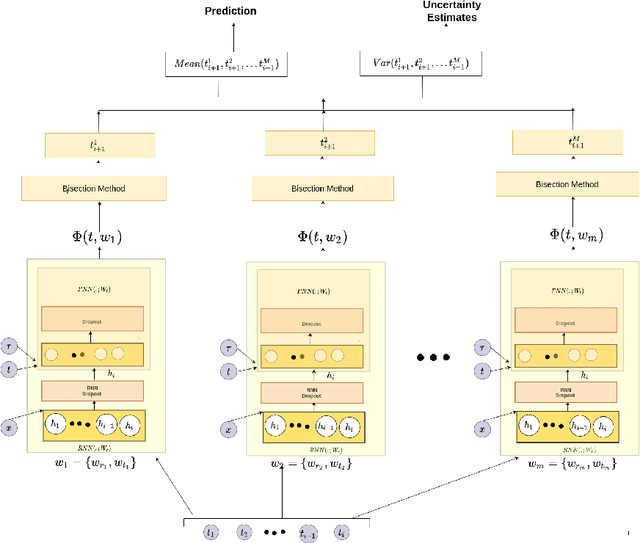
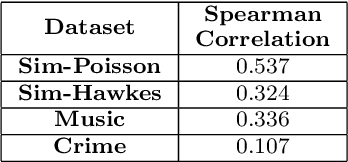
Event data consisting of time of occurrence of the events arises in several real-world applications. Recent works have introduced neural network based point processes for modeling event-times, and were shown to provide state-of-the-art performance in predicting event-times. However, neural point process models lack a good uncertainty quantification capability on predictions. A proper uncertainty quantification over event modeling will help in better decision making for many practical applications. Therefore, we propose a novel point process model, Bayesian Neural Hawkes process (BNHP) which leverages uncertainty modelling capability of Bayesian models and generalization capability of the neural networks to model event occurrence times. We augment the model with spatio-temporal modeling capability where it can consider uncertainty over predicted time and location of the events. Experiments on simulated and real-world datasets show that BNHP significantly improves prediction performance and uncertainty quantification for modelling events.