 Add to Chrome
 Add to Firefox
 Add to Edge
AugSplat: Radiance Field-Informed Gaussian Splatting for Sparse-View Settings
Jun 30, 2026
Generating high-quality novel views at real-time frame rates remains a central challenge in 3D vision, particularly in sparse-view scenarios. Neural radiance fields have demonstrated robust reconstruction from limited observations, but their reliance on volumetric rendering leads to high computational cost and slow inference. In contrast, Gaussian Splatting methods achieve real-time rendering through rasterization, but their optimization is highly sensitive to the quality of the initial geometry. This sensitivity becomes especially problematic in sparse-view settings, where limited observations often lead to incomplete or noisy point-cloud reconstructions. In this work, we present AugSplat, a simple framework for improving Gaussian Splatting in sparse-view regimes using radiance-field-based view augmentation. We first train a radiance field on the sparse input views and use it to synthesize additional images from nearby novel viewpoints, increasing the effective view-space coverage available for supervision. These synthetic views are then used as auxiliary supervision during Gaussian Splatting optimization. We study two variants: Staged AugSplat, which uses synthetic views for an initial optimization phase before switching to real images, and Dual AugSplat, which jointly trains on real and synthetic views with a decaying synthetic loss weight. Experiments on sparse-view mip-NeRF 360 scenes show that AugSplat improves reconstruction quality over standard Gaussian Splatting. Staged AugSplat achieves the strongest average performance, while Dual AugSplat provides a closely performing formulation that keeps real-image supervision active throughout training, and both variants preserve real-time rendering at inference.

HoloSpot: Intuitive Object Manipulation via Mixed Reality Drag-and-Drop
Oct 14, 2024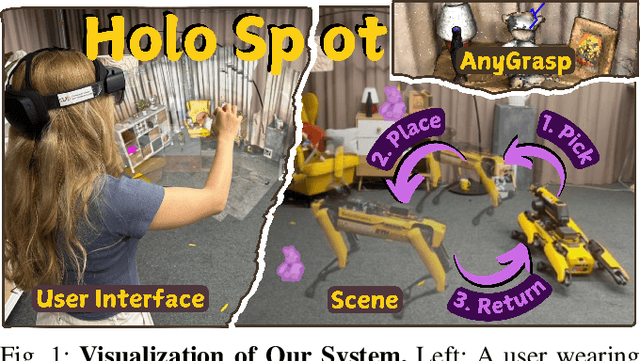

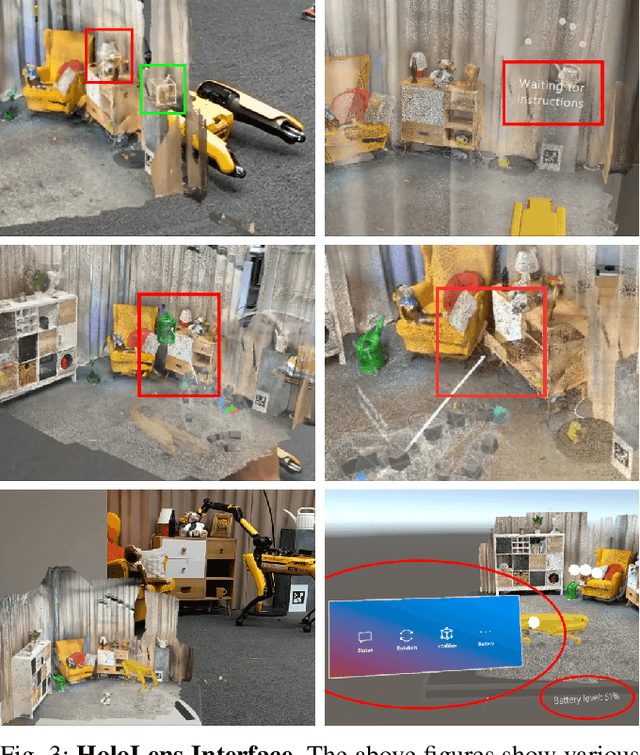

Human-robot interaction through mixed reality (MR) technologies enables novel, intuitive interfaces to control robots in remote operations. Such interfaces facilitate operations in hazardous environments, where human presence is risky, yet human oversight remains crucial. Potential environments include disaster response scenarios and areas with high radiation or toxic chemicals. In this paper we present an interface system projecting a 3D representation of a scanned room as a scaled-down 'dollhouse' hologram, allowing users to select and manipulate objects using a straightforward drag-and-drop interface. We then translate these drag-and-drop user commands into real-time robot actions based on the recent Spot-Compose framework. The Unity-based application provides an interactive tutorial and a user-friendly experience, ensuring ease of use. Through comprehensive end-to-end testing, we validate the system's capability in executing pick-and-place tasks and a complementary user study affirms the interface's intuitive controls. Our findings highlight the advantages of this interface in improving user experience and operational efficiency. This work lays the groundwork for a robust framework that advances the potential for seamless human-robot collaboration in diverse applications. Paper website: https://holospot.github.io/