 Add to Chrome
 Add to Firefox
 Add to Edge
Deep Image Prior for Computed Tomography Reconstruction
Feb 16, 2026
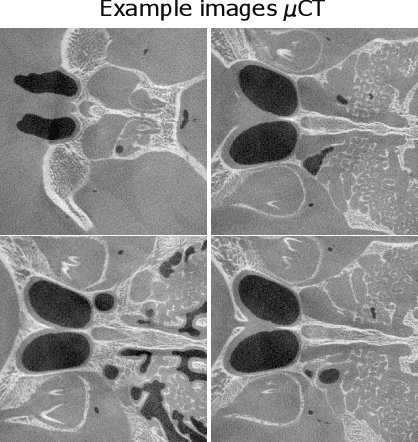
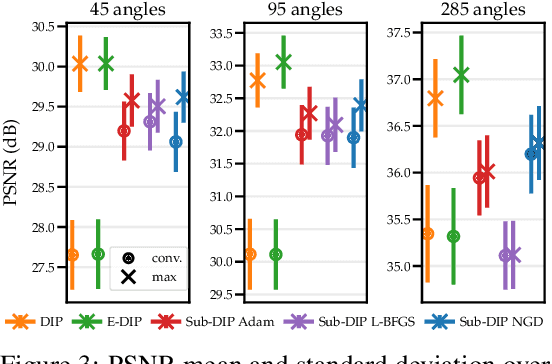
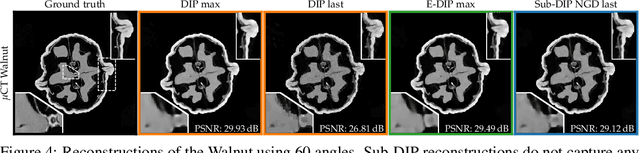
We present a comprehensive overview of the Deep Image Prior (DIP) framework and its applications to image reconstruction in computed tomography. Unlike conventional deep learning methods that rely on large, supervised datasets, the DIP exploits the implicit bias of convolutional neural networks and operates in a fully unsupervised setting, requiring only a single measurement, even in the presence of noise. We describe the standard DIP formulation, outline key algorithmic design choices, and review several strategies to mitigate overfitting, including early stopping, explicit regularisation, and self-guided methods that adapt the network input. In addition, we examine computational improvements such as warm-start and stochastic optimisation methods to reduce the reconstruction time. The discussed methods are tested on real $μ$CT measurements, which allows examination of trade-offs among the different modifications and extensions.

CMAD: Cooperative Multi-Agent Diffusion via Stochastic Optimal Control
Feb 11, 2026Continuous-time generative models have achieved remarkable success in image restoration and synthesis. However, controlling the composition of multiple pre-trained models remains an open challenge. Current approaches largely treat composition as an algebraic composition of probability densities, such as via products or mixtures of experts. This perspective assumes the target distribution is known explicitly, which is almost never the case. In this work, we propose a different paradigm that formulates compositional generation as a cooperative Stochastic Optimal Control problem. Rather than combining probability densities, we treat pre-trained diffusion models as interacting agents whose diffusion trajectories are jointly steered, via optimal control, toward a shared objective defined on their aggregated output. We validate our framework on conditional MNIST generation and compare it against a naive inference-time DPS-style baseline replacing learned cooperative control with per-step gradient guidance.
Solving Inverse Problems with Flow-based Models via Model Predictive Control
Jan 30, 2026Flow-based generative models provide strong unconditional priors for inverse problems, but guiding their dynamics for conditional generation remains challenging. Recent work casts training-free conditional generation in flow models as an optimal control problem; however, solving the resulting trajectory optimisation is computationally and memory intensive, requiring differentiation through the flow dynamics or adjoint solves. We propose MPC-Flow, a model predictive control framework that formulates inverse problem solving with flow-based generative models as a sequence of control sub-problems, enabling practical optimal control-based guidance at inference time. We provide theoretical guarantees linking MPC-Flow to the underlying optimal control objective and show how different algorithmic choices yield a spectrum of guidance algorithms, including regimes that avoid backpropagation through the generative model trajectory. We evaluate MPC-Flow on benchmark image restoration tasks, spanning linear and non-linear settings such as in-painting, deblurring, and super-resolution, and demonstrate strong performance and scalability to massive state-of-the-art architectures via training-free guidance of FLUX.2 (32B) in a quantised setting on consumer hardware.
Best Practices for Multi-Fidelity Bayesian Optimization in Materials and Molecular Research
Oct 01, 2024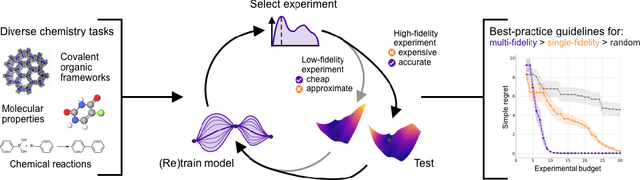
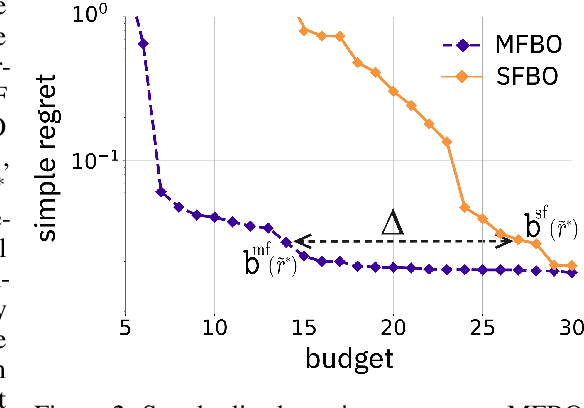
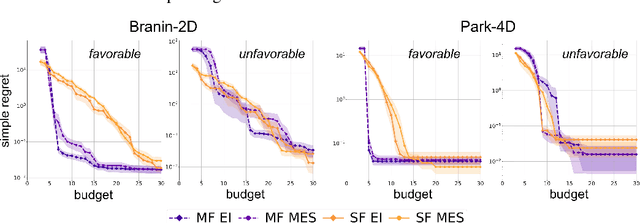
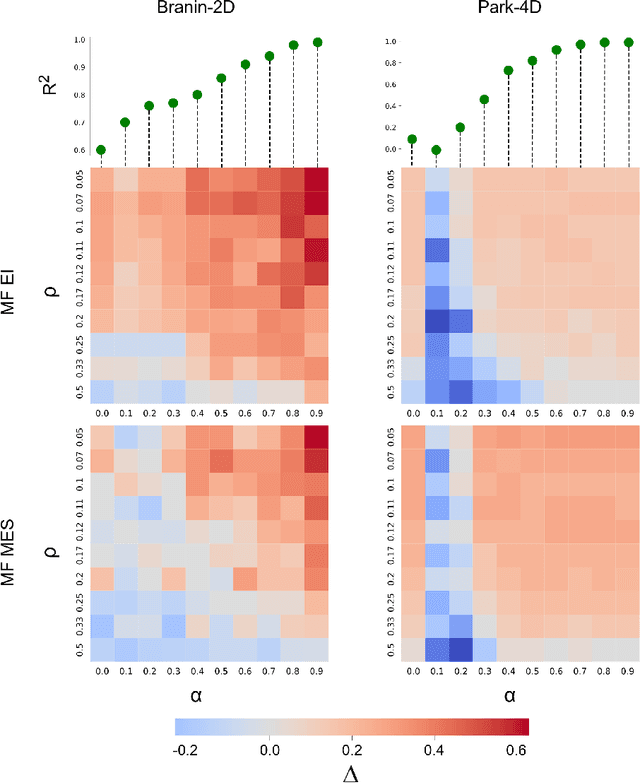
Multi-fidelity Bayesian Optimization (MFBO) is a promising framework to speed up materials and molecular discovery as sources of information of different accuracies are at hand at increasing cost. Despite its potential use in chemical tasks, there is a lack of systematic evaluation of the many parameters playing a role in MFBO. In this work, we provide guidelines and recommendations to decide when to use MFBO in experimental settings. We investigate MFBO methods applied to molecules and materials problems. First, we test two different families of acquisition functions in two synthetic problems and study the effect of the informativeness and cost of the approximate function. We use our implementation and guidelines to benchmark three real discovery problems and compare them against their single-fidelity counterparts. Our results may help guide future efforts to implement MFBO as a routine tool in the chemical sciences.
DEFT: Efficient Finetuning of Conditional Diffusion Models by Learning the Generalised $h$-transform
Jun 03, 2024Generative modelling paradigms based on denoising diffusion processes have emerged as a leading candidate for conditional sampling in inverse problems. In many real-world applications, we often have access to large, expensively trained unconditional diffusion models, which we aim to exploit for improving conditional sampling. Most recent approaches are motivated heuristically and lack a unifying framework, obscuring connections between them. Further, they often suffer from issues such as being very sensitive to hyperparameters, being expensive to train or needing access to weights hidden behind a closed API. In this work, we unify conditional training and sampling using the mathematically well-understood Doob's h-transform. This new perspective allows us to unify many existing methods under a common umbrella. Under this framework, we propose DEFT (Doob's h-transform Efficient FineTuning), a new approach for conditional generation that simply fine-tunes a very small network to quickly learn the conditional $h$-transform, while keeping the larger unconditional network unchanged. DEFT is much faster than existing baselines while achieving state-of-the-art performance across a variety of linear and non-linear benchmarks. On image reconstruction tasks, we achieve speedups of up to 1.6$\times$, while having the best perceptual quality on natural images and reconstruction performance on medical images.
Steerable Conditional Diffusion for Out-of-Distribution Adaptation in Imaging Inverse Problems
Aug 28, 2023
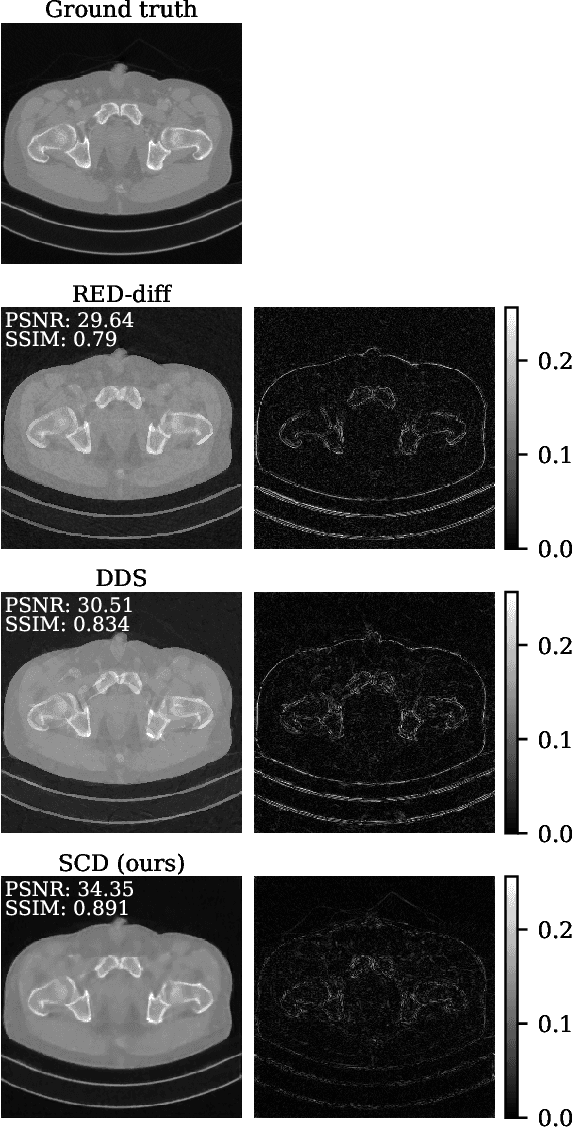

Denoising diffusion models have emerged as the go-to framework for solving inverse problems in imaging. A critical concern regarding these models is their performance on out-of-distribution (OOD) tasks, which remains an under-explored challenge. Realistic reconstructions inconsistent with the measured data can be generated, hallucinating image features that are uniquely present in the training dataset. To simultaneously enforce data-consistency and leverage data-driven priors, we introduce a novel sampling framework called Steerable Conditional Diffusion. This framework adapts the denoising network specifically to the available measured data. Utilising our proposed method, we achieve substantial enhancements in OOD performance across diverse imaging modalities, advancing the robust deployment of denoising diffusion models in real-world applications.
Score-Based Generative Models for PET Image Reconstruction
Aug 27, 2023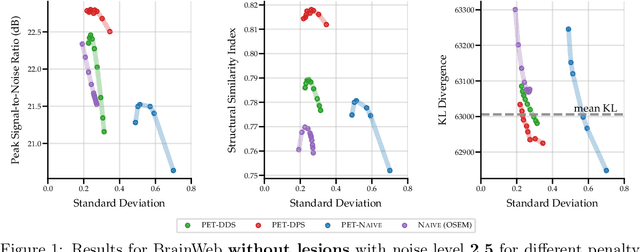
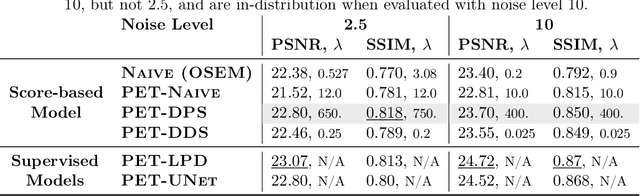
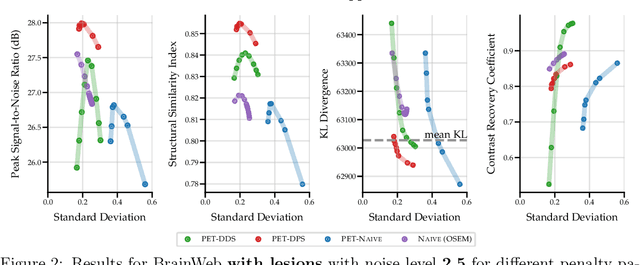
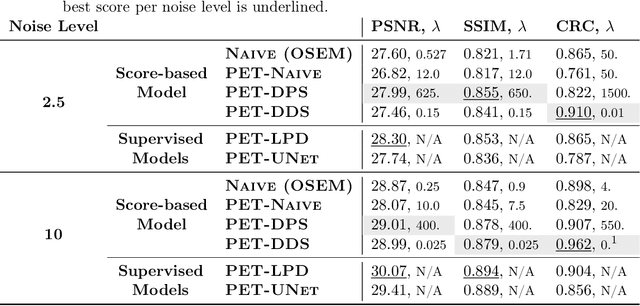
Score-based generative models have demonstrated highly promising results for medical image reconstruction tasks in magnetic resonance imaging or computed tomography. However, their application to Positron Emission Tomography (PET) is still largely unexplored. PET image reconstruction involves a variety of challenges, including Poisson noise with high variance and a wide dynamic range. To address these challenges, we propose several PET-specific adaptations of score-based generative models. The proposed framework is developed for both 2D and 3D PET. In addition, we provide an extension to guided reconstruction using magnetic resonance images. We validate the approach through extensive 2D and 3D $\textit{in-silico}$ experiments with a model trained on patient-realistic data without lesions, and evaluate on data without lesions as well as out-of-distribution data with lesions. This demonstrates the proposed method's robustness and significant potential for improved PET reconstruction.
SVD-DIP: Overcoming the Overfitting Problem in DIP-based CT Reconstruction
Mar 28, 2023


The deep image prior (DIP) is a well-established unsupervised deep learning method for image reconstruction; yet it is far from being flawless. The DIP overfits to noise if not early stopped, or optimized via a regularized objective. We build on the regularized fine-tuning of a pretrained DIP, by adopting a novel strategy that restricts the learning to the adaptation of singular values. The proposed SVD-DIP uses ad hoc convolutional layers whose pretrained parameters are decomposed via the singular value decomposition. Optimizing the DIP then solely consists in the fine-tuning of the singular values, while keeping the left and right singular vectors fixed. We thoroughly validate the proposed method on real-measured $\mu$CT data of a lotus root as well as two medical datasets (LoDoPaB and Mayo). We report significantly improved stability of the DIP optimization, by overcoming the overfitting to noise.
Fast and Painless Image Reconstruction in Deep Image Prior Subspaces
Feb 20, 2023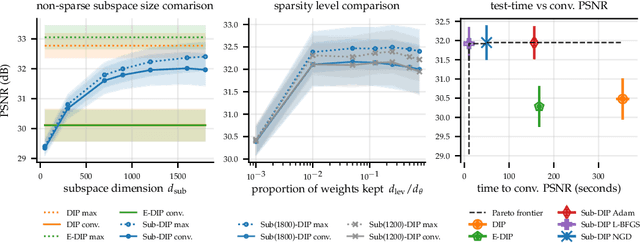
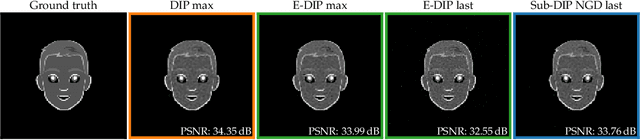
The deep image prior (DIP) is a state-of-the-art unsupervised approach for solving linear inverse problems in imaging. We address two key issues that have held back practical deployment of the DIP: the long computing time needed to train a separate deep network per reconstruction, and the susceptibility to overfitting due to a lack of robust early stopping strategies in the unsupervised setting. To this end, we restrict DIP optimisation to a sparse linear subspace of the full parameter space. We construct the subspace from the principal eigenspace of a set of parameter vectors sampled at equally spaced intervals during DIP pre-training on synthetic task-agnostic data. The low-dimensionality of the resulting subspace reduces DIP's capacity to fit noise and allows the use of fast second order optimisation methods, e.g., natural gradient descent or L-BFGS. Experiments across tomographic tasks of different geometry, ill-posedness and stopping criteria consistently show that second order optimisation in a subspace is Pareto-optimal in terms of optimisation time to reconstruction fidelity trade-off.
Sampling-based inference for large linear models, with application to linearised Laplace
Oct 10, 2022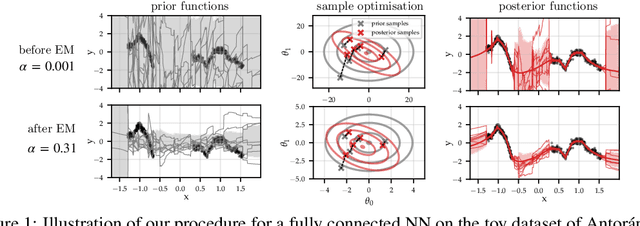
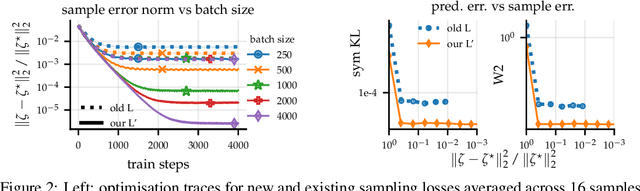

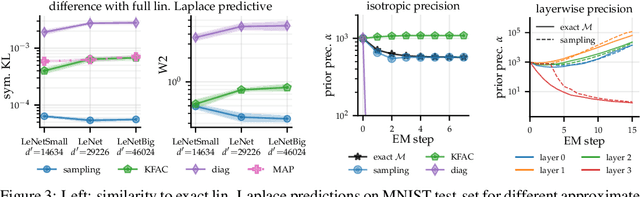
Large-scale linear models are ubiquitous throughout machine learning, with contemporary application as surrogate models for neural network uncertainty quantification; that is, the linearised Laplace method. Alas, the computational cost associated with Bayesian linear models constrains this method's application to small networks, small output spaces and small datasets. We address this limitation by introducing a scalable sample-based Bayesian inference method for conjugate Gaussian multi-output linear models, together with a matching method for hyperparameter (regularisation) selection. Furthermore, we use a classic feature normalisation method (the g-prior) to resolve a previously highlighted pathology of the linearised Laplace method. Together, these contributions allow us to perform linearised neural network inference with ResNet-18 on CIFAR100 (11M parameters, 100 output dimensions x 50k datapoints) and with a U-Net on a high-resolution tomographic reconstruction task (2M parameters, 251k output dimensions).