 Add to Chrome
 Add to Firefox
 Add to Edge
A Stability Benchmark of Generative Regularizers for Inverse Problems
May 11, 2026
Generative (diffusion) priors demonstrate remarkable performance in addressing inverse problems in imaging. Yet, for scientific and medical imaging, it is crucial that reconstruction techniques remain stable and reliable under imperfect settings. Typical definitions of stability encompass the notion of ''convergent regularization'', robustness to out-of-distribution data, and to inaccuracies in the forward operator or noise model. We evaluate these properties numerically. Furthermore, we benchmark generative approaches against modern optimization-based methods inspired by the widely used variational techniques. Our results give insights for which settings and applications generative priors can deliver state-of-the-art reconstructions, and on those in which they fall short or may even be problematic.

GRIFDIR: Graph Resolution-Invariant FEM Diffusion Models in Function Spaces over Irregular Domains
May 05, 2026Score-based diffusion models in infinite-dimensional function spaces provide a mathematically principled framework for modelling function-valued data, offering key advantages such as resolution invariance and the ability to handle irregular discretisations. However, practical implementations have struggled to fully realise these benefits. Existing backbones like Fourier neural operators are often biased towards regular grids and fail to generalise to complex domain topologies. We propose a novel architecture for function-space diffusion models that represents generalised graph convolutional kernels as finite element functions, enabling the model to naturally handle unstructured meshes and complex geometries. We demonstrate the efficacy of our network architecture through a series of unconditional and conditional sampling experiments across diverse geometries, including non-convex and multiply-connected domains. Our results show that the proposed method maintains resolution invariance and achieves high fidelity in capturing functional distributions on non-trivial geometries.
Deep Image Prior for Computed Tomography Reconstruction
Feb 16, 2026We present a comprehensive overview of the Deep Image Prior (DIP) framework and its applications to image reconstruction in computed tomography. Unlike conventional deep learning methods that rely on large, supervised datasets, the DIP exploits the implicit bias of convolutional neural networks and operates in a fully unsupervised setting, requiring only a single measurement, even in the presence of noise. We describe the standard DIP formulation, outline key algorithmic design choices, and review several strategies to mitigate overfitting, including early stopping, explicit regularisation, and self-guided methods that adapt the network input. In addition, we examine computational improvements such as warm-start and stochastic optimisation methods to reduce the reconstruction time. The discussed methods are tested on real $μ$CT measurements, which allows examination of trade-offs among the different modifications and extensions.
CMAD: Cooperative Multi-Agent Diffusion via Stochastic Optimal Control
Feb 11, 2026Continuous-time generative models have achieved remarkable success in image restoration and synthesis. However, controlling the composition of multiple pre-trained models remains an open challenge. Current approaches largely treat composition as an algebraic composition of probability densities, such as via products or mixtures of experts. This perspective assumes the target distribution is known explicitly, which is almost never the case. In this work, we propose a different paradigm that formulates compositional generation as a cooperative Stochastic Optimal Control problem. Rather than combining probability densities, we treat pre-trained diffusion models as interacting agents whose diffusion trajectories are jointly steered, via optimal control, toward a shared objective defined on their aggregated output. We validate our framework on conditional MNIST generation and compare it against a naive inference-time DPS-style baseline replacing learned cooperative control with per-step gradient guidance.
Trajectory Stitching for Solving Inverse Problems with Flow-Based Models
Feb 09, 2026Flow-based generative models have emerged as powerful priors for solving inverse problems. One option is to directly optimize the initial latent code (noise), such that the flow output solves the inverse problem. However, this requires backpropagating through the entire generative trajectory, incurring high memory costs and numerical instability. We propose MS-Flow, which represents the trajectory as a sequence of intermediate latent states rather than a single initial code. By enforcing the flow dynamics locally and coupling segments through trajectory-matching penalties, MS-Flow alternates between updating intermediate latent states and enforcing consistency with observed data. This reduces memory consumption while improving reconstruction quality. We demonstrate the effectiveness of MS-Flow over existing methods on image recovery and inverse problems, including inpainting, super-resolution, and computed tomography.
Solving Inverse Problems with Flow-based Models via Model Predictive Control
Jan 30, 2026Flow-based generative models provide strong unconditional priors for inverse problems, but guiding their dynamics for conditional generation remains challenging. Recent work casts training-free conditional generation in flow models as an optimal control problem; however, solving the resulting trajectory optimisation is computationally and memory intensive, requiring differentiation through the flow dynamics or adjoint solves. We propose MPC-Flow, a model predictive control framework that formulates inverse problem solving with flow-based generative models as a sequence of control sub-problems, enabling practical optimal control-based guidance at inference time. We provide theoretical guarantees linking MPC-Flow to the underlying optimal control objective and show how different algorithmic choices yield a spectrum of guidance algorithms, including regimes that avoid backpropagation through the generative model trajectory. We evaluate MPC-Flow on benchmark image restoration tasks, spanning linear and non-linear settings such as in-painting, deblurring, and super-resolution, and demonstrate strong performance and scalability to massive state-of-the-art architectures via training-free guidance of FLUX.2 (32B) in a quantised setting on consumer hardware.
Supervised Guidance Training for Infinite-Dimensional Diffusion Models
Jan 28, 2026Score-based diffusion models have recently been extended to infinite-dimensional function spaces, with uses such as inverse problems arising from partial differential equations. In the Bayesian formulation of inverse problems, the aim is to sample from a posterior distribution over functions obtained by conditioning a prior on noisy observations. While diffusion models provide expressive priors in function space, the theory of conditioning them to sample from the posterior remains open. We address this, assuming that either the prior lies in the Cameron-Martin space, or is absolutely continuous with respect to a Gaussian measure. We prove that the models can be conditioned using an infinite-dimensional extension of Doob's $h$-transform, and that the conditional score decomposes into an unconditional score and a guidance term. As the guidance term is intractable, we propose a simulation-free score matching objective (called Supervised Guidance Training) enabling efficient and stable posterior sampling. We illustrate the theory with numerical examples on Bayesian inverse problems in function spaces. In summary, our work offers the first function-space method for fine-tuning trained diffusion models to accurately sample from a posterior.
Learning Regularization Functionals for Inverse Problems: A Comparative Study
Oct 02, 2025In recent years, a variety of learned regularization frameworks for solving inverse problems in imaging have emerged. These offer flexible modeling together with mathematical insights. The proposed methods differ in their architectural design and training strategies, making direct comparison challenging due to non-modular implementations. We address this gap by collecting and unifying the available code into a common framework. This unified view allows us to systematically compare the approaches and highlight their strengths and limitations, providing valuable insights into their future potential. We also provide concise descriptions of each method, complemented by practical guidelines.
Learning Binary Sampling Patterns for Single-Pixel Imaging using Bilevel Optimisation
Aug 26, 2025Single-Pixel Imaging enables reconstructing objects using a single detector through sequential illuminations with structured light patterns. We propose a bilevel optimisation method for learning task-specific, binary illumination patterns, optimised for applications like single-pixel fluorescence microscopy. We address the non-differentiable nature of binary pattern optimisation using the Straight-Through Estimator and leveraging a Total Deep Variation regulariser in the bilevel formulation. We demonstrate our method on the CytoImageNet microscopy dataset and show that learned patterns achieve superior reconstruction performance compared to baseline methods, especially in highly undersampled regimes.
Deep Learning Based Reconstruction Methods for Electrical Impedance Tomography
Aug 08, 2025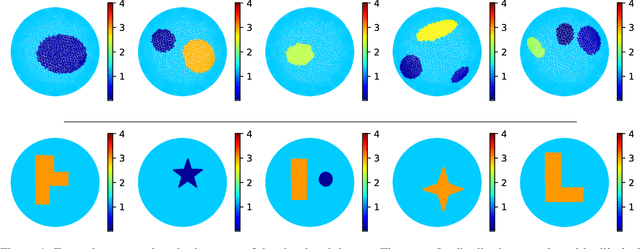
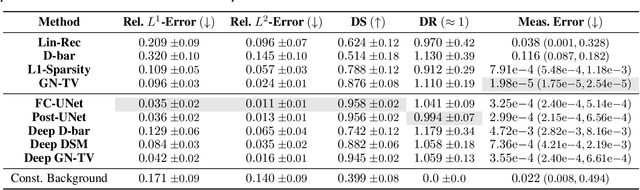
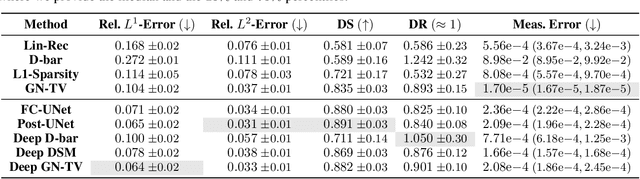

Electrical Impedance Tomography (EIT) is a powerful imaging modality widely used in medical diagnostics, industrial monitoring, and environmental studies. The EIT inverse problem is about inferring the internal conductivity distribution of the concerned object from the voltage measurements taken on its boundary. This problem is severely ill-posed, and requires advanced computational approaches for accurate and reliable image reconstruction. Recent innovations in both model-based reconstruction and deep learning have driven significant progress in the field. In this review, we explore learned reconstruction methods that employ deep neural networks for solving the EIT inverse problem. The discussion focuses on the complete electrode model, one popular mathematical model for real-world applications of EIT. We compare a wide variety of learned approaches, including fully-learned, post-processing and learned iterative methods, with several conventional model-based reconstruction techniques, e.g., sparsity regularization, regularized Gauss-Newton iteration and level set method. The evaluation is based on three datasets: a simulated dataset of ellipses, an out-of-distribution simulated dataset, and the KIT4 dataset, including real-world measurements. Our results demonstrate that learned methods outperform model-based methods for in-distribution data but face challenges in generalization, where hybrid methods exhibit a good balance of accuracy and adaptability.