 Add to Chrome
 Add to Firefox
 Add to Edge
Dual-Domain Manifold Modeling for Hyperspectral Image Fusion
Jul 28, 2026
Achieving a coherent integration of spectral richness and spatial fidelity remains a central objective in hyperspectral image fusion. However, existing hyperspectral image fusion methods struggle to effectively model geometric constraints. In the spatial domain, weak spatial-spectral interaction limits geometry-aware feature learning and suppresses high-frequency structural information, resulting in low-frequency bias and structural degradation. In the spectral domain, local manifold structures induced by spectral similarity are insufficiently exploited, limiting intrinsic pixel relationship modeling and fine-grained spectral reconstruction. To address these challenges, we propose a dual-domain manifold modeling (DDMM) framework. Specifically, we introduce a Topology-Aware Transformer (TPFormer) that combines global attention with neighborhood propagation, jointly modeling spatial topology and pixel-level feature manifold relationships to capture intrinsic spatial-spectral structures and improve topology-aware representation learning. Furthermore, a Frequency-Decoupled Spatial-Spectral Collaborative Fusion (FDSCF) module is devised, in which features are projected into the frequency domain via the discrete cosine transform and explicitly decoupled into low- and high-frequency components. Guided by a low-rank structural prior and spectral-driven spatial enhancement, FDSCF selectively enhances geometry-aware high-frequency features, strengthening spatia-spectral coupling and recovering sharper edges and finer textures. Extensive experiments on multiple benchmark datasets demonstrate that DDMM achieves superior overall performance over SoTA methods in terms of spatial structure preservation and spectral reconstruction.

Semi-Supervised Flow Matching for Mosaiced and Panchromatic Fusion Imaging
Apr 22, 2026Fusing a low resolution (LR) mosaiced hyperspectral image (HSI) with a high resolution (HR) panchromatic (PAN) image offers a promising avenue for video-rate HR-HSI imaging via single-shot acquisition, yet its severely ill-posed nature remains a significant challenge. In this work, we propose a novel semi-supervised flow matching framework for mosaiced and PAN image fusion. Unlike previous diffusion-based approaches constrained by specific protocols or handcrafted assumptions, our method seamlessly integrates an unsupervised scheme with flow matching, resulting in a generalizable and efficient generative framework. Specifically, our method follows a two-stage training pipeline. First, we pretrain an unsupervised prior network to produce an initial pseudo HR-HSI. Building on this, we then train a conditional flow matching model to generate the target HR-HSI, introducing a random voting mechanism that iteratively refines the initial HR-HSI estimate, enabling robust and effective fusion. During inference, we employ a conflict-free gradient guidance strategy that ensures spectrally and spatially consistent HR-HSI reconstruction. Experiments on multiple benchmark datasets demonstrate that our method achieves superior quantitative and qualitative performance by a significant margin compared to representative baselines. Beyond mosaiced and PAN fusion, our approach provides a flexible generative framework that can be readily extended to other image fusion tasks and integrated with unsupervised or blind image restoration algorithms.
ASSR-Net: Anisotropic Structure-Aware and Spectrally Recalibrated Network for Hyperspectral Image Fusion
Apr 07, 2026Hyperspectral image fusion aims to reconstruct high-spatial-resolution hyperspectral images (HR-HSI) by integrating complementary information from multi-source inputs. Despite recent progress, existing methods still face two critical challenges: (1) inadequate reconstruction of anisotropic spatial structures, resulting in blurred details and compromised spatial quality; and (2) spectral distortion during fusion, which hinders fine-grained spectral representation. To address these issues, we propose \textbf{ASSR-Net}: an Anisotropic Structure-Aware and Spectrally Recalibrated Network for Hyperspectral Image Fusion. ASSR-Net adopts a two-stage fusion strategy comprising anisotropic structure-aware spatial enhancement (ASSE) and hierarchical prior-guided spectral calibration (HPSC). In the first stage, a directional perception fusion module adaptively captures structural features along multiple orientations, effectively reconstructing anisotropic spatial patterns. In the second stage, a spectral recalibration module leverages the original low-resolution HSI as a spectral prior to explicitly correct spectral deviations in the fused results, thereby enhancing spectral fidelity. Extensive experiments on various benchmark datasets demonstrate that ASSR-Net consistently outperforms state-of-the-art methods, achieving superior spatial detail preservation and spectral consistency.
Robust Remote Sensing Image-Text Retrieval with Noisy Correspondence
Mar 30, 2026As a pivotal task that bridges remote visual and linguistic understanding, Remote Sensing Image-Text Retrieval (RSITR) has attracted considerable research interest in recent years. However, almost all RSITR methods implicitly assume that image-text pairs are matched perfectly. In practice, acquiring a large set of well-aligned data pairs is often prohibitively expensive or even infeasible. In addition, we also notice that the remote sensing datasets (e.g., RSITMD) truly contain some inaccurate or mismatched image text descriptions. Based on the above observations, we reveal an important but untouched problem in RSITR, i.e., Noisy Correspondence (NC). To overcome these challenges, we propose a novel Robust Remote Sensing Image-Text Retrieval (RRSITR) paradigm that designs a self-paced learning strategy to mimic human cognitive learning patterns, thereby learning from easy to hard from multi-modal data with NC. Specifically, we first divide all training sample pairs into three categories based on the loss magnitude of each pair, i.e., clean sample pairs, ambiguous sample pairs, and noisy sample pairs. Then, we respectively estimate the reliability of each training pair by assigning a weight to each pair based on the values of the loss. Further, we respectively design a new multi-modal self-paced function to dynamically regulate the training sequence and weights of the samples, thus establishing a progressive learning process. Finally, for noisy sample pairs, we present a robust triplet loss to dynamically adjust the soft margin based on semantic similarity, thereby enhancing the robustness against noise. Extensive experiments on three popular benchmark datasets demonstrate that the proposed RRSITR significantly outperforms the state-of-the-art methods, especially in high noise rates. The code is available at: https://github.com/MSFLabX/RRSITR
Physics-Inspired Degradation Models for Hyperspectral Image Fusion
Feb 04, 2024The fusion of a low-spatial-resolution hyperspectral image (LR-HSI) with a high-spatial-resolution multispectral image (HR-MSI) has garnered increasing research interest. However, most fusion methods solely focus on the fusion algorithm itself and overlook the degradation models, which results in unsatisfactory performance in practical scenarios. To fill this gap, we propose physics-inspired degradation models (PIDM) to model the degradation of LR-HSI and HR-MSI, which comprises a spatial degradation network (SpaDN) and a spectral degradation network (SpeDN). SpaDN and SpeDN are designed based on two insights. First, we employ spatial warping and spectral modulation operations to simulate lens aberrations, thereby introducing non-uniformity into the spatial and spectral degradation processes. Second, we utilize asymmetric downsampling and parallel downsampling operations to separately reduce the spatial and spectral resolutions of the images, thus ensuring the matching of spatial and spectral degradation processes with specific physical characteristics. Once SpaDN and SpeDN are established, we adopt a self-supervised training strategy to optimize the network parameters and provide a plug-and-play solution for fusion methods. Comprehensive experiments demonstrate that our proposed PIDM can boost the fusion performance of existing fusion methods in practical scenarios.
Asymmetric Hash Code Learning for Remote Sensing Image Retrieval
Jan 15, 2022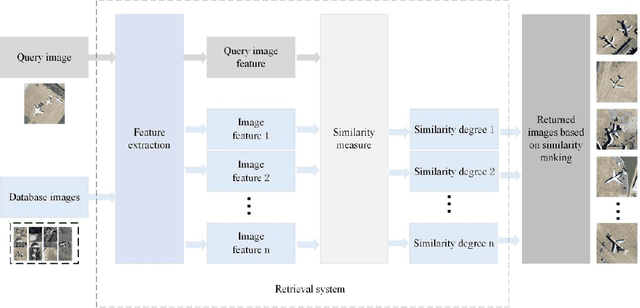
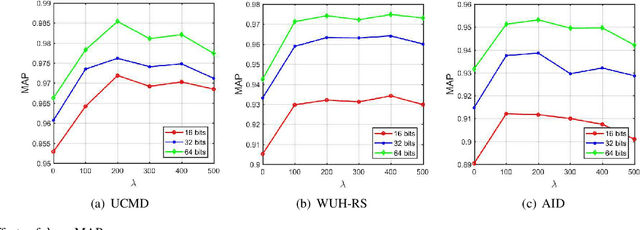
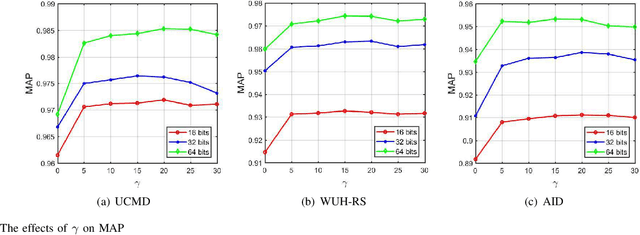
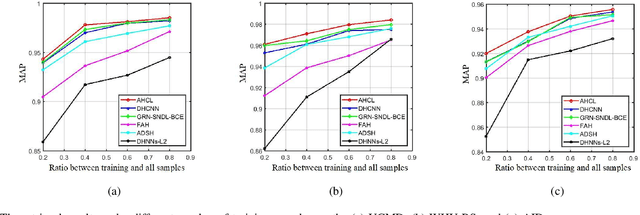
Remote sensing image retrieval (RSIR), aiming at searching for a set of similar items to a given query image, is a very important task in remote sensing applications. Deep hashing learning as the current mainstream method has achieved satisfactory retrieval performance. On one hand, various deep neural networks are used to extract semantic features of remote sensing images. On the other hand, the hashing techniques are subsequently adopted to map the high-dimensional deep features to the low-dimensional binary codes. This kind of methods attempts to learn one hash function for both the query and database samples in a symmetric way. However, with the number of database samples increasing, it is typically time-consuming to generate the hash codes of large-scale database images. In this paper, we propose a novel deep hashing method, named asymmetric hash code learning (AHCL), for RSIR. The proposed AHCL generates the hash codes of query and database images in an asymmetric way. In more detail, the hash codes of query images are obtained by binarizing the output of the network, while the hash codes of database images are directly learned by solving the designed objective function. In addition, we combine the semantic information of each image and the similarity information of pairs of images as supervised information to train a deep hashing network, which improves the representation ability of deep features and hash codes. The experimental results on three public datasets demonstrate that the proposed method outperforms symmetric methods in terms of retrieval accuracy and efficiency. The source code is available at https://github.com/weiweisong415/Demo AHCL for TGRS2022.
Recent Advances and New Guidelines on Hyperspectral and Multispectral Image Fusion
Aug 08, 2020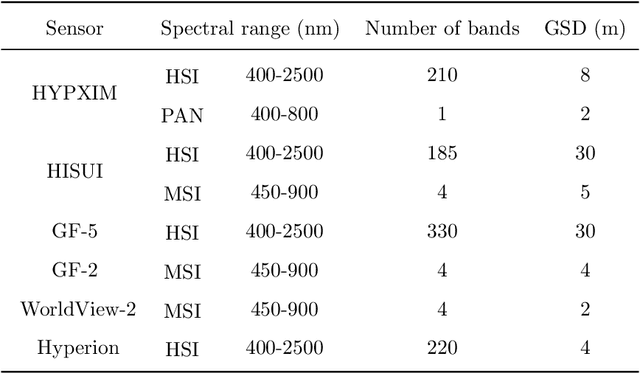
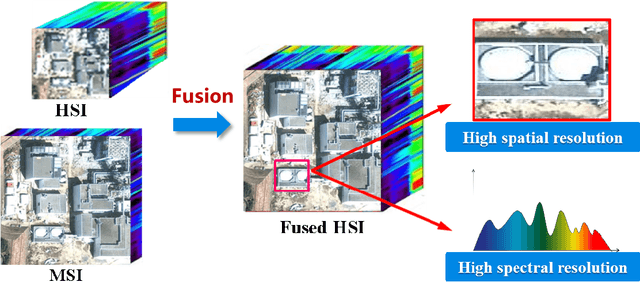
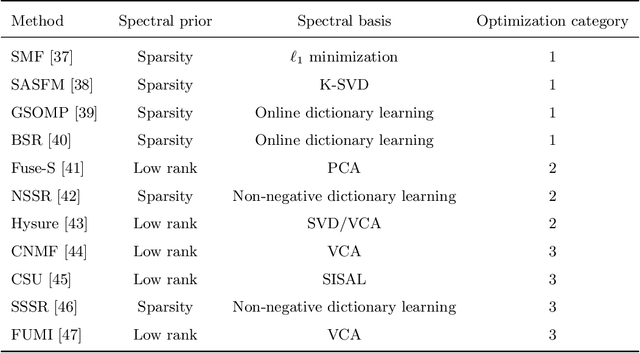
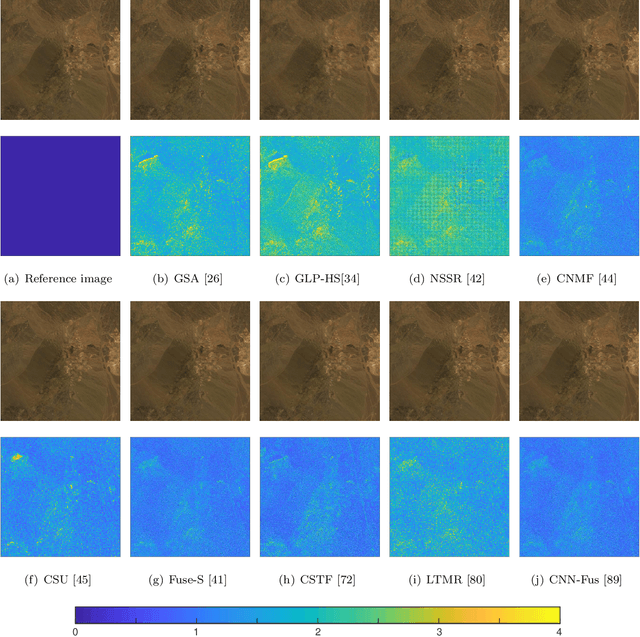
Hyperspectral image (HSI) with high spectral resolution often suffers from low spatial resolution owing to the limitations of imaging sensors. Image fusion is an effective and economical way to enhance the spatial resolution of HSI, which combines HSI with higher spatial resolution multispectral image (MSI) of the same scenario. In the past years, many HSI and MSI fusion algorithms are introduced to obtain high-resolution HSI. However, it lacks a full-scale review for the newly proposed HSI and MSI fusion approaches. To tackle this problem,this work gives a comprehensive review and new guidelines for HSI-MSI fusion. According to the characteristics of HSI-MSI fusion methods, they are categorized as four categories, including pan-sharpening based approaches, matrix factorization based approaches, tensor representation based approaches, and deep convolution neural network based approaches. We make a detailed introduction, discussions, and comparison for the fusion methods in each category. Additionally, the existing challenges and possible future directions for the HSI-MSI fusion are presented.