 Add to Chrome
 Add to Firefox
 Add to Edge
From Noise to Control: Parameterized Diffusion Policies
May 29, 2026
We propose Parameterized Diffusion Policy (PDP), a framework for learning diffusion policies conditioned on low-dimensional, continuous parameters embedded in a learned behavior manifold. By constructing this manifold so that distances between latent representations reflect the semantic similarity between physical trajectories, we transform diffusion from a mechanism for stochastic diversity into a precise and optimizable tool for behavior steering. Our approach enables smooth interpolation between known strategies and efficient adaptation to novel constraints without updating policy weights. We demonstrate that PDP significantly improves adaptation performance on complex multimodal benchmarks in both simulated and real-robot experiments compared to standard diffusion policies, particularly in scenarios requiring the synthesis of novel behaviors.

Learning to Edit Visual Programs with Self-Supervision
Jun 04, 2024We design a system that learns how to edit visual programs. Our edit network consumes a complete input program and a visual target. From this input, we task our network with predicting a local edit operation that could be applied to the input program to improve its similarity to the target. In order to apply this scheme for domains that lack program annotations, we develop a self-supervised learning approach that integrates this edit network into a bootstrapped finetuning loop along with a network that predicts entire programs in one-shot. Our joint finetuning scheme, when coupled with an inference procedure that initializes a population from the one-shot model and evolves members of this population with the edit network, helps to infer more accurate visual programs. Over multiple domains, we experimentally compare our method against the alternative of using only the one-shot model, and find that even under equal search-time budgets, our editing-based paradigm provides significant advantages.
Model-based Reinforcement Learning for Parameterized Action Spaces
Apr 05, 2024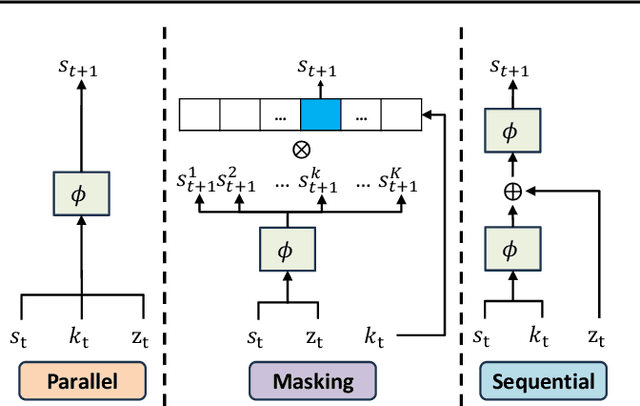
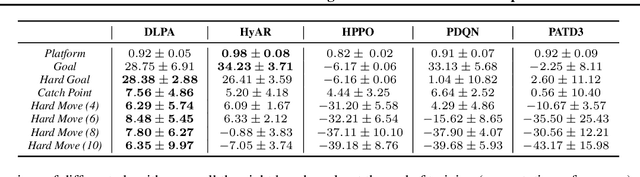
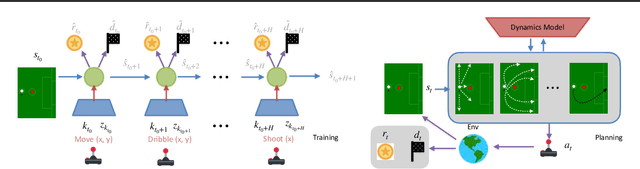
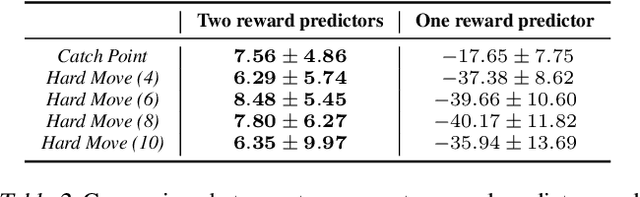
We propose a novel model-based reinforcement learning algorithm -- Dynamics Learning and predictive control with Parameterized Actions (DLPA) -- for Parameterized Action Markov Decision Processes (PAMDPs). The agent learns a parameterized-action-conditioned dynamics model and plans with a modified Model Predictive Path Integral control. We theoretically quantify the difference between the generated trajectory and the optimal trajectory during planning in terms of the value they achieved through the lens of Lipschitz Continuity. Our empirical results on several standard benchmarks show that our algorithm achieves superior sample efficiency and asymptotic performance than state-of-the-art PAMDP methods.