 Add to Chrome
 Add to Firefox
 Add to Edge
Can You Trust the Confidence? ConfBench for Vision-Language Models on Document Extraction
Aug 03, 2026
Intelligent document processing (IDP) with vision-language models (VLMs) hinges on confidence scores trustworthy enough to route extractions between automation and human review. Existing document benchmarks are dominated by clean, high-quality samples, leaving low accuracy regions too sparse for calibration assessment. We introduce ConfBench, the first calibration-specific benchmark for key information extraction (KIE), built by applying 20 controlled degradation pipelines to a diverse document set, yielding 1,346 variants and 70K+ entity-level evaluations spanning the full accuracy spectrum. We evaluate four proprietary and three open-weight VLMs under verbalized and log-probability confidence estimation methods across three input modalities, and find: (i) OCR+Image modality results in more accurate confidence estimates; (ii) model capability is the dominant factor: within the Claude family confidence quality scales monotonically with capability, while across families parameter count is a poor predictor; (iii) calibration quality varies widely across models, from near-perfect to severely overconfident, and per-model post-hoc correction rescales these absolute confidence values for threshold-based routing without altering ranking-based operational metrics; and (iv) log-probability with first-token aggregation consistently outperforms mean-token and margin aggregations. We also introduce ECARB, a review-budget metric translating discriminative gains into operational savings. We release ConfBench publicly to enable systematic study of confidence estimators and calibration methods for trustworthy IDP application deployment.

PRISM: Position-encoded Regressive Inverse Spectral Model for Multilayer Thin-Film Design
May 26, 2026The inverse problem of multilayer thin-film optical coatings design represents a complex combinatorial-continuous optimization challenge. We present PRISM (Position-encoded Regressive Inverse Spectral Model), a unified decoder-only autoregressive transformer that streamlines this process by jointly predicting discrete material selection and continuous thickness regression within a single backbone. PRISM introduces two primary architectural innovations: (1) spectrum prefix conditioning, which utilizes standard prefix tokens for in-context target injection, and (2) cumulative-depth Rotary Position Embeddings, which encode continuous thickness directly into the positional representation to preserve the physical spatial relationships of the stack. Our benchmarks demonstrate that a PRISM-13M model reduces MAE by over 50\% compared to other transformer baselines while utilizing only one-fifth of the parameters. Furthermore, a 44M-parameter variant achieves state-of-the-art performance (MAE = 0.010) on our in-distribution validation benchmark and operates significantly faster than simulated annealing, offering a highly efficient alternative to classical optimization methods.
AME-TS: Anchored Mixture-of-Experts for Time Series Forecasting
May 24, 2026Time series forecasting models are increasingly scaled through large Transformer backbones, yet most existing approaches process all series through a shared dense computation path despite substantial heterogeneity in temporal structure. Mixture-of-Experts (MoE) offers a natural alternative by enabling conditional computation, but standard MoE routing leaves expert specialization weakly identified and often unstable during downstream adaptation. We propose AME-TS, a structure-guided sparse time series foundation model that aligns expert routing with interpretable temporal structure. AME-TS first uses a lightweight regime predictor to estimate series-level descriptors, including forecastability, seasonality, trend, and sparsity, and maps them to a soft structural prior over experts. This series-level prior guides token-level routing during training, encouraging structure-aligned specialization. On the GIFT-Eval benchmark, AME-TS delivers a strong accuracy-efficiency tradeoff across model scales: it substantially outperforms existing time series foundation models at small model scales and remains competitive with the strongest models at larger scales, while activating substantially fewer parameters through sparse routing. We further show that AME-TS learns more interpretable routing geometry and substantially more stable expert specialization than standard MoE during fine-tuning on the M5 dataset. These results suggest that structure-aware routing is an effective and reliable way to realize the benefits of sparse expert models for time series forecasting.
Symbol Rate and Carries Estimation in OFDM Framework: A high Accuracy Technique under Low SNR
Jul 27, 2022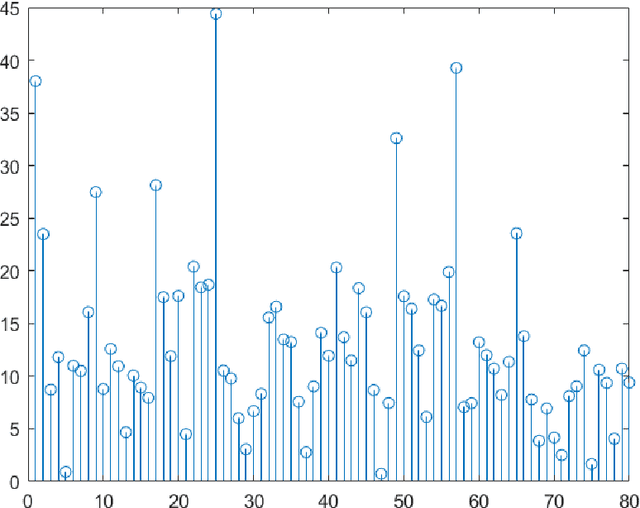
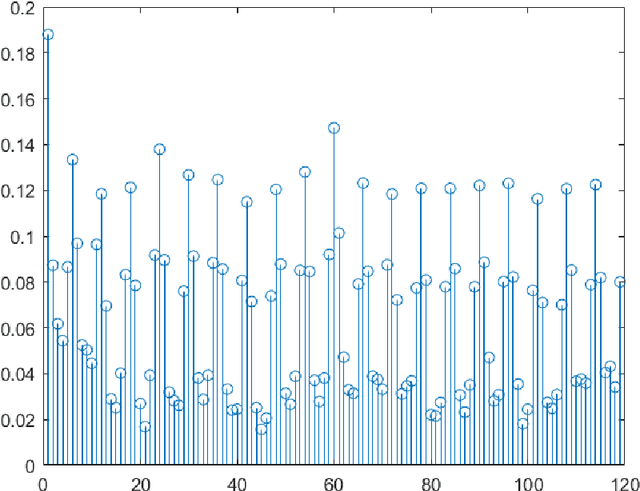

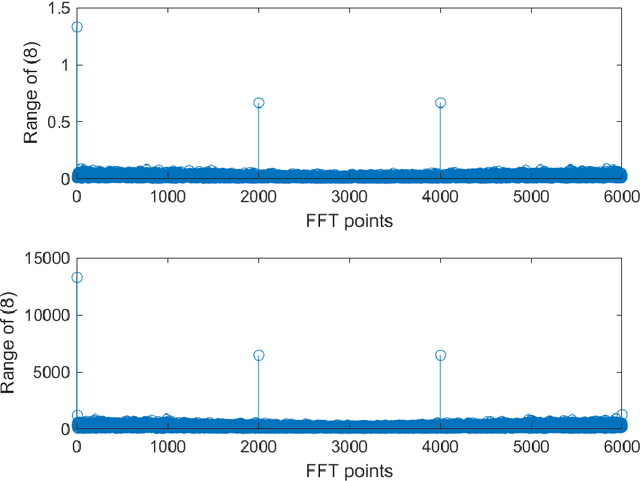
Under a low Signal-to-Noise Ratio (SNR), the Orthogonal Frequency-Division Multiplexing (OFDM) signal symbol rate is limited. Existing carrier number estimation algorithms lack adequate methods to deal with low SNR. This paper proposes an algorithm with a low error rate under low SNR by correlating the signal and applying a Fast Fourier Transform (FFT) operation. By improving existing algorithms, we improve the performance of the OFDM carrier count algorithm. The performance of the OFDM's useful symbol time estimation algorithm is improved by estimating the number of carriers and symbol rate.