 Add to Chrome
 Add to Firefox
 Add to Edge
Physics-Informed Neural Embeddings of PDE Solution Families
Jul 07, 2026
We introduce a physics-informed framework for learning finite-dimensional embeddings of solution families of partial differential equations. The method uses a multihead Physics-Informed Neural Network in which a shared body learns a latent manifold representing the solution space, while linear heads reconstruct individual solutions associated with different initial conditions. A head-orthogonalization penalty removes degeneracies in the latent representation and stabilizes the principal-component spectrum across training realizations. Because the initial condition is built into the network output by construction, these principal components measure the additional variability the network learns on top of the initial profile, not the full solution itself. We apply the method to the one-dimensional viscous Burgers equation, with the heat and wave equations as robustness checks. For a latent dimension $n_b=20$, the learned manifolds exhibit pronounced effective dimensional reduction: for Burgers dynamics, only $2$-$4$ principal components capture about $95\%$ of the latent-space variance, while $4$-$7$ capture about $99\%$, depending on the initial-condition family; the same qualitative compression holds for the heat and wave equations. We also split the wavenumber axis into bands (``Fourier shells'') and measure how much each band contributes to every principal component. The resulting frequency profile is invariant under the change-of-basis freedom that the orthogonalization penalty leaves in the latent space, and is therefore reproducible across independent training runs. More broadly, this establishes the learned spectral profiles and principal components as robust observables of solution-manifold geometry.

Recovering Sharp Conductivity Features in the Finite-Data Calderón Problem with Physics-Informed Neural Networks
Jun 26, 2026Physics-informed neural networks (PINNs) have recently emerged as a promising framework for addressing the Calderón inverse problem from limited boundary data. In this work, we revisit neural Calderón inversion by introducing multiscale boundary excitations based on randomized wavelet functions and investigating the role of Fourier-feature encoding (FFE) for representing sharp conductivity variations. We propose a physics-informed reconstruction framework that represents the unknown conductivity and the associated family of electric potentials with separate neural networks conditioned on the applied boundary excitations. The governing elliptic PDE is enforced through physics-informed residuals, while finite Dirichlet-to-Neumann (DtN) data are incorporated through boundary losses. Using synthetic data from a finite-difference forward solver, we evaluate the method on conductivity fields with inclusions, sharp interfaces, smooth profiles, and heterogeneous media. Results show that the framework recovers dominant conductivity structures from finite boundary measurements with relative errors between $3\%-12\%$ approximately. We show that FFE improves the reconstruction of localized sharp features, particularly for inclusions and interfaces, but are not universally optimal, with raw-coordinate networks performing competitively for smoother fields. These results highlight coordinate representations and boundary excitation design as key factors in neural Calderón inversion.
AI Scientists as Engines of Discovery: A Case for Development within Reformed Institutions
Jun 22, 2026Agentic artificial intelligence (AI) systems are beginning to assist, accelerate, and partially automate scientific discovery, performing tasks that span literature synthesis, code generation, data analysis, hypothesis proposal, and model criticism. We argue that this transition is qualitative rather than incremental, and that suitably designed multi-agent systems may evolve from passive computational tools into ``AI scientists'' that can expand the hypothesis-generating and verification capacity of science. Such systems must be developed and deployed within a scientific ecosystem fit for purpose: institutions must be redesigned for verification, accountability, interpretability, and dual-use safety. We sketch how multi-agent architectures, illustrated by the prototype framework \textit{Denario}, accelerate the discovery cycle and traverse model spaces beyond human reach; examine what this implies for authorship, peer review, and the enduring role of human scientists; and close with recommendations for governing AI as an epistemic actor rather than a mere instrument.
Learning embeddings of non-linear PDEs: the Burgers' equation
Mar 08, 2026Embeddings provide low-dimensional representations that organize complex function spaces and support generalization. They provide a geometric representation that supports efficient retrieval, comparison, and generalization. In this work we generalize the concept to Physics Informed Neural Networks. We present a method to construct solution embedding spaces of nonlinear partial differential equations using a multi-head setup, and extract non-degenerate information from them using principal component analysis (PCA). We test this method by applying it to viscous Burgers' equation, which is solved simultaneously for a family of initial conditions and values of the viscosity. A shared network body learns a latent embedding of the solution space, while linear heads map this embedding to individual realizations. By enforcing orthogonality constraints on the heads, we obtain a principal-component decomposition of the latent space that is robust to training degeneracies and admits a direct physical interpretation. The obtained components for Burgers' equation exhibit rapid saturation, indicating that a small number of latent modes captures the dominant features of the dynamics.
The Denario project: Deep knowledge AI agents for scientific discovery
Oct 30, 2025We present Denario, an AI multi-agent system designed to serve as a scientific research assistant. Denario can perform many different tasks, such as generating ideas, checking the literature, developing research plans, writing and executing code, making plots, and drafting and reviewing a scientific paper. The system has a modular architecture, allowing it to handle specific tasks, such as generating an idea, or carrying out end-to-end scientific analysis using Cmbagent as a deep-research backend. In this work, we describe in detail Denario and its modules, and illustrate its capabilities by presenting multiple AI-generated papers generated by it in many different scientific disciplines such as astrophysics, biology, biophysics, biomedical informatics, chemistry, material science, mathematical physics, medicine, neuroscience and planetary science. Denario also excels at combining ideas from different disciplines, and we illustrate this by showing a paper that applies methods from quantum physics and machine learning to astrophysical data. We report the evaluations performed on these papers by domain experts, who provided both numerical scores and review-like feedback. We then highlight the strengths, weaknesses, and limitations of the current system. Finally, we discuss the ethical implications of AI-driven research and reflect on how such technology relates to the philosophy of science. We publicly release the code at https://github.com/AstroPilot-AI/Denario. A Denario demo can also be run directly on the web at https://huggingface.co/spaces/astropilot-ai/Denario, and the full app will be deployed on the cloud.
Efficient PINNs: Multi-Head Unimodular Regularization of the Solutions Space
Jan 21, 2025We present a machine learning framework to facilitate the solution of nonlinear multiscale differential equations and, especially, inverse problems using Physics-Informed Neural Networks (PINNs). This framework is based on what is called multihead (MH) training, which involves training the network to learn a general space of all solutions for a given set of equations with certain variability, rather than learning a specific solution of the system. This setup is used with a second novel technique that we call Unimodular Regularization (UR) of the latent space of solutions. We show that the multihead approach, combined with the regularization, significantly improves the efficiency of PINNs by facilitating the transfer learning process thereby enabling the finding of solutions for nonlinear, coupled, and multiscale differential equations.
Gravitational Duals from Equations of State
Mar 21, 2024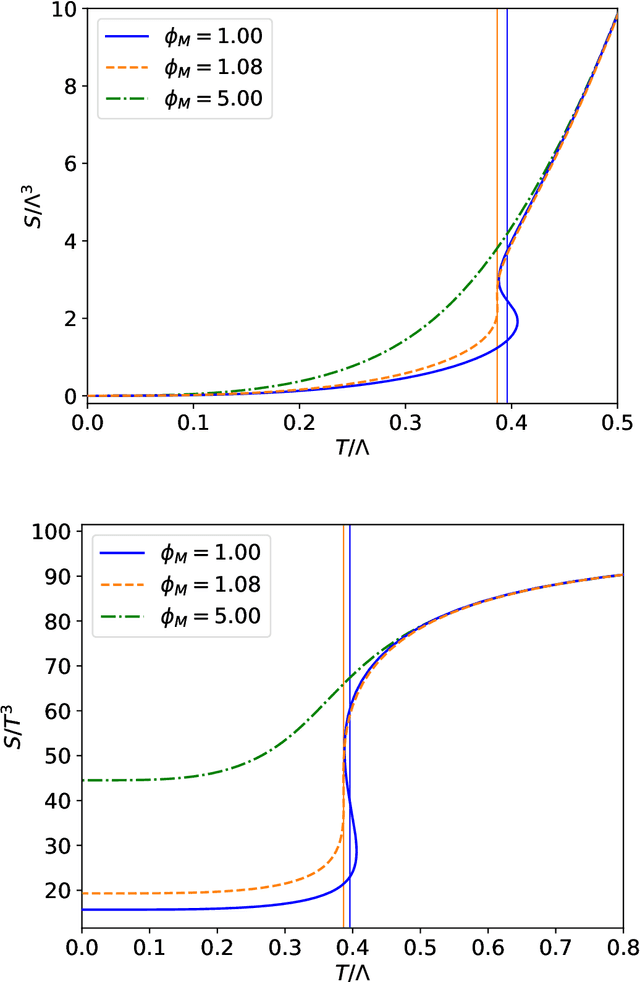
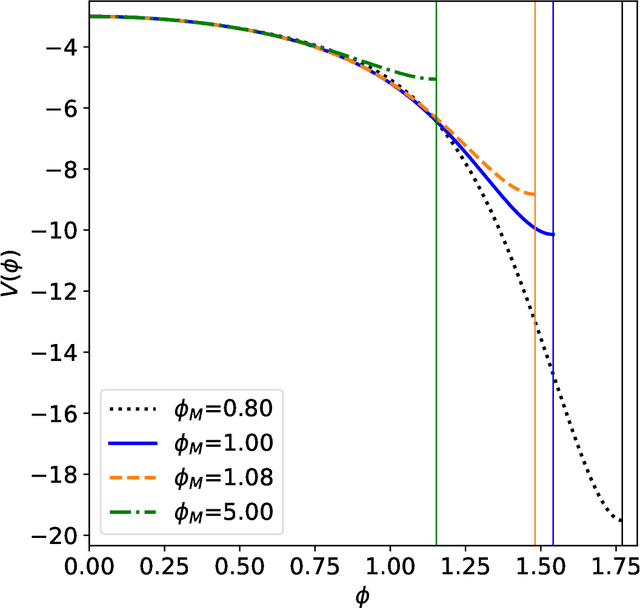
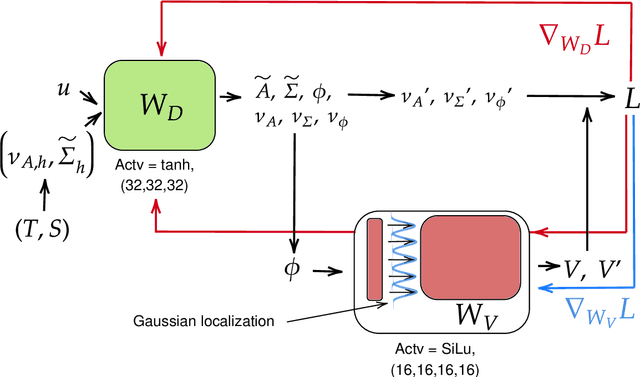
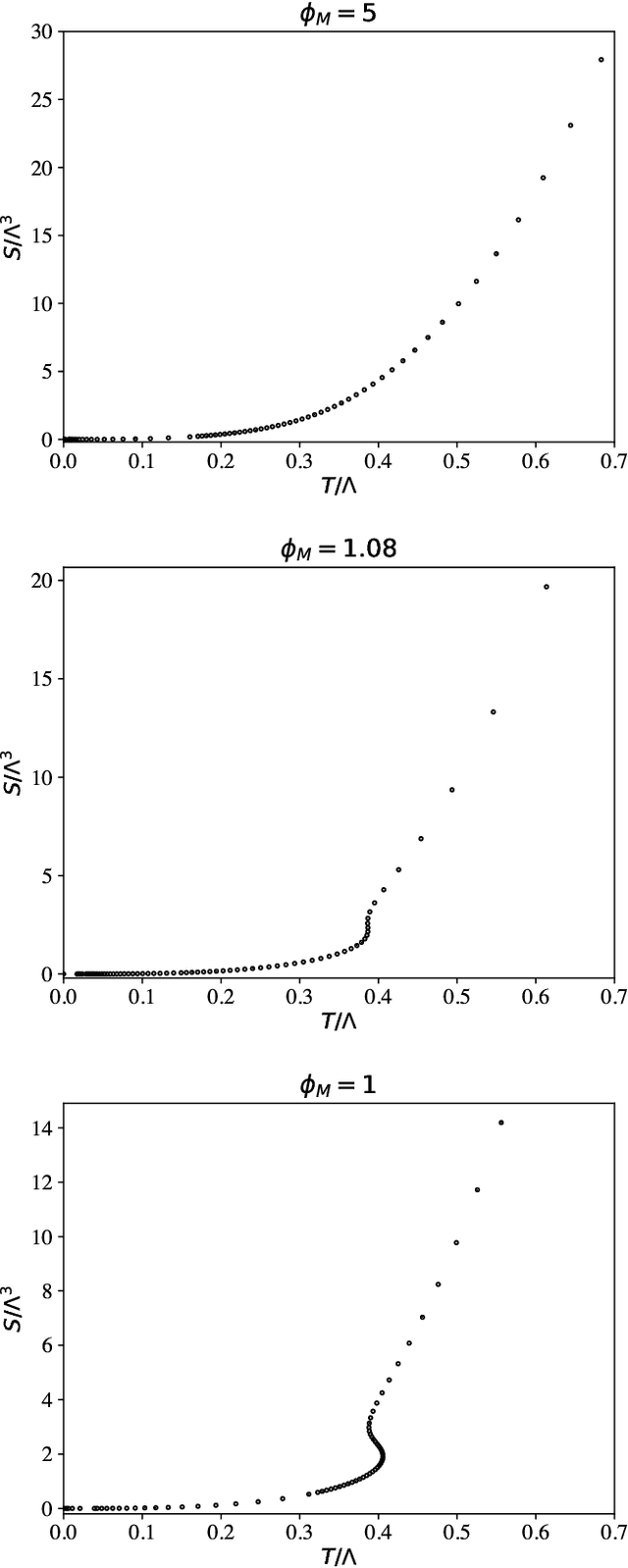
Holography relates gravitational theories in five dimensions to four-dimensional quantum field theories in flat space. Under this map, the equation of state of the field theory is encoded in the black hole solutions of the gravitational theory. Solving the five-dimensional Einstein's equations to determine the equation of state is an algorithmic, direct problem. Determining the gravitational theory that gives rise to a prescribed equation of state is a much more challenging, inverse problem. We present a novel approach to solve this problem based on physics-informed neural networks. The resulting algorithm is not only data-driven but also informed by the physics of the Einstein's equations. We successfully apply it to theories with crossovers, first- and second-order phase transitions.